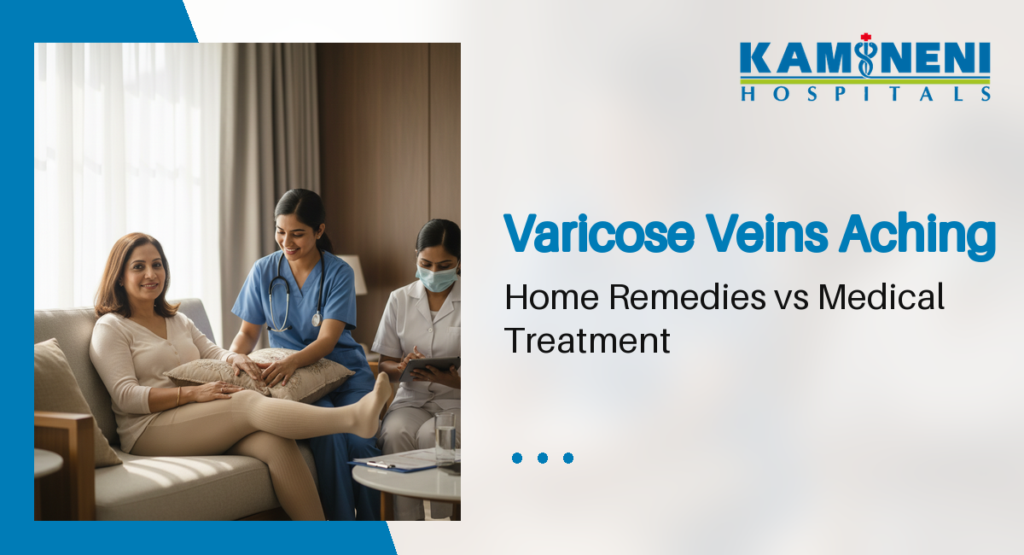
Varicose veins aching home remedies are what most people try first, hoping to avoid a hospital visit. The aching, throbbing, and heaviness in your legs often flares after standing all day, and it is natural to want relief without procedures. Home measures like leg elevation, walking, and compression stockings can reduce symptoms for many people. Yet these methods do not fix the underlying vein valve damage, and symptoms often return. At Kamineni Hospitals, vascular specialists see patients daily who delayed too long, assuming home care would be enough. This article compares what home remedies actually achieve against what medical treatment offers, so you can decide your next step with clear information rather than guesswork.
Key takeaways
- Compression stockings are the most effective home remedy, but they do not remove varicose veins.
- Medical treatment becomes necessary when aching, swelling, or skin changes persist despite home care.
- Exercise and leg elevation help symptoms but cannot reverse damaged vein valves.
- A vascular surgeon can assess whether minimally invasive procedures suit your case.
What home remedies actually help varicose veins aching?
Compression stockings are the most evidence-backed home remedy for varicose veins aching. They apply graduated pressure that keeps veins from dilating, which reduces aching, throbbing, and itching. For best results, you should put them on in the morning before swelling starts and wear them throughout the day. Your doctor or pharmacist can help you choose the correct pressure grade and size.
- Regular walking or swimming: activates calf muscles that pump blood back toward the heart.
- Leg elevation: raising legs above heart level for 15 to 20 minutes, several times daily, reduces pooled blood and pressure.
- Weight management: excess body weight increases pressure on leg veins and worsens symptoms over time.
- Avoiding prolonged standing or sitting: changing position every 30 to 60 minutes keeps blood moving.
- Loose clothing: tight garments around the waist or groin restrict venous return and aggravate symptoms.
These measures improve comfort and may slow progression, but they do not remove existing varicose veins or repair faulty valves. If your aching persists or worsens, a consultation with Vascular Surgery can clarify whether home care alone is sufficient for your case.
What medical treatments are available when home remedies fail?
When varicose veins aching home remedies no longer control symptoms, several medical options close or remove the affected veins. The choice depends on vein size, location, symptom severity, and whether you have complications like skin changes or ulcers.
| Treatment | What it does | Typical recovery |
|---|---|---|
| Sclerotherapy | Injection of a solution that scars and closes small to medium varicose veins | Same day; walking encouraged |
| Endovenous laser ablation (EVLA) | Laser heat seals the faulty vein from inside | 1 to 2 days of reduced activity |
| Radiofrequency ablation | Heat energy closes the affected vein via a thin catheter | 1 to 2 days of reduced activity |
| Vein stripping or ligation | Surgical removal of the damaged vein through small incisions | 1 to 2 weeks |
Your vascular surgeon selects the approach after a duplex ultrasound maps your venous system. At Kamineni Hospitals, diagnosis-first care means tests are chosen from your symptoms and clinical history rather than sold as a fixed package. Departments coordinate when needed, and each branch runs its own emergency and critical care unit round the clock. If you also experience unrelated symptoms such as persistent stomach pain, our Antral Gastritis: Know About its Symptoms, Causes & Treatment resource may help you understand when to seek Gastroenterology input.
How do I know when to stop relying on home remedies?
Home remedies for varicose veins aching are appropriate when symptoms are mild and stable. You should seek medical assessment if any of the following develop:
- Aching or throbbing that interferes with sleep or daily activities.
- Swelling that does not improve overnight or after leg elevation.
- Skin discoloration, thickening, or eczema around the ankle.
- Non-healing sores or ulcers near the ankle.
- Sudden increase in vein size, redness, warmth, or tenderness.
These signs suggest complications such as chronic venous insufficiency or superficial thrombophlebitis, which home remedies cannot treat. Early evaluation by a vascular specialist preserves treatment options and reduces the risk of progression. At Kamineni Hospitals, NABH and NABL accredited facilities support accurate diagnosis, and care is recognised by 150+ insurance TPAs for cashless treatment. If you have concerns about neurological symptoms alongside leg issues, our Paralysis Attack: What Triggers It and How Can It Be Treated? page explains warning signs that need urgent Neurology review.
Does exercise help or worsen varicose veins aching?
Appropriate exercise generally helps varicose veins aching by improving calf muscle pump function and venous return. The key is choosing low-impact activities that do not add sudden strain.
| Helpful exercises | Exercises to limit |
|---|---|
| Walking at a steady pace | Heavy weightlifting with breath-holding |
| Swimming or water aerobics | High-impact running on hard surfaces |
| Stationary cycling | Prolonged static standing in one position |
| Calf raises and ankle circles | Deep squats with heavy loads |
Exercise alone will not remove varicose veins, but it complements compression therapy and may reduce symptom frequency. If exercise triggers new pain, numbness, or swelling, stop and consult a specialist. For general health concerns, General Medicine provides baseline assessment and referral.
Are compression stockings enough for long-term management?
Compression stockings are the cornerstone of conservative care for varicose veins aching, but they manage symptoms rather than cure the condition. They work by applying external pressure that supports vein walls and improves blood flow against gravity. For long-term use, you will need:
- Proper fitting: ill-fitting stockings can bunch, slip, or cause skin irritation.
- Correct pressure grade: measured in millimetres of mercury (mmHg); mild (15-20 mmHg) for prevention, higher (20-30 mmHg or 30-40 mmHg) for established disease.
- Replacement every 3 to 6 months: elasticity degrades with washing and wear.
- Skin checks: daily inspection for dryness, cracking, or pressure marks, especially if you have diabetes or reduced sensation.
If you find yourself dependent on stockings daily and still experiencing aching, it is time to discuss procedural options. The vascular team at Kamineni Hospitals assesses whether minimally invasive treatments could free you from long-term compression dependence. For ear, nose, or throat concerns that may coexist, ENT services are available across our branches.
What happens during a vascular consultation for varicose veins?
A vascular consultation for varicose veins aching follows a clear, step-by-step path. Understanding this can reduce anxiety about the visit.
- History and symptom review: your doctor asks about duration, triggers, relief measures, family history, and any prior clots or vein treatments.
- Physical examination: standing inspection to see vein pattern, size, and any skin changes; palpation for tenderness or hardness.
- Duplex ultrasound: a painless scan using sound waves to map blood flow, identify reflux (backward flow), and locate faulty valves.
- Treatment discussion: based on findings, your vascular surgeon explains whether conservative management, minimally invasive procedures, or surgery is appropriate.
- Follow-up plan: scheduling of procedure if needed, or review date if continuing with home remedies.
This diagnosis-first approach ensures you receive tests matched to your symptoms rather than a generic package. At Kamineni Hospitals, 34+ years of multispeciality care means complex cases benefit from input across departments when needed.
Varicose veins aching home remedies offer real symptom relief, especially compression stockings and regular movement, yet they do not remove damaged veins or repair valve failure. When aching persists, disrupts sleep, or is joined by skin changes, medical treatment becomes the safer path. A vascular specialist can match the right procedure to your ultrasound findings. To book a consultation at Kamineni Hospitals, call +91 70362 70362.
FAQs
Can varicose veins go away with home remedies?
No. Home remedies such as compression stockings, leg elevation, and exercise can reduce aching and swelling, but they do not make varicose veins disappear. The underlying vein valve damage remains. Medical procedures are needed to close or remove the affected veins.
How long should I try home remedies before seeing a doctor?
If your symptoms are mild and stable, a trial of home remedies for 4 to 6 weeks is reasonable. Seek medical review sooner if pain worsens, skin changes appear, or you develop ankle swelling that does not resolve overnight.
Are compression stockings safe to wear every day?
Yes, when properly fitted and in good condition. Replace them every 3 to 6 months as elasticity fades. Check your skin daily for irritation, and ensure the pressure grade is appropriate for your condition.
What is the most effective medical treatment for varicose veins?
Endovenous laser ablation and radiofrequency ablation have high success rates for closing faulty veins with minimal downtime. The best treatment for you depends on vein size, location, and your overall health, determined after duplex ultrasound.
Is walking good for varicose veins aching?
Yes. Walking activates calf muscles that pump blood back toward the heart, reducing venous pooling and aching. Aim for regular, moderate-paced walks rather than intense or high-impact exercise.
Can I treat varicose veins aching with massage?
Gentle massage may temporarily ease discomfort, but it does not treat the underlying venous reflux. Avoid deep pressure over enlarged, painful veins. Do not massage a leg with sudden swelling, warmth, or redness, as this may indicate a blood clot.