


You went in for a stomach complaint. The doctor listened, did a quick test, and you came back with a term: antral gastritis. Now you are sitting with a word that sounds serious, a prescription, and a stack of questions nobody fully answers.
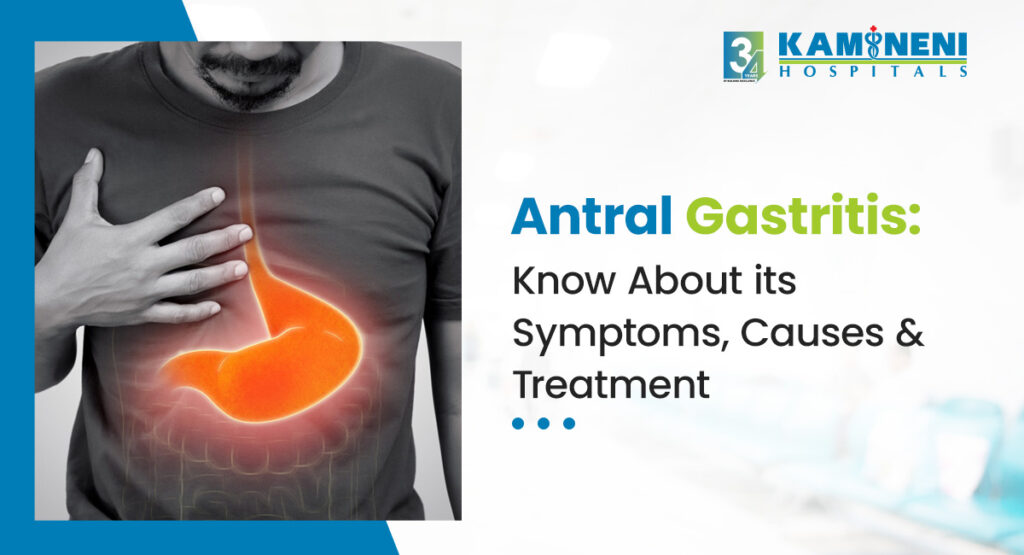
Antral gastritis is inflammation in the lower part of the stomach (antrum). When the lining gets damaged, the valve stops working efficiently and acid builds. And burning becomes a daily event.
The Gastroenterology team at Kamineni Hospitals, LB Nagar sees cases of antral gastritis every week. With 6 advanced endoscopy technologies and medical and surgical gastroenterology under one roof, the team moves from diagnosis to a clear treatment plan fast.
This blog answers what your doctor meant, why this part of your stomach is affected, what are the Antral Gastritis symptoms and causes, and what this treatment involves.
What Does Antral Gastritis Mean?
Gastritis means inflammation of the stomach lining. Antral tells you exactly where.
Your stomach is not one uniform space. It has zones. The antrum is the lower section, roughly the exit area of the stomach. It is responsible for grinding food down into smaller pieces, controlling when food moves into the small intestine, and regulating acid signals.
Antral gastritis means the lining in this lower zone has become inflamed. When that happens, the lining’s normal protective layer gets disrupted. Acid that should be managed starts to build. And what feels like “acidity” becomes a daily pattern that antacids cannot fully fix.
Antral gastritis has two forms, and they are not treated identically:
| Type | What is happening | What it means for you |
| Non-erosive | Lining is inflamed but the surface is still intact | Responds to medication and dietary changes |
| Erosive | Surface damage and small sores are forming | Needs targeted treatment and close monitoring |
You cannot tell which type you have from symptoms alone. Only a direct look through an endoscope confirms it.
Why Does It Happen in the Antrum Specifically?
A recent study in the Indian Journal of Pathology and Oncology tells that the antrum is the most frequently affected site in biopsy-confirmed gastritis. And this is not a coincidence.
The antrum’s position forces it to process everything that enters the stomach first. Bacteria prefer it. Painkillers damage it first. Acid erodes it the longest. Hence, the most exposed section of stomach, and the most commonly inflamed one.
What Are the Antral Gastritis Symptoms You Must Consider?
Antral gastritis symptoms generally do not announce themselves. They get labelled as acidity, and stay. Here is what persistent antral gastritis actually feels like day to day:
| Symptom | What it actually feels like |
| Upper stomach burning | A biting heat below the chest, worse right after eating |
| Early fullness and bloating | Full after a few bites, heavy even on small meals. |
| Morning nausea | Sickness before or right after the first meal |
| Frequent slow eating | A sour or bitter aftertaste |
| Appetite loss | Eating triggers discomfort |
| Persistent indigestion | Heaviness that over-the-counter tablets do not clear |
The danger is not how bad these feel today. It is how long they have been there.
Antral gastritis symptoms include: blood in vomit, black or tarry stools, unexplained weight loss, need for same-day attention.
What Causes Antral Gastritis? The Reason Antacids Are Not Enough
Antral gastritis falls into specific categories, and each one needs a different treatment. An antacid lowers acid. It does not address what damaged the lining in the first place.
1. Helicobacter pylori (H. pylori) Infection
- The most common cause of chronic antral gastritis.
- H. pylori prevalence in India is between 50% to 80%. This bacterium spreads through contaminated food and water, often in childhood, and settles in the antrum for years before symptoms appear.
- It colonises and damages the stomach’s protective mucous lining, making the underlying tissue vulnerable to digestive acids.
2. Medications (NSAIDs)
- Nonsteroidal Anti-Inflammatory Drugs such as ibuprofen, aspirin, and naproxen use for long term is another major cause.
- These medications block the chemicals that help protect the stomach lining, leading to inflammation.
- Thus, long-term painkiller use without a stomach protector is a route to antral gastritis.
3. Alcohol and Tobacco
- Excessive alcohol consumption weakens and erodes the stomach’s protective barrier, leaving it for further acid damage. Tobacco also irritates the gastric lining and reduces its ability to repair itself.
4. Bile Reflux
- Bile is a digestive fluid produced in the liver. When it flows backward into the stomach from the small intestine it can severely irritate and inflame the stomach lining.
- Unlike acid reflux, bile reflux does not respond to antacids, which is one reason it often goes undiagnosed for longer.
5. Physiological Stress
- Severe stress from major trauma, serious burns, or surgery can restrict blood flow to the stomach, leading to acute gastritis.
6. Dietary and Lifestyle Habits
- Diets high in fat, heavily spicy foods, and frequently skipping meals do not cause antral gastritis directly but trigger an already inflamed lining and slow recovery.
- Chronic emotional stress increases acid production over time, compounding damage when another cause is already present.
Two Antral gastritis causes can run together. Treating only one will not clear it. This is why identifying the cause matters before any treatment begins.
How Is Antral Gastritis Diagnosed?
Antral gastritis is not diagnosed from its symptoms alone. Burning, bloating, nausea appear in GERD, and gallbladder conditions matter too. Without a confirmed look inside, Antral Gastritis treatment is a guess.
At Kamineni Hospitals, the best gastro hospital in Hyderabad, diagnosis does not wait for paperwork. The process starts immediately.
| Test | What it tells the gastroenterologist |
| Upper GI Endoscopy | Direct view of the antral lining, how inflamed it is, whether erosions are present |
| Biopsy with Rapid Urease Test | Confirms H. pylori infection at the tissue level |
| Histopathology | Checks for cellular changes, rules out early gastric metaplasia |
| Blood and stool tests | Screens for anaemia from any internal bleeding |
The Gastroenterology department at Kamineni Hospitals runs 6 advanced endoscopy systems: Chromoendoscopy, Narrow-Band Imaging, Flexible Spectral Imaging Color Enhancement, I-Scan, Magnifying Endoscopy, and Confocal Laser Endomicroscopy. No transfer. No waiting for equipment. The team moves from arrival to diagnosis to action.
What Does Antral Gastritis Treatment Actually Involve?
- If the cause is H. pylori triple therapy approach is considered. Two antibiotics and a proton pump inhibitor is given for 10 to 14 days. The antibiotics clear the bacteria. The PPI lowers acid so the lining heals.
- If the cause is NSAIDs, alcohol, or bile reflux PPIs or H2-blockers are used to lower acid, sucralfate to coat the damaged surface, and stopping the causative medication.
- Other changes like smaller, more frequent meals, no spicy food, fried food, or caffeine intake while the lining heals.
- Some erosive cases progress to ulcers or do not respond to medication. Endoscopic or surgical intervention is the next step in such cases.
If the Antacid Stops Working, That Is the Signal!
An antacid brings acid down for a few hours. That is all it does. It does not identify H. pylori. It does not tell you whether the lining is eroding underneath.
If symptoms return within hours of taking one, you are not overtreating acidity. You are under-diagnosing something else. Get evaluated.
Kamineni Hospitals is among the best gastroenterology hospitals in Hyderabad with advanced endoscopy technologies, medical and surgical gastroenterology, and 34+ years of digestive care across 3,000+ beds in South India.
Do not wait for it to get worse. Call +91 70362 70362.
Disclaimer: This blog is intended for educational and informational purposes only. It should not be considered medical advice, diagnosis, or treatment. Please consult a qualified healthcare professional for any medical concerns or decisions.
Frequently Asked Questions
Can antral gastritis go away on its own?
Short-term cases sometimes do. But if H. pylori or ongoing painkiller use is the cause, it will not. The inflammation builds until the root is treated. Left alone, it leads to ulcers and in persistent cases raises the risk of gastric cancer.
How long does treatment take?
H. pylori eradication runs 10 to 14 days. Mucosal healing takes another 4 to 8 weeks. A follow-up test confirms eradication before treatment ends.
Is antral gastritis dangerous if left untreated?
Over time, yes. Inflammation leads to ulcers and internal bleeding. Long-term H. pylori in the antrum is a recognised risk factor for gastric cancer. Caught early, it is manageable and reversible.
Which foods make antral gastritis worse?
Spicy food, fried food, citrus, tomatoes, caffeine, alcohol, and carbonated drinks all aggravate an inflamed lining. They do not cause antral gastritis. But during an active episode, they slow recovery considerably.