

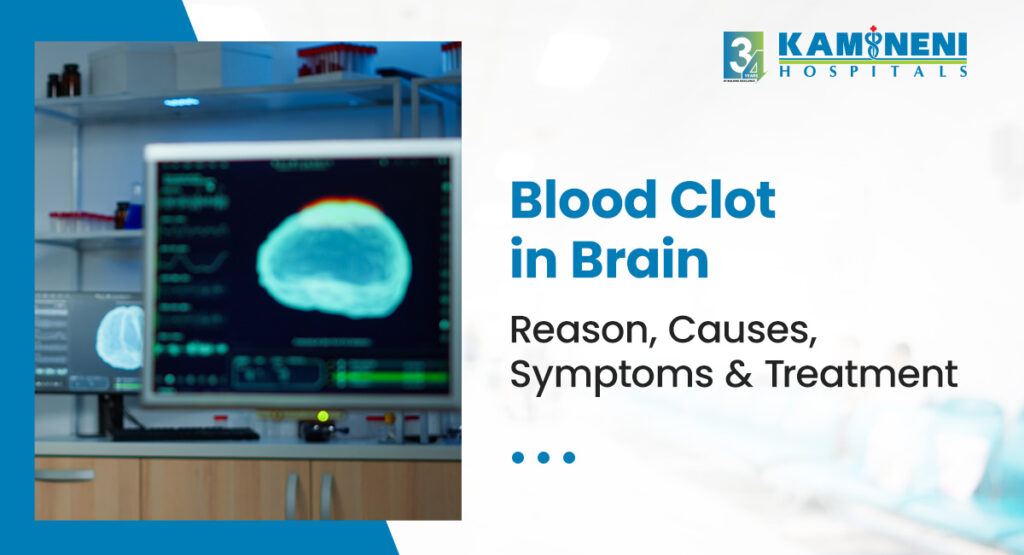
One minute everything was fine. Then one arm stopped responding. Words came out wrong. Half the face wasn’t moving the way it should. That’s what a blood clot in brain looks like and it happens in under 60 seconds.
When a clot cuts off blood to the brain, cells don’t slowly deteriorate. They die in minutes. Around 1.9 million of them for every minute without treatment. Which is why the time between noticing something is wrong and getting to a hospital changes everything.
Kamineni Hospitals Neurology and Neurosurgery department handles exactly this. Stroke care, clot removal, craniotomy, neurovascular surgery. Dr. M. Lakshmi Lavanya (MBBS, MD, DM Neurology, Gold Medalist — Sr. Consultant Neurologist) leads the team, with 34+ years of multispeciality care behind every case.
What follows is what every family in this situation needs to know.
What Is a Blood Clot in the Brain?
A blood clot in the brain blocks blood flow to brain tissue cutting off the oxygen and nutrients brain cells need to survive. In India, roughly 108 to 172 people per 100,000 suffer a stroke every year, making it one of the top causes of death and permanent disability in the country.
Two types exist, and the treatment for each one is completely different:
- Ischaemic Stroke : A clot blocks a cerebral artery, stopping blood from reaching brain tissue. This accounts for roughly 87% of all strokes. The clot either forms inside the artery or travels from elsewhere the heart, the neck, or a deep vein.
- Haemorrhagic Stroke : A blood vessel ruptures instead of blocking. Bleeding puts direct pressure on brain tissue. Treatment here is the opposite of ischaemic, blood thinners that treat an ischaemic stroke are dangerous in a haemorrhagic one, which is why correct diagnosis before treatment is non-negotiable.
The warning sign most people ignore : TIA
TIA (Transient Ischaemic Attack) looks exactly like a stroke but resolves within 24 hours. Symptoms disappear. Most people assume it passed and nothing’s urgent. One in ten people who have a TIA will have a full stroke within the next 48 hours. A TIA isn’t a “small stroke that cleared.” It’s the body sending the strongest warning it has.
What Are the Reasons and Causes of a Blood Clot in the Brain?
Blood clot in brain causes is a combination of underlying medical conditions and lifestyle factors with uncontrolled hypertension and atrial fibrillation being the two most common medical triggers.
Medical causes:
- Atrial fibrillation (irregular heartbeat)
- Hypertension (high blood pressure)
- Diabetes
- Carotid artery disease
- Heart valve disease and prior heart attack
- Cerebral venous sinus thrombosis (CVST), a distinct type that affects the brain’s drainage veins
Lifestyle risk factors:
- Smoking
- Obesity and physical inactivity
- Excessive alcohol use
- High cholesterol
- Chronic stress and disrupted sleep
Indian Context : Young Stroke Is Rising:
The average age of stroke in India is around 62 years, nearly a decade younger than in Western countries. Young strokes under 45 are increasing in Indian urban populations, particularly because of blood clot in brain reason like uncontrolled hypertension, diabetes, obesity, and heavy smoking.
What Are the Symptoms of a Blood Clot in the Brain?
Blood clot in brain symptoms in Hyderabad and anywhere else follow the same pattern: they appear suddenly, not gradually, and they affect one specific function: movement, speech, vision, or consciousness.
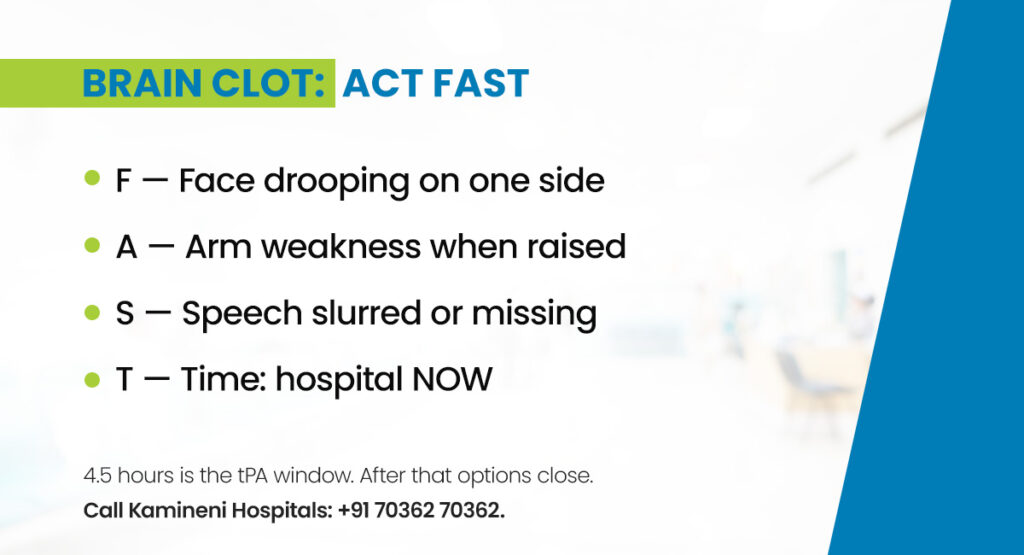
Use The Fast Test:
F : Face drooping: One side of the face droops. Ask the person to smile, if it’s uneven, act immediately.
A : Arm weakness: One arm drifts down when both are raised. The person can’t lift one arm properly.
S : Speech difficulty: Speech is slurred, garbled, or absent. Ask the person to repeat a simple sentence, if they can’t, that’s the signal.
T : Time: Every minute counts. Call emergency services or drive to the nearest best multispeciality hospital in LB Nagar immediately.
One rule: Symptoms that disappear within minutes or hours are not a reason to relax. That’s a TIA and it needs same-day emergency evaluation. Waiting for symptoms to return is one of the most dangerous decisions a family can make.
How Is a Blood Clot in the Brain Diagnosed?
A CT scan is the first test used to identify a blood clot in the brain in Hyderabad hospitals. It shows bleeding, swelling, or arterial blockage within minutes and determines whether the stroke is ischaemic or haemorrhagic before any treatment begins.
- CT scan results determine which treatment path is safe and it’s done within minutes of arrival.
- MRI with diffusion-weighted imaging (DWI) is more detailed as it pinpoints the exact location and extent of brain tissue affected.
Supporting tests that guide treatment:
- ECG : Detects atrial fibrillation as the clot source
- Echocardiogram : Checks for clots forming inside heart chambers
- Carotid Doppler : Identifies artery narrowing in the neck
- Blood Tests: Clotting disorders, cholesterol, blood sugar, full blood count
How Is a Blood Clot in the Brain Treated?
Blood clot in brain treatment depends entirely on the type, ischaemic stroke is treated with clot-dissolving drugs or catheter-based clot removal, while haemorrhagic stroke may need surgery to stop the bleeding and reduce pressure on the brain.
For ischaemic stroke:
- TPA (tissue plasminogen activator) : Clot-dissolving drug given through a vein, effective within 4.5 hours of symptom onset. Every 15-minute delay reduces the chance of full recovery.
- Mechanical thrombectomy : Catheter-guided clot removal from the blocked artery, effective up to 24 hours in selected patients.
- Anticoagulants : Blood thinners (heparin, warfarin, newer NOACs like apixaban) prevent new clots especially important in atrial fibrillation-related strokes.
For haemorrhagic stroke:
- Craniotomy : Skull is opened to access the clot or repair the bleeding vessel, available at Kamineni Hospitals, the best multispeciality hospital in Hyderabad.
- Coiling or clipping : Minimally invasive repair for aneurysms that caused the bleed
- Blood pressure management : Rapid BP reduction to stop further bleeding
Can You Recover from a Blood Clot in the Brain?
Recovery from a blood clot in the brain in Hyderabad depends on how fast treatment was given, which part of the brain was affected, and how quickly rehabilitation begins and full or significant recovery is possible, particularly when treatment starts within the first few hours.
- Time to treatment : Arriving within 4.5 hours of symptoms dramatically improves recovery chances
- Location and size of the clot : Clots in language or motor areas cause more visible disability; clots in other regions may have minimal lasting impact
- Age and overall health : Younger patients and those without prior brain damage tend to recover more
- Rehabilitation : Physiotherapy, speech therapy, and occupational therapy started within 24 to 48 hours of stroke improve long-term outcomes
Brain clot treatment isn’t just about surviving. It’s about what function comes back and how much of it. That depends on what happens in the first few hours after symptoms start.
At Kamineni Hospitals, one of the best brain hospital in Hyderabad, our Neurology and Neurosurgery team provides emergency stroke evaluation, CT and MRI imaging, tPA administration, blood clot removal, craniotomy, and post-stroke rehabilitation within a NABH and NABL-accredited multispeciality hospital with 34+ years of clinical experience. Dial +91 70362 70362 for 24/7 emergency line.
Disclaimer: This content is for general patient education only. A blood clot in the brain is a medical emergency. Do not use this content to delay seeking immediate emergency care.
Frequently Asked Questions
What are the first signs of a blood clot in the brain?
Face drooping on one side. One arm dropping when raised. Speech that won’t form properly. Sudden severe headache. Any of these hospital immediately, no watching and waiting.
Can a blood clot in the brain go away on its own?
Small clots can sometimes dissolve naturally but brain cells die within minutes of losing blood supply. By the time a clot “goes away on its own,” the damage is often already done.
What is the difference between a stroke and a blood clot in the brain?
Same event, two names. The clot is what blocks the artery or causes the vessel to rupture. The stroke is what that does to the brain. One causes the other.
How long can you survive with a blood clot in the brain without treatment?
Brain cells die at roughly 1.9 million per minute without blood supply. There’s no safe waiting period. The 4.5-hour tPA window and the 24-hour thrombectomy window exist because beyond those points, treatment options narrow.
Which is the best hospital for blood clot in brain treatment in Hyderabad?
Kamineni Hospitals offer stroke care, CT and MRI, blood clot removal, craniotomy, neurovascular surgery and 24/7 emergency line. NABH and NABL accredited, 34+ years. Call +91 70362 70362.