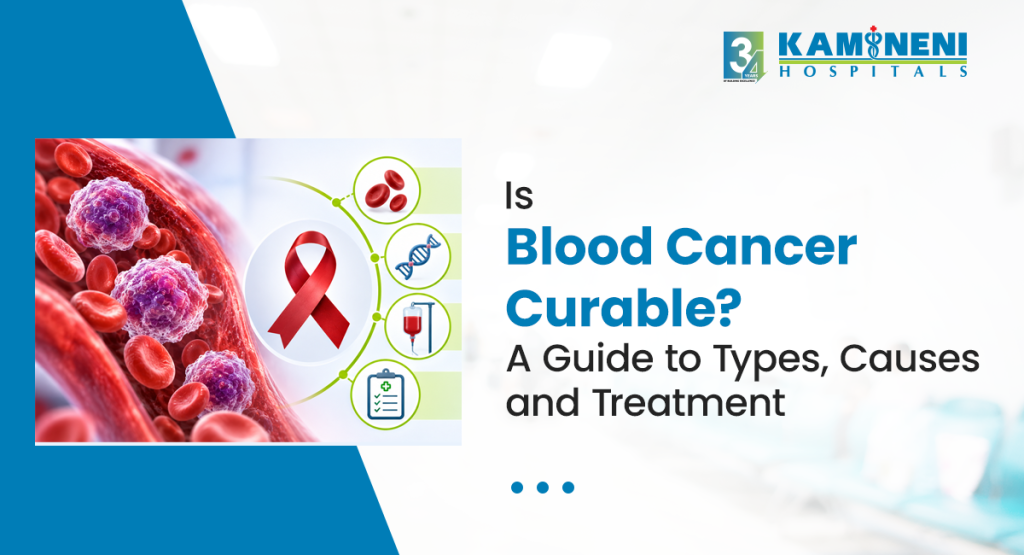
The report says leukaemia, lymphoma or myeloma. Most families ask us one thing first. Can doctors cure it?
Doctors can cure many blood cancers, and they can keep many others under control for years. The answer depends mostly on the type. Some types, like Hodgkin lymphoma and leukaemia in children, have high cure rates. Others, like myeloma, are often treated like a long-term illness.
Our blood cancer team at Kamineni Hospitals knows how heavy the blood cancer curable question feels, so we’ll answer it plainly. Our specialists see blood cancer patients at all three of our hospitals: LB Nagar, King Koti and Vijayawada. You can start tests and treatment close to home. If you need a bone marrow transplant, our dedicated institute at LB Nagar takes over, backed by 34+ years of care. Here’s what each type means for you.
Is Blood Cancer Curable?
Yes, many types of blood cancer are curable, but not all. Fast-growing types often respond well to strong treatment. Doctors can often cure them. Slow-growing types usually stay under control rather than go away, sometimes for decades. Your doctor can only tell you which group yours falls in once tests show the exact type.
| Type | Usually Cured or Usually Controlled? |
| Acute lymphoblastic leukaemia (ALL) in children | Often cured |
| ALL in adults | Sometimes cured, often with strong treatment |
| Acute myeloid leukaemia (AML) | Cured in some people, often with a transplant |
| Chronic myeloid leukaemia (CML) | Usually controlled for years with daily tablets |
| Chronic lymphocytic leukaemia (CLL) | Usually controlled; treated when it grows |
| Hodgkin lymphoma | Often cured |
| Non-Hodgkin lymphoma | Fast types often cured; slow types controlled |
| Myeloma | Usually controlled for years; rarely cured |
The numbers back this up. Take Hodgkin lymphoma. In the US, 89.3% of people live at least five years after diagnosis, says the National Cancer Institute. Or take ALL in children. In the UK, more than 90 in 100 children now live five years or more, says Cancer Research UK. That’s up from about 70 in 100 in the 1980s. Results in any one person depend on the type, the stage and how early treatment begins.
What does ‘cured’ mean here? When tests show no sign of cancer, doctors call it remission. If it stays away for several years, many doctors consider the cancer cured. That’s why you’ll keep having check-ups even after you feel well.
What Are the Main Types of Blood Cancer?
There are three main types of blood cancer: leukaemia, lymphoma and myeloma. Each starts in a different kind of blood cell. Leukaemia affects the blood and bone marrow. Lymphoma affects the lymph glands. Myeloma affects plasma cells in the bone marrow.
Leukaemia
Leukaemia is a cancer of the white blood cells, which start in the bone marrow. Bone marrow is the soft tissue inside your bones where blood cells are made. Doctors sort leukaemia by speed and cell type:
- ALL is fast-growing. It’s the most common cancer in children.
- AML is fast-growing. It mostly affects adults over 60.
- CML grows slowly. Most people manage it with daily tablets.
- CLL grows slowly. It mostly affects older adults, and some never need treatment.
Lymphoma
Lymphoma is a cancer of lymphocytes, white blood cells that live in your lymph glands. It often shows up as a painless lump in the neck, armpit or groin. Some people also get fevers, heavy night sweats or weight loss they can’t explain. Doctors split it into two groups. Hodgkin lymphoma often affects young adults and older people. Non-Hodgkin lymphoma covers many types, some fast and some slow.
Myeloma
Myeloma is a cancer of plasma cells in the bone marrow. Plasma cells help your body fight germs. Myeloma mostly affects people over 60. It can cause bone pain, tiredness and kidney problems. If it’s slow and causes no trouble, doctors may watch it closely before starting treatment.
What Causes Blood Cancer?
Blood cancer starts when the DNA inside a blood cell changes. The cell then grows out of control. In most people, doctors can’t find one clear reason for that change. It usually happens by chance during a person’s life.
Some things raise the risk:
- Getting older, for most types
- Past chemotherapy or radiation for another cancer
- Years of contact with benzene, a chemical in petrol fumes and some factories
- Smoking, which raises the risk of AML
- Some conditions you’re born with, such as Down syndrome
- Weak body defences, for example from HIV or from drugs taken after an organ transplant
Blood cancer isn’t contagious, so you can’t catch it from anyone. It rarely runs in families. And in nearly every case, nothing the person or their family did caused it.
What Are the Options for Blood Cancer Treatment?
Blood cancer treatment depends on the type, the stage, your age and your health. Most plans use one or more of these: chemotherapy, targeted therapy, immunotherapy, radiation and a bone marrow transplant. Your doctor plans treatment only after tests show the exact type.
These tests matter a lot.
- Doctors usually start with a full blood count.
- Next comes a bone marrow biopsy.
- The doctor takes a small sample of marrow from the hip bone, usually with a numbing injection.
- Then lab tests study the cancer cells up close.
These include flow cytometry and gene tests such as FISH and BCR-ABL. Our haematology team in Hyderabad runs these tests to find the exact type. Our diagnostic services at LB Nagar handle the scans and blood work.
Chemotherapy
Chemotherapy uses strong medicines that kill fast-growing cells. It’s the main treatment for most fast leukaemias and many lymphomas. You get it in rounds, with rest weeks in between so your body can recover.
Targeted Therapy
Targeted therapy blocks the exact fault that makes a cancer cell grow. CML is the best example. Daily tablets can keep it in check for many years. Many people live a near-normal life on them.
Immunotherapy
Immunotherapy helps your body’s own defences find and attack cancer cells. Some of these medicines stick to cancer cells and mark them, so your defences can kill them. Doctors often use it with chemotherapy for lymphoma and myeloma.
Radiation
Radiation uses high-energy beams to destroy cancer cells in one area. Doctors mostly use it for lymphoma in a single group of lymph glands, or to ease bone pain.
Bone Marrow Transplant
A bone marrow transplant, or stem cell transplant, swaps damaged bone marrow for healthy cells that make blood. There are two kinds. An autologous transplant uses your own cells. Doctors collect them before high-dose treatment. Doctors often use it for myeloma and some lymphomas. An allogeneic transplant uses cells from a matched donor, often a brother or sister. Doctors often use it for some leukaemias. A transplant is a big step. Doctors offer it only when it’s likely to do more good than harm for you. Our bone marrow transplant team in Hyderabad offers both kinds.
Supportive Care
Treatment can lower your blood counts for a while. So care also includes blood transfusions, steps to prevent infection and help with eating well. This support keeps you strong enough to finish treatment.
Is Blood Cancer Deadly?
Blood cancer can be a threat to life if it isn’t treated, mainly the fast-growing types. But is blood cancer deadly for everyone who has it? No. Doctors cure many types, and they hold others in check for years. What helps most is the right diagnosis and an early start to treatment.
The type matters more than the word ‘cancer’. A child with ALL and an adult with slow CLL face very different paths. Yet both have leukaemia. Treatment has also improved a lot. Targeted medicines and transplants now help many people who had few options 20 years ago.
Fast-growing types, like AML and ALL, can become serious within weeks. So if a blood test shows something odd, see a specialist soon. Don’t wait. Delay is one of the biggest risks you can avoid. Our oncology team at LB Nagar works with the blood cancer team so treatment can start fast.
Got a Blood Cancer Report? Let’s Go Through It Together
Blood cancer care works best when blood doctors, cancer doctors, transplant teams and lab experts plan your care together. That’s why a Hyderabad multispeciality hospital helps. At Kamineni Hospitals, a multi speciality hospital in Hyderabad, you’ll find:
- Bone marrow biopsy and detailed lab tests of cancer cells in Hyderabad
- A bone marrow transplant institute at LB Nagar, with transplants at King Koti too
- Day care for blood disorders, and blood transfusions, at King Koti
- Chemotherapy and immunotherapy at our cancer hospital in Vijayawada
- NABH and NABL accreditation, and cashless care with 150+ insurers
Bring all your scans and reports. Call +91 70362 70362 (LB Nagar), +91 83339 93001 (Vijayawada), or book a consultation.
This content is for general patient education only. It does not replace medical consultation, diagnosis, or treatment advice from a qualified haematologist, oncologist or doctor. Please consult a specialist at Kamineni Hospitals for personalised guidance based on your symptoms and medical history.
Frequently Asked Questions
What Are the Early Signs of Blood Cancer?
Common signs include constant tiredness, frequent infections, easy bruising or bleeding, painless lumps in the neck, fever, night sweats and weight loss.
Is Blood Cancer Hereditary?
Rarely. Most blood cancers come from DNA changes that happen during a person’s life. Parents usually don’t pass them on to children.
Can Blood Cancer Come Back After Treatment?
Yes, it can. Doctors call this a relapse. Regular follow-up blood tests help catch it early, and further treatment is often possible.
How Long Does Blood Cancer Treatment Take?
It varies by type. Chemotherapy may run for months, childhood ALL treatment lasts about two to three years, and CML tablets continue long term.
Can Children Recover From Blood Cancer?
Yes, many do. In the UK, more than 90 in 100 children with ALL survive five years or more, according to Cancer Research UK.