Your report says ‘stage 2’ or ‘stage 3’ liver cancer. But nobody has explained what that means. Not knowing can feel harder than the news itself.
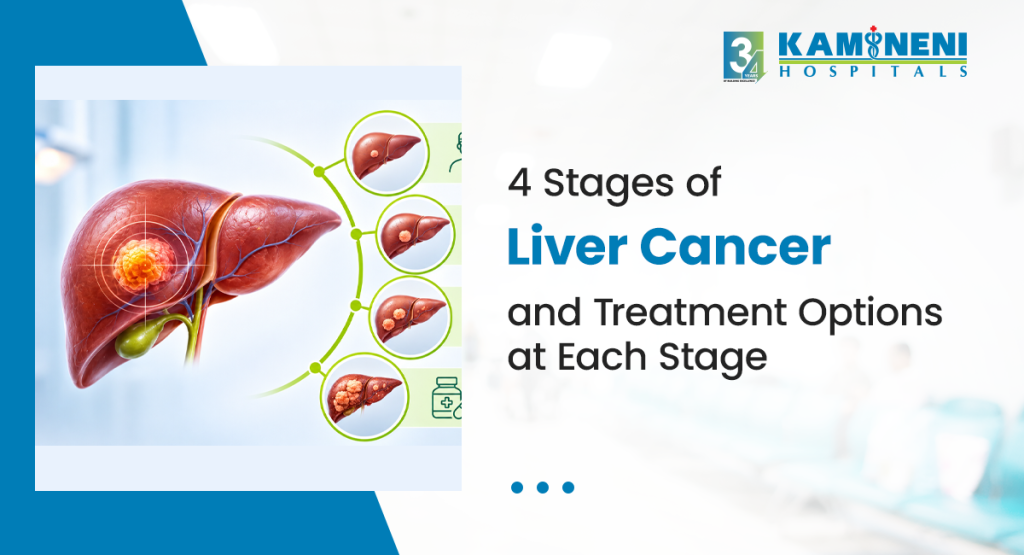
Doctors describe liver cancer in four stages. Each stage depends on the size and number of tumours, and how far the cancer has spread. Knowing the different stages in liver cancer helps you follow the plan. The treatment of liver cancer by stage also depends on how healthy the rest of your liver is.
Our liver and cancer teams at Kamineni Hospitals Hyderabad know how much a clear answer matters. With 34+ years of care, we treat every stage. Care ranges from small needle procedures to liver transplant, with a dedicated liver ICU at LB Nagar. In Vijayawada, a joint specialist team reviews every cancer plan. Here’s what each stage means for you.
What Are the Different Stages in Liver Cancer?
Liver cancer has four main stages. Stage 1 is one small tumour. Stage 4 means the cancer has spread beyond the liver. This guide covers cancer that starts in the liver, called hepatocellular carcinoma (HCC). Cancer that spreads to the liver from another organ follows a different plan.
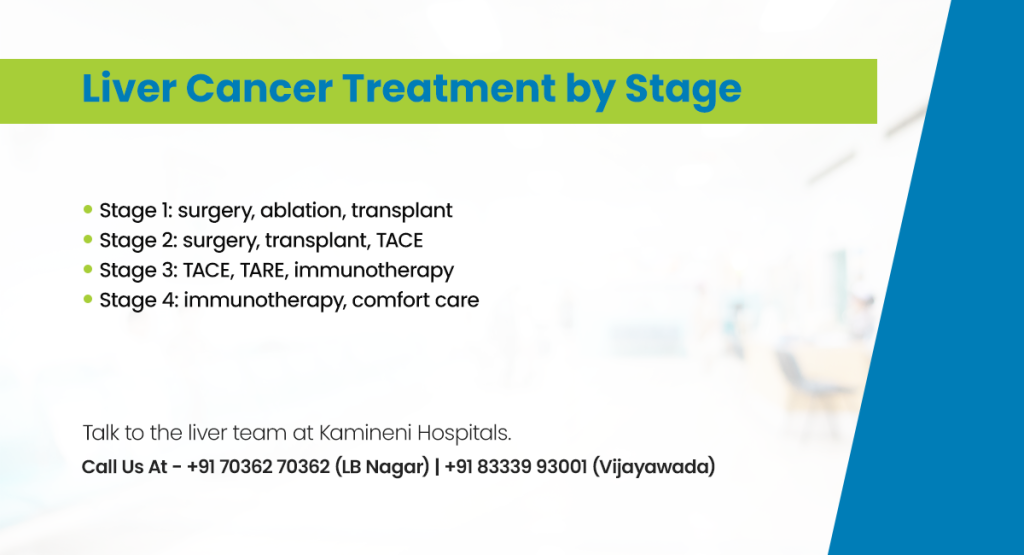
Here’s a quick view of the treatment of liver cancer by stage:
| Stage | What It Means | Main Treatment Options |
| Stage 1 | One tumour, not grown into blood vessels | Surgery, ablation, transplant for some |
| Stage 2 | Into small blood vessels, or several small tumours | Surgery, transplant, ablation, TACE |
| Stage 3 | A tumour over 5 cm, or spread into a major liver vein | TACE, TARE, targeted therapy, immunotherapy |
| Stage 4 | Spread to lymph nodes or other organs | Immunotherapy, targeted therapy, comfort care |
Doctors find the stage with a CT or MRI scan and a blood test called AFP. Sometimes they also take a biopsy, a tiny sample of the tumour. Our diagnostic services at LB Nagar handle these tests.
The stage isn’t the only thing that decides your treatment. Many people with liver cancer also have cirrhosis. That’s scarring of the liver from hepatitis, alcohol or fatty liver. A scarred liver may not cope with major surgery. So doctors also check how well your liver works. They ask how active you are each day, too. Many teams use a system called BCLC to weigh all of these together. Our gastroenterology and liver team checks your liver health before we make any plan.
When you meet your doctor, ask three things. What stage is it? How well is my liver working? Is the aim to cure the cancer or to control it? The answers will tell you a lot about the road ahead.
Stage 1 Liver Cancer: What It Means and How It’s Treated?
Stage 1 means there’s one tumour in the liver, and it hasn’t grown into any blood vessels. At this stage, treatment has the best chance of removing all of the cancer. Doctors split stage 1 into two. In 1A, the tumour is 2 cm or smaller. In 1B, it’s bigger than 2 cm.
Treatment at this stage usually aims for a cure. The options are:
- Surgery. If the rest of your liver is healthy, a surgeon takes out the part with the tumour. The liver can regrow some of what’s lost over the next few weeks.
- Ablation. For small tumours, doctors pass a thin needle through the skin into the tumour. Then they destroy it with heat. RFA (radiofrequency ablation) uses radio waves. MWA (microwave ablation) uses microwaves. There’s no large cut, and most people go home within a day or two.
- Liver transplant. If cirrhosis makes surgery unsafe, a transplant can replace the whole diseased liver. Doctors usually offer a transplant for one tumour up to 5 cm. They may also offer it for up to three tumours, each 3 cm or less. Doctors call these limits the Milan criteria. Our hepatology and liver transplant team at LB Nagar assesses patients for transplant.
Whatever the treatment, you’ll need regular scans and AFP blood tests after it. At first, these come every few months. Liver cancer can come back in another part of the liver. These checks help us catch it early.
Stage 2 Liver Cancer: What It Means and How It’s Treated?
Stage 2 can mean two things. One tumour has started growing into small blood vessels. Or there are several tumours, all under 5 cm. The cancer is still inside the liver. For many people at this stage, the aim is still a cure.
The right option depends on how many tumours there are and how well your liver works:
- Surgery if the tumours sit in one part of the liver and the liver is strong.
- Liver transplant if you have cirrhosis and the tumours fall within the Milan limits.
- Ablation for one or two small tumours.
- TACE when there are several tumours or surgery isn’t possible.
TACE stands for transarterial chemoembolisation. A doctor passes a thin tube through an artery in your groin up to the liver. Cancer medicine goes straight into the tumour’s blood supply. Then the doctor blocks that vessel. The tumour loses its food supply and shrinks. The rest of your body gets only a small dose of the medicine.
After TACE, you may have a fever, some belly pain or nausea for a few days. These usually settle on their own. Some people need two or more sessions, a few weeks apart. If tumours come back later, doctors can often repeat TACE or ablation.
Stage 3 Liver Cancer: What It Means and How It’s Treated?
Stage 3 means the cancer has grown larger, or spread into the liver’s main blood vessels. In stage 3A, at least one of several tumours is bigger than 5 cm. In stage 3B, the cancer has grown into one of the large veins of the liver.
At this stage, the aim often shifts to keeping the cancer in check. The options include:
- TACE, as explained above, for large tumours that haven’t reached the main veins.
- TARE (transarterial radioembolisation). Tiny beads that carry radiation go into the arteries that feed the tumour. The beads work from inside the tumour and spare most of the healthy liver.
- Targeted therapy. These tablets block the signals that help cancer cells grow.
- Immunotherapy. You get these medicines through a drip. They help your own body find and fight cancer cells.
In stage 3B, when the cancer has grown into a main vein, TACE often isn’t safe. Immunotherapy or targeted therapy then becomes the main treatment. Side effects differ from person to person. So your team checks your blood tests and liver health closely.
Sometimes TACE or TARE shrinks a tumour enough. Then surgery or a transplant may become possible later. That’s worth asking about. At our cancer hospital in Vijayawada, the hepatology team offers TACE, TARE and ablation alongside the oncology team.
Stage 4 Liver Cancer: What It Means, and Is It Too Late?
Stage 4 means the cancer has spread outside the liver. In stage 4A, it has reached nearby lymph nodes. In stage 4B, it has spread to other organs, most often the lungs or bones. A cure is rarely possible at this stage. But treatment can still control the cancer and help you live well.
We understand why families ask, ‘Is it too late?’ The honest answer is that the goal changes, not that care stops. Treatment at stage 4 includes:
- Immunotherapy, often combined with a targeted medicine, as the first choice for many people
- Targeted therapy tablets if immunotherapy doesn’t suit you
- Radiation to ease pain, for example from cancer in the bones
- Palliative care, which is specialist care to control pain, tiredness, poor appetite and swelling
Palliative care doesn’t mean giving up. It runs alongside cancer treatment and helps people feel better day to day. Our oncology team at LB Nagar plans stage 4 care with you. The plan fits your liver health and your wishes. Your doctor can also tell you about clinical trials that may suit you.
If the liver is badly damaged, strong cancer medicines can do more harm than good. In that case, comfort care becomes the main focus. Otherwise, treatment goes on while it keeps the cancer in check and you cope well.
Just Got a Liver Cancer Report? Let’s Go Through It Together
Liver cancer care works best when liver surgeons, liver doctors, scan-guided specialists and cancer doctors plan your treatment together. That’s why a Hyderabad multispeciality hospital helps. At Kamineni Hospitals, a multi speciality hospital in Hyderabad, you’ll find:
- 3T MRI and 128-slice CT scans, plus AFP and liver function blood tests, at LB Nagar
- TACE, TARE and ablation at LB Nagar and at our cancer hospital in Vijayawada
- A liver transplant programme with a dedicated liver ICU at LB Nagar
- NABH and NABL accreditation, and cashless care with 150+ insurance partners
Bring all your scans and reports. Call +91 70362 70362 (LB Nagar) or +91 83339 93001 (Vijayawada), or book a consultation.
This content is for general patient education only. It does not replace medical consultation, diagnosis, or treatment advice from a qualified oncologist, hepatologist or doctor. Please consult a specialist at Kamineni Hospitals for personalised guidance based on your symptoms and medical history.
Frequently Asked Questions
Can Liver Cancer Be Cured?
Sometimes. Stage 1 and some stage 2 liver cancers can often be cured. Doctors use surgery, ablation or a transplant to remove the cancer.
How Do Doctors Find the Stage of Liver Cancer?
Doctors use a CT or MRI scan, an AFP blood test and sometimes a biopsy. They also check how well your liver works.
Who Can Get a Liver Transplant for Liver Cancer?
Usually people with cirrhosis and either one tumour up to 5 cm, or up to three tumours each 3 cm or smaller.
Does Hepatitis B Lead to Liver Cancer?
Not always, but it raises the risk. A 2024 review linked hepatitis B to about 41% of liver cancers in India.
Is Cancer That Spread to the Liver Treated the Same Way?
No. Doctors treat cancer that spreads from the bowel or breast based on where it started, not as liver cancer.