


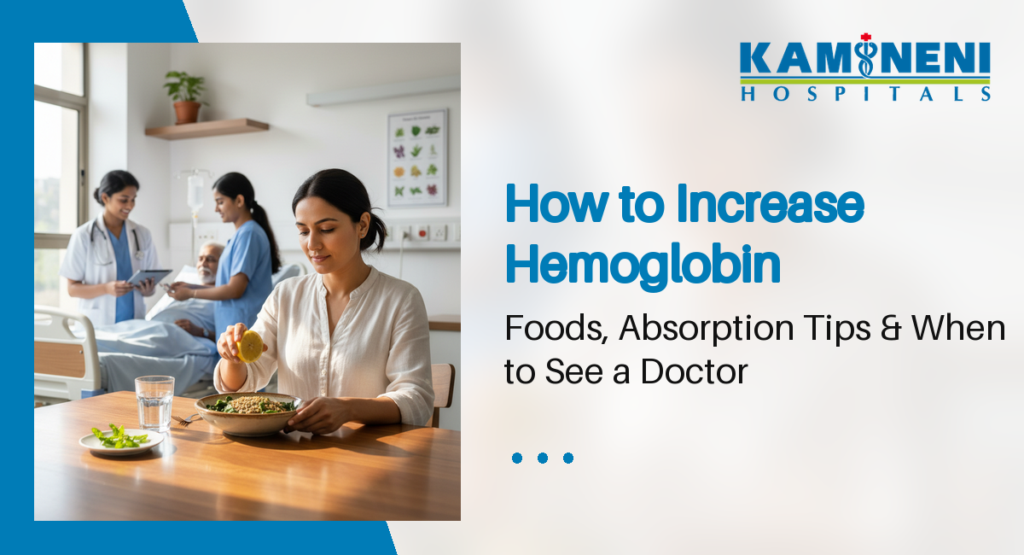
How to increase hemoglobin is a question many people face after seeing low numbers on a blood test, or feeling unusually tired, short of breath, or pale. Low hemoglobin means your blood carries less oxygen, so everyday tasks feel harder. The direct answer is that most people raise hemoglobin by eating more iron-rich foods, pairing them with vitamin C, avoiding iron blockers like tea or coffee with meals, and treating any underlying cause a doctor finds. At Kamineni Hospitals, our specialists in general medicine and hematology see this every day, and we start with your symptoms and history before ordering tests, never a fixed package. Read on for the specific foods, habits, and warning signs that tell you when diet alone is not enough.
Key takeaways
- Iron-rich foods with low glycemic index help stabilize blood sugar while raising hemoglobin.
- Vitamin C with meals doubles iron absorption; tea or coffee within an hour of eating blocks it.
- Oral iron supplements help some patients, but only after a doctor confirms the cause of low hemoglobin.
- Fatigue, pale skin, or shortness of breath with normal diet changes mean you need blood tests and specialist review.
Which foods raise hemoglobin fastest?
The foods that raise hemoglobin fastest are those rich in heme iron, which your body absorbs most easily. Heme iron comes from animal sources. Non-heme iron from plants needs more support to absorb well.
- Lean red meat: beef, lamb, and goat provide highly absorbable heme iron.
- Seafood: clams, oysters, sardines, and mackerel pack dense iron per serving.
- Organ meats: liver and kidney contain the highest iron concentration of any food.
- Dark poultry: chicken and turkey thighs have more iron than white meat.
- Leafy greens: spinach, fenugreek, and amaranth supply non-heme iron plus folate.
- Legumes and beans: lentils, chickpeas, and kidney beans are steady plant sources.
- Fortified grains: oatmeal, cereals, and rice with added iron help close gaps.
- Nuts and seeds: pumpkin seeds, sesame, and cashews work as snacks or toppings.
Pair any of these with vitamin C-rich foods at the same meal. Squeeze lemon on lentils, eat oranges with fortified cereal, or add tomatoes to bean curry. How to Increase Haemoglobin Naturally with Nutrient-Rich Foods? covers meal planning in more detail.
What blocks iron absorption and how do you stop it?
Several common foods and drinks block iron from entering your bloodstream. You do not need to give them up entirely, but timing matters.
| Iron blocker | How it interferes | What to do instead |
|---|---|---|
| Tea and coffee | Tannins bind iron in the gut, cutting absorption by half or more | Drink them one hour before or after iron-rich meals |
| Calcium-rich foods or supplements | Calcium competes with iron for the same absorption pathway | Take calcium at a different meal from your main iron source |
| Whole grains with phytates | Phytates in bran and brown rice reduce non-heme iron uptake | Soak, sprout, or ferment grains to lower phytate levels |
| Antacids and PPIs | Lower stomach acid, which you need to dissolve iron | Discuss timing with your doctor; do not stop on your own |
Even small changes help. A patient who moved her morning tea to mid-morning, after her iron-fortified breakfast, saw better numbers in six weeks. Your stomach acid matters too. If you take acid-reducing medicine regularly, mention it when you see a General Medicine specialist.
Do iron supplements work, and are they safe to start alone?
Iron supplements do raise hemoglobin, but starting them without knowing your cause is risky. Too much iron damages the liver, heart, and pancreas. In one randomized trial of 100 patients with cancer-related anemia, weekly oral iron equivalent to 200 mg elemental iron per day showed benefit, but those patients were under close medical supervision.
Your doctor will check:
- Complete blood count (CBC): confirms hemoglobin level and red cell size.
- Serum ferritin: measures iron stores, not just current blood levels.
- Transferrin saturation: shows how much iron is actually moving through your blood.
- Vitamin B12 and folate: low levels mimic iron deficiency and need different treatment.
- Stool occult blood or endoscopy: rules out hidden bleeding in the gut.
At Kamineni Hospitals, our diagnosis-first approach means we choose tests from your symptoms and history, not a preset package. If you have kidney disease, your anemia may need a different strategy entirely. What can increase the risk of kidney disease? – Welcome to Kamineni Hospitals explains how renal function affects red blood cell production.
How to increase hemoglobin when diet is not enough?
Sometimes diet changes plateau, or the drop is too steep for food alone. That is when medical treatment steps in, targeted to the cause your tests reveal.
| Cause found | Typical medical approach | What the patient does |
|---|---|---|
| Iron-deficiency anemia | Oral or intravenous iron replacement, based on severity and tolerance | Take prescribed iron with vitamin C; return for hemoglobin recheck in 8 weeks |
| Chronic kidney disease | Erythropoiesis-stimulating agents (ESAs) plus iron management | Follow nephrology appointments; monitor blood pressure and fluid balance |
| Vitamin B12 or folate deficiency | B12 injections or oral folate, not iron | Report any numbness or balance changes early |
| Blood loss (heavy periods, ulcers, polyps) | Treat the bleeding source; transfuse only if hemoglobin is dangerously low | Track menstrual flow or stool color; do not ignore black or tarry stools |
Our Nephrology and Gastroenterology teams coordinate when anemia crosses specialties. Complex cases get reviewed together, not passed between departments.
When should you see a doctor instead of trying home remedies?
Certain signs mean low hemoglobin has a cause that food cannot fix. Delaying care risks heart strain, falls, or missed diagnosis of serious conditions.
Call our 24/7 emergency line or book urgent consultation if you have:
- Chest pain or heartbeat that races with mild exertion: your heart works harder when oxygen is low.
- Shortness of breath at rest or while lying flat: this can signal heart failure from chronic anemia.
- Black, tarry stools or visible blood in stool or urine: internal bleeding needs immediate source control.
- Rapid worsening of fatigue over days, not weeks: sudden drops suggest acute blood loss or bone marrow problem.
- Pale skin plus numbness in hands or feet: B12 deficiency damages nerves permanently if untreated.
- Pregnancy with previously diagnosed low hemoglobin: your blood volume rises, diluting hemoglobin further; both mother and fetus need monitoring.
Do not drive yourself if you feel faint or breathless. Call +91 70362 70362 for emergency guidance. Our emergency and critical care units operate round the clock at every branch. For expectant mothers, How can you prevent preterm labour? – Welcome to Kamineni Hospitals includes guidance on maternal nutrition and monitoring.
What daily habits protect hemoglobin long-term?
Once your hemoglobin recovers, maintenance matters. Relapse is common when patients stop paying attention after the first normal blood test.
- Build meals around iron plus vitamin C: think dal with tomatoes, spinach with lemon, or fortified cereal with orange slices.
- Space tea and coffee away from iron-rich meals by at least one hour.
- Get screened for hidden blood loss if you are over 45, or earlier with family history of colon polyps.
- Manage periods if they are heavy: gynecological review can reduce blood loss through medication or procedures.
- Check hemoglobin yearly if you have conditions that affect absorption: celiac disease, Crohn’s disease, or after bariatric surgery.
- Avoid self-prescribing iron: recheck levels before restarting any supplement.
Our Diagnostic Services team runs the full anemia panel, and results feed directly to your treating specialist. No package is sold without clinical reason. How worse can kidney infection be? – Welcome to Kamineni Hospitals shows how untreated infections can cascade into broader health problems, including anemia.
Raising hemoglobin starts with iron-rich meals timed away from blockers like tea, plus vitamin C to boost uptake. Supplements help only after a doctor confirms the cause and monitors your response. If fatigue, breathlessness, or paleness persists despite diet changes, blood tests and specialist review are the next step. Call Kamineni Hospitals at +91 70362 70362 to book a general medicine consultation or reach our 24/7 emergency unit.
FAQs
How long does it take to raise hemoglobin with diet alone?
Most people see hemoglobin rise within 8 to 12 weeks of consistent dietary change, but only if iron deficiency is the sole cause. If levels do not improve, a doctor needs to check for absorption problems, ongoing blood loss, or other deficiencies like B12 or folate.
Can I drink green tea if I have low hemoglobin?
Green tea contains tannins that block iron absorption, though less than black tea. If you drink it, keep it at least one hour away from iron-rich meals or supplements. Herbal teas without tannin, like chamomile or peppermint, do not interfere.
Why is my hemoglobin low even though I eat meat?
You may absorb iron poorly due to low stomach acid, celiac disease, or medications like antacids. Alternatively, you could be losing iron through heavy periods, hidden gut bleeding, or a condition like chronic kidney disease that reduces red blood cell production.
Is hemoglobin of 8 dangerous?
Hemoglobin below 8 g/dL is severe anemia. Most patients feel marked fatigue, shortness of breath, and rapid heartbeat. It strains the heart and needs urgent medical evaluation to find the cause and decide if transfusion or other treatment is needed.
Can exercise lower hemoglobin?
Intense endurance exercise can temporarily lower hemoglobin through increased plasma volume or foot-strike damage to red blood cells. This is usually mild and reverses with rest. If you are an athlete with persistent low hemoglobin, see a specialist to rule out iron deficiency or other causes.
Should children follow the same diet to increase hemoglobin?
Children need iron for growth, but their portions and sources differ. Breastfed infants need iron drops from 4 months; toddlers benefit from iron-fortified cereals and pureed meats. Never give adult iron supplements to a child without pediatric guidance, as overdose is dangerous.