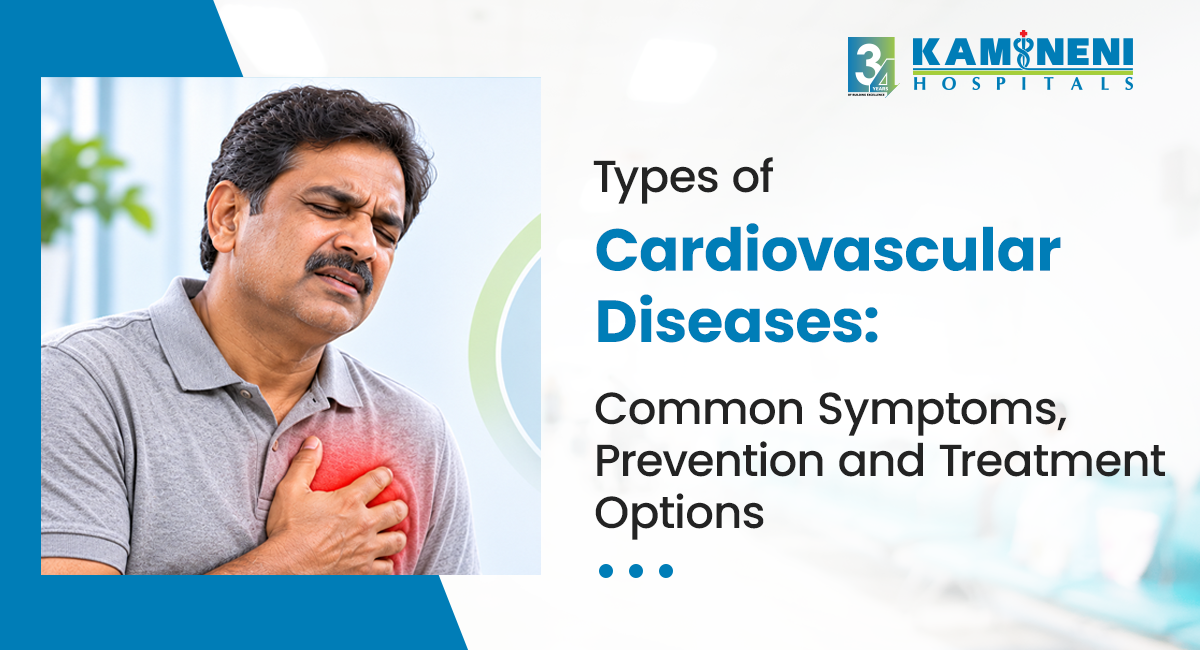
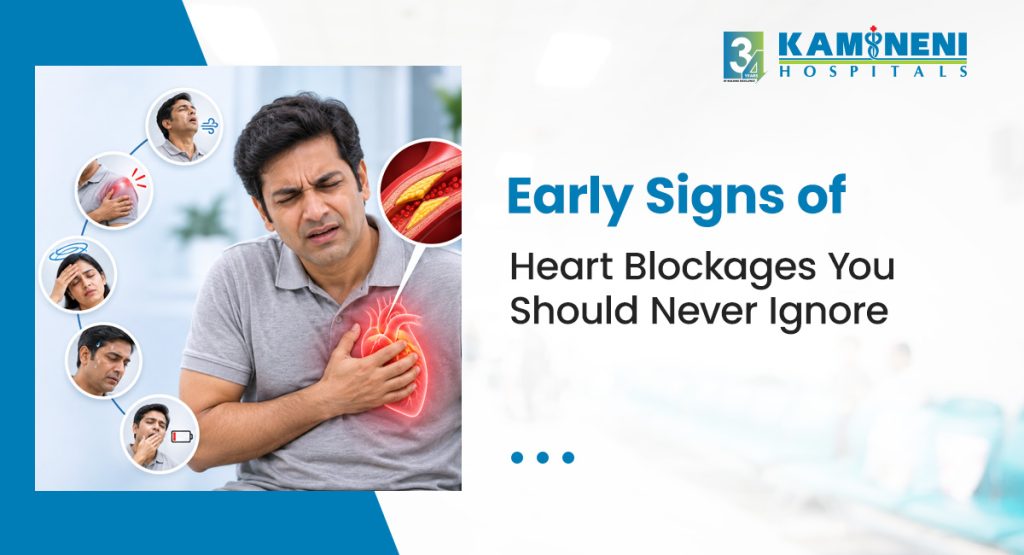
You walk fast to catch a bus, and your chest feels tight. You stop, and it eases in a minute. So you take an antacid and call it gas. In our clinic, we hear this story every week.
The early signs of heart blockages often show up when you’re active. You might feel chest heaviness, get breathless sooner or notice pain in your arm or jaw. These signs usually settle with rest. Some blockages cause no signs at all. That’s why heart blockage symptoms deserve a proper check, not a guess.
We’re the cardiology team at Kamineni Hospitals, part of a group with 34+ years of care. Below, we answer the questions our patients ask us most. You’ll learn how to tell gas from your heart, which tests find a blockage and what treatment looks like.
What Is a Heart Blockage?
A heart blockage is a narrowing in the arteries that carry blood to your heart muscle. Fat and cholesterol build up inside the artery wall as plaque. Over the years, the plaque shrinks the space for blood. Doctors call this coronary artery disease, or CAD.
You may also hear the term “heart block”. That’s a different problem. It affects the heart’s electrical signals, not its arteries. In this blog, we’re talking about blocked arteries.
Heart disease is now India’s biggest killer. The Registrar General of India’s Sample Registration System report for 2021 to 2023 found that heart disease causes nearly 31% of all deaths. It’s the leading cause of death for people aged 30 and above.
What Are the Early Signs of Heart Blockages?
The early signs of heart blockages are chest heaviness, breathlessness and pain that spreads to your arm or jaw. They usually come on when you walk, climb stairs or feel stressed. They fade when you rest. That pattern matters more than any single sign.
Chest Heaviness When You Walk or Climb
Doctors call this angina. It’s chest pain or pressure caused by too little blood reaching the heart. People describe it as a weight, a squeeze or a burning. It often starts on a brisk walk or a flight of stairs and goes away within minutes of rest.
Getting Breathless Faster Than Before
Maybe you used to climb two floors easily. Now you need to stop after one. When your heart gets less blood, it can’t pump as well, and you feel out of breath sooner.
Pain That Spreads to the Arm, Jaw, Neck or Back
Heart pain doesn’t always stay in the chest. It can travel to your left arm, your jaw, your neck or the space between your shoulder blades.
Unusual Tiredness, Sweating or Nausea
Some people feel drained after small tasks. Others break into a cold sweat or feel sick in the stomach during effort. These signs are easy to blame on work or heat.
| Sign | What Makes It Suspicious |
| Chest heaviness | It comes with effort and eases with rest |
| Breathlessness | It starts sooner than it used to |
| Arm or jaw pain | It appears along with chest discomfort |
| Tiredness | It’s new and doesn’t match your activity |
| Cold sweat | It happens during effort, not heat |
Is It Gas or Your Heart?
It’s hard to tell by feel alone, and that’s the honest answer. Gas pain often links to meals, burping and bloating. Heart pain often links to effort and eases with rest. If you’re not sure, get your heart checked rather than taking one more antacid.
| More Likely Gas or Acidity | Get Your Heart Checked |
| Starts after a heavy or spicy meal | Starts when you walk, climb or feel stressed |
| Gets better after burping | Gets better only when you stop and rest |
| Burning moves up the throat | Heaviness spreads to the arm, jaw or back |
| Comes with bloating | Comes with breathlessness or sweating |
| Shifts when you change position | Stays the same whatever position you’re in |
Many of our patients first tried Eno or Digene for days. A short check with a cardiologist would have answered the question sooner. A simple ECG and a few tests can settle it.
Do Women and People With Diabetes Feel Different Signs?
Yes, they often do. Women and people with diabetes may not feel the classic chest pain. Instead, they may feel breathless, tired or sick in the stomach. This is why their heart blockage symptoms are easier to miss.
A 2016 scientific statement from the American Heart Association, published in the journal Circulation, made this clear. Chest pain is still the most common heart attack sign in both men and women. But women are more likely to have shortness of breath, nausea, and back or jaw pain.
Long-term diabetes can also damage the nerves that carry pain signals. So a person with diabetes may have a blockage with little or no chest pain. If you have diabetes, regular heart checks matter even when you feel fine.
Who Is Most Likely to Get Heart Blockages?
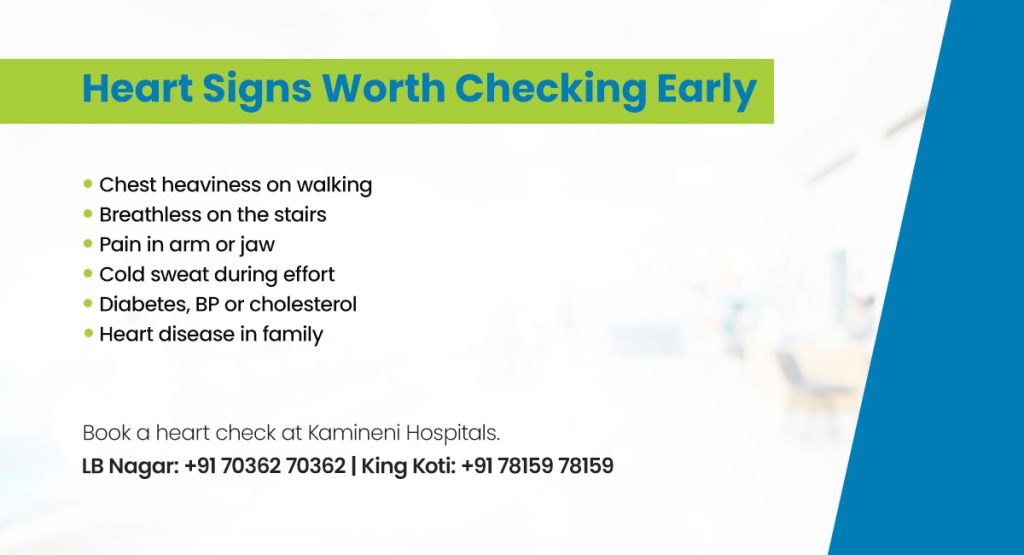
You’re more likely to get heart blockages if you have diabetes, high blood pressure or high cholesterol. Smoking, a family history of early heart disease, extra weight and too little exercise raise the risk too. Most people have more than one of these.
Your risk goes up if you:
- Have diabetes or prediabetes
- Have high blood pressure
- Have high LDL cholesterol, the “bad” cholesterol
- Smoke or chew tobacco
- Have a parent or sibling who had heart disease at a young age
- Carry extra weight around your belly
- Sit most of the day and rarely exercise
- Live with constant stress or poor sleep
Heart disease also tends to start younger here. A 2011 review in the Indian Journal of Medical Research noted that Indians get heart attacks 5 to 10 years earlier than people in Western countries. So don’t wait until 50 to think about your heart.
When Is Chest Pain an Emergency?
Chest pain is an emergency if it lasts more than a few minutes at rest, or keeps coming back. It’s also an emergency if it comes with sweating, breathlessness, vomiting or fainting. These can be signs of a heart attack. Don’t drive yourself. Get help now.
Call for emergency help straight away if you have:
- Chest pain or pressure that doesn’t settle with rest
- Pain spreading to the arm, jaw or back
- Heavy sweating, breathlessness or vomiting
- Sudden dizziness or fainting
In an emergency, every minute counts. If you’re searching for a heart hospital near me in Hyderabad, our emergency and critical care team at Kamineni Hospitals, LB Nagar is open 24/7. You can call the helpline on +91 70362 70362, or go to the nearest emergency department.
How Do Doctors Check for Heart Blockages?
We check for heart blockages with a few simple tests. They usually start with an ECG and an echo. If needed, we move to a treadmill test or a CT scan of the heart arteries. Only an angiogram shows the exact blockage.
Here’s how the tests usually go:
- ECG. Small stickers on your chest record your heart’s electrical signals. It takes a few minutes.
- Echo. An echocardiogram is an ultrasound of your heart. It shows how well your heart pumps.
- TMT. In a treadmill test, you walk on a treadmill while we watch your ECG. It shows how your heart copes with effort.
- CT coronary angiogram. A CT scan with dye shows the heart arteries without a tube. We advise it for some patients.
- Coronary angiography. A thin tube goes into an artery in your wrist or groin, and dye shows the exact blockage.
Our diagnostic services at Kamineni Hospitals, LB Nagar handle these tests under one roof. People looking for the best cardiologist in Hyderabad often start here, because the right test saves time.
“My ECG Was Normal. Am I Safe?”
Not always. An ECG at rest records only a few seconds of your heart’s activity. A blockage can hide when you’re sitting still. That’s why we may add a treadmill test or a CT angiogram if your heart blockage symptoms come with effort.
What Are the Options for Heart Blockage Treatment?
Heart blockage treatment depends on where the blockage is, how narrow it is and how you feel. Many people do well with lifestyle changes and medicines. Some need a stent, and a few need bypass surgery. Your cardiologist decides after your tests.
| Treatment | When Doctors May Advise It |
| Lifestyle changes | For everyone, alongside any other treatment |
| Medicines | To lower cholesterol, control BP and sugar, and protect the heart |
| Angioplasty with a stent | When one or two arteries are badly narrowed |
| Bypass surgery (CABG) | When many arteries are blocked, or a stent isn’t suitable |
Angioplasty uses a small balloon to open the artery. A stent, a tiny mesh tube, then keeps it open. Bypass surgery, or CABG, makes a new route for blood around the blockage. Our cardiothoracic and vascular surgery team handles bypass surgery when it’s needed.
No treatment removes the need for good habits. Medicines, regular follow-ups, no tobacco and daily walks all help keep the heart healthy. Results depend on your condition, your overall health and how closely you follow your care plan.
Chest Feels Heavy When You Walk? Let’s Check Your Heart
A heavy chest on the stairs deserves a real answer. Kamineni Hospitals brings 34+ years of care to every heart check. Meet Dr. G. Shiva Prasad at our cardiology department in LB Nagar, or Dr. Saket S. Khetan at our cardiology department in King Koti. Searching for the best cardiologist in Hyderabad, the best cardiologist near me or a heart hospital near me? Call LB Nagar at +91 70362 70362 or King Koti at +91 78159 78159, or book a consultation. Our health packages include heart checks.
This content is for general patient education only. It does not replace medical consultation, diagnosis, or treatment advice from a qualified cardiologist or doctor. Please consult a specialist at Kamineni Hospitals for personalised guidance based on your symptoms and medical history.
Frequently Asked Questions
Can a Heart Blockage Show Up on an ECG?
Sometimes. An ECG at rest can look normal even with a blockage. A treadmill test or CT angiogram often gives a clearer picture.
Can Heart Blockages Be Reversed?
Plaque rarely disappears fully. Medicines, quitting tobacco and daily exercise can slow it down and lower your chance of a heart attack.
At What Age Can Heart Blockages Start?
Plaque can start building in your twenties. In India, heart attacks often happen earlier, so heart checks after 35 make sense for many people.
How Do I Find the Best Cardiologist Near Me?
Look for a qualified cardiologist with ECG, echo, TMT and angiography close by. Kamineni Hospitals offers these in LB Nagar and King Koti.
Does Every Heart Blockage Need a Stent?
No. Many blockages are treated with medicines and lifestyle changes. Your cardiologist suggests a stent only when your tests show it’s needed.