




You went to bed fine. By morning the fever’s sitting at 39°C and every joint in the body feels hard to move.
Most people’s first thought is : is this dengue?
Dengue fever is a viral infection, where an infected Aedes mosquito bites you and the virus enters your blood. Antibiotics cannot do anything here because it isn’t a bacterial infection.
Most people recover. The ones that don’t usually have warning signs that were missed.
At Kamineni Hospitals, the General Medicine and Emergency teams see dengue cases every monsoon season. We offer same-day NS1 testing, platelet monitoring, and 34+ years of multispeciality care behind every evaluation.
What Causes Dengue Fever?
Dengue fever causes are one of four virus strains: DENV-1, DENV-2, DENV-3, DENV-4 transmitted through the bite of an infected Aedes aegypti mosquito. It doesn’t spread through air, water, coughing, or person-to-person contact.
Recovering from one dengue strain gives lifelong immunity to that strain only. A second infection with a different strain raises the risk of severe dengue significantly.
The Aedes Aegypti Mosquito, What Makes It Different:
- Bites during the day, most actively between 6 to 8 AM and 6 to 8 PM
- Breeds in clean, still water : flower pots, cooler trays, old tyres, and uncovered tanks
- A small amount of water is enough
What Puts Someone At Higher Risk Of Catching Dengue:
- Living or working near unchecked stagnant water during monsoon months
- Being outdoors at dawn or dusk without protective clothing or repellent
- Dense residential areas in Hyderabad where water accumulates in common spaces
- A previous dengue infection, higher severity risk
What Are the Symptoms of Dengue Fever?
Dengue fever symptoms typically appear 4 to 10 days after a mosquito bite. They move through three phases and the dangerous one isn’t always the most painful one.
Phase 1 : Febrile (Days 1 to 3)
This is when the fever announces itself.
- Sudden high fever – 39°C to 40°C (102°F to 104°F)
- Severe headache, especially a deep pain behind the eyes
- Intense joint and muscle pain
- Nausea, vomiting, and loss of appetite
- A faint rash may appear on the skin by day 2 or 3
Phase 2 : Critical (Days 3 to 7)
The fever drops. Many families think this means recovery. It doesn’t.
Day 3 to 7 is the most dangerous window. This is when platelet count falls.
Platelets are the cells that help blood clot. Normal platelet count in a healthy person sits at 1.5 to 4.5 lakh per microlitre of blood. In dengue, the virus suppresses the bone marrow and destroys platelets. When count falls below 50,000 per microlitre, bleeding risk rises sharply.
Warning signs during the critical phase, go to a best emergency hospital near me immediately if you see any of these:
- Bleeding from gums, nose, or under the skin (small red or purple spots)
- Blood in urine, vomit, or stool
- Severe stomach pain that doesn’t ease
- Skin turning pale, cold, or clammy
- Confusion, dizziness, or difficulty staying awake
- No urination for more than 6 hours
These aren’t rare. They’re the signs that dengue has moved into severe territory.
Phase 3 : Recovery (Days 7 to 10)
- Fever breaks
- Appetite returns
- Platelet count begins climbing back
- Fatigue and rash may stick around for another week
Rest and hydration are the main requirements here. The body does the rest.
| Phase | Days | What’s Happening | What to Watch |
| Febrile | 1–3 | High fever, severe pain | Monitor temperature and hydration |
| Critical | 3–7 | Fever drops, platelet count falls | Watch for warning signs above |
| Recovery | 7–10 | Fever gone, appetite returns | Rest, watch for fatigue and rash |
How to Prevent Dengue Fever Effectively?
Effective dengue fever prevention in Hyderabad means cutting off the Aedes mosquito’s breeding cycle before it bites. Repellent and clothing reduce risk, but they can’t replace source control.
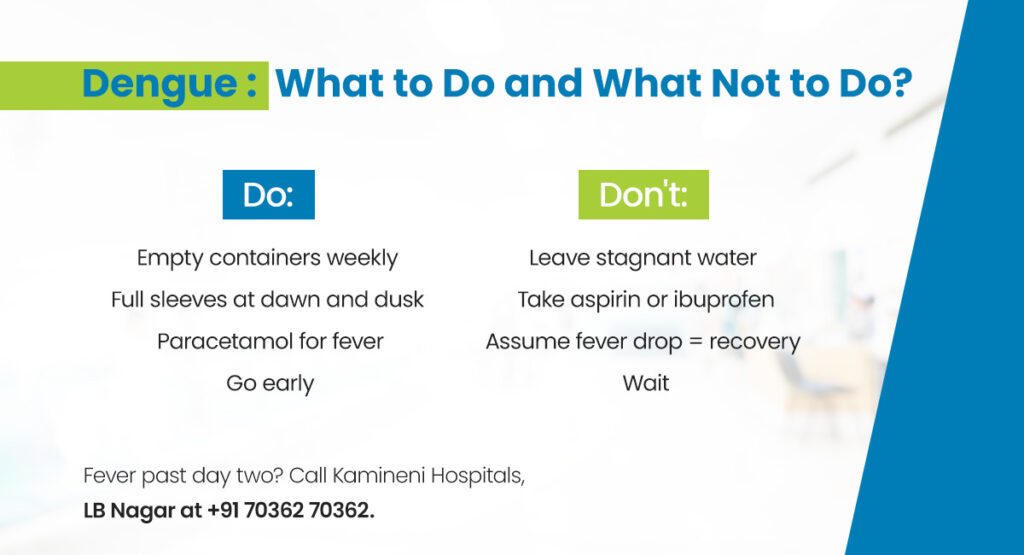
Source Control : Empty These Every Week:
- Flower pots and the trays underneath them
- Cooler water trays and drums
- Overhead tank lids and edges where water pools
- Old tyres, unused buckets, empty bottles, and any outdoor container
Personal Protection:
- Full sleeves and covered legs between 6 to 8 AM and 6 to 8 PM
- DEET-based repellent on all exposed skin before going out
- Mosquito nets at night
What Not To Do When Dengue Is Suspected?
- Do not take aspirin or ibuprofen. These medicines thin the blood. Paracetamol is the safe option for fever and pain.
- Do not assume the fever dropping on day 3 to 5 means recovery. That’s the critical phase.
- Do not wait. By the time platelet count becomes critically low, the body is already in trouble. Early evaluation, gives the treating team time and avoids complications.
Consult Kamineni Hospitals, LB Nagar for Dengue Fever Care.
Dengue is manageable. Cases that go wrong are almost always ones where warning signs got missed or where people waited because the fever seemed to be improving.
If the fever’s been going for two days, get a test at Kamineni Hospitals, a multi speciality hospital in Hyderabad. The Emergency and General Medicine departments run same-day dengue diagnostics so the clinical picture is clear from day one.
Call +91 70362 70362 for round-the-clock diagnostics and specialist backup.
Disclaimer: This content is for general patient education only. It does not replace medical consultation, diagnosis, or treatment advice from a qualified doctor. Please consult a specialist at Kamineni Hospitals for personalised guidance based on your symptoms and medical history.
Frequently Asked Questions
How do I know if my fever is dengue or just a viral fever?
Viral fever settles in three to five days. Dengue doesn’t and the pain behind the eyes is a giveaway. Get an NS1 test on day one. Don’t guess.
What is the dengue NS1 test and when should I get it?
Day one or two of fever, that’s when it’s most accurate. It picks up the virus directly in the blood, before antibodies even appear.
How long does dengue fever last?
Fever runs three to seven days. Full recovery: fatigue, rash, weakness takes closer to two weeks. Day three to seven is the dangerous stretch, not the end.
Why should I avoid aspirin and ibuprofen during dengue?
Both thin the blood. Platelet count’s already falling during dengue. Adding a blood-thinning medicine on top of that raises bleeding risk fast. Paracetamol only.