




A routine urine test comes back. One line reads: Urobilinogen – 1+ or 2+. Most people don’t know what urobilinogen is, what the number means, or whether to worry. Some panic. Most ignore it.
Urobilinogen is a normal substance found in urine in small amounts. Trace readings on a routine test aren’t always cause for concern. But abnormal levels : too high or completely absent can point to liver, bile duct, or blood-related conditions that need further testing.
At Kamineni Hospitals, our NABL-accredited diagnostic lab processes urine routine and microscopy alongside liver function tests, bilirubin panels, and specialist review across Nephrology, Urology, and Hepatology : all under one roof.
This guide by our specialist team covers what urobilinogen is, what the ranges mean, what causes abnormal levels, and when a result needs a best urology hospital in Hyderabad attention.
What Is Urobilinogen and Why Is It in Urine?
Urobilinogen shows up in urine because the body is constantly breaking down old red blood cells and a small amount making it into urine means things are working normally, not that something’s gone wrong.
Here’s how it gets there.
- Red blood cells last about 120 days. After that, they break down and release haemoglobin. The body converts that into bilirubin : a yellow waste product the liver picks up, processes, and pushes into the gut through bile.
- Gut bacteria take it from there, converting bilirubin into urobilinogen. Most of it leaves the body in the stool.
- A small amount gets pulled back into the blood, and the kidneys filter that fraction out into urine.
That’s the fraction the dipstick picks up. Seeing it on a report from the best multispeciality hospital in Hyderabad doesn’t mean something’s failing. Most of the time it’s the opposite, the whole recycling process ran exactly as it was supposed to.
What Are the Normal Ranges for Urobilinogen in Urine?
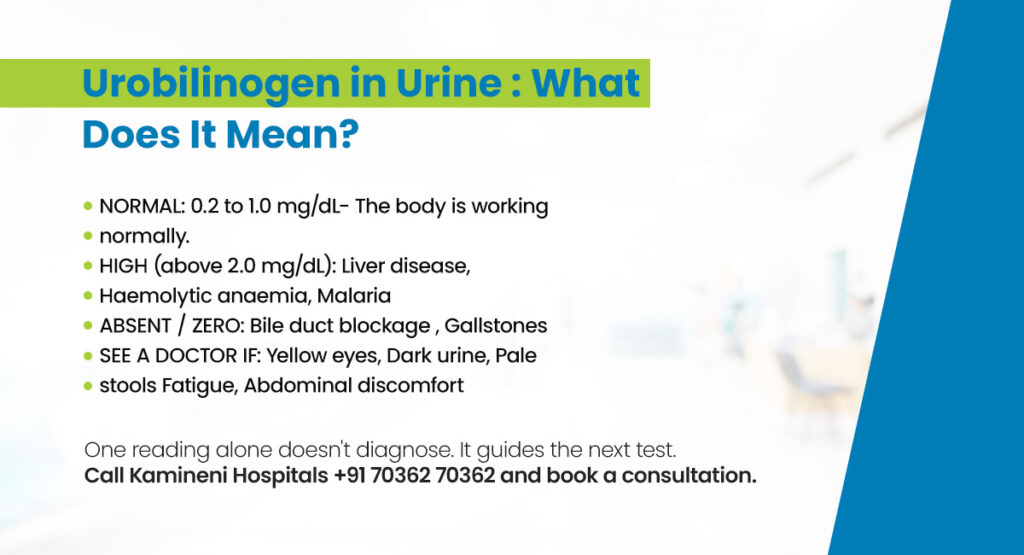
Normal urobilinogen levels in urine range between 0.1 to 1.8 mg/dL. Most labs and dipstick tests use 0.2 to 1.0 mg/dL as their reference range for healthy adults.
What 0.2 mg/dL on a report means?
That’s the lowest value a standard dipstick can actually detect. Seeing 0.2 urobilinogen in urine ranges doesn’t mean there’s a problem, it means the test picked up the smallest measurable amount, which is exactly what’s expected in someone healthy.
What do the readings point toward?
| Reading | What It Likely Means |
| 0.2 to 1.0 mg/dL | Normal : expected trace amount |
| 1.0 to 2.0 mg/dL | Borderline: check other urine and blood markers |
| Above 2.0 mg/dL | Elevated : needs further investigation |
| Negative or absent | Abnormal : possible bile duct blockage |
No single result gives a diagnosis. Numbers only mean something when read alongside symptoms and blood test findings.
What Causes High or Absent Urobilinogen in Urine?
High and absent urobilinogen aren’t two versions of the same problem. They point in completely opposite directions.
When urobilinogen is high:
- Liver disease is the most common reason. Hepatitis, cirrhosis, or any condition that damages the liver slows down how it handles bilirubin. More bilirubin backs up into the gut, more urobilinogen gets made, and more ends up in the urine.
- Haemolytic anemia is another urobilinogen in urine causes. Here, red blood cells are breaking down faster than normal which means more haemoglobin, more bilirubin, and more urobilinogen than the system can process quietly.
- Malaria does the same thing. It destroys red blood cells rapidly, which pushes urobilinogen levels up. During Hyderabad’s monsoon season, this is worth keeping in mind.
- Some medicines also raise the level temporarily : rifampicin, which is used in TB treatment, is one of them. Worth mentioning to a doctor if it’s being taken.
Low or Absent Urobilinogen:
- Bile Duct Blockage : When bile can’t reach the intestine from gallstones, bile duct cancer, or severe liver failure, bilirubin never arrives for gut bacteria to convert; urobilinogen drops to zero
- Antibiotics : Broad-spectrum antibiotics reduce urobilinogen levels by destroying the intestinal bacteria that convert bilirubin into urobilinogen
Think of it this way. High means too much bilirubin is making it through the system. Absent means bilirubin isn’t getting into the gut at all. Two very different problems wearing a similar-looking result.
When Should an Abnormal Urobilinogen Result Send You to a Doctor?
Borderline results in someone with no symptoms and normal blood tests often say more about the dipstick’s sensitivity than about the patient. An isolated abnormal reading in someone who feels well and has normal blood tests very often reflects the test rather than the person. The calculation changes when symptoms are present alongside the abnormal result.
Go for evaluation if the result comes with any of these:
- Yellow eyes or skin (jaundice)
- Dark, cola-coloured urine
- Pale or clay-coloured stools
- Fatigue that sleep doesn’t fix
- Discomfort in the upper right abdomen
- Itching without an obvious skin cause
- Recent fever with body ache
Conclusion
Urobilinogen in urine is normal in small amounts. Seeing it on a report isn’t automatically a problem.
But high levels, absent levels, or any result that comes with symptoms like jaundice, dark urine, or persistent fatigue those combinations deserve proper evaluation.
At Kamineni Hospitals, our NABL-accredited lab provides urine routine and microscopy, liver function tests, bilirubin panel, and full blood count. Nephrology, Urology, and Hepatology specialists review abnormal urine results and guide the next step.
Call +91 70362 70362 : Kamineni Hospitals, and book an appointment with a team of 34+ years of experience.
Disclaimer: This content is for general patient education only. Urobilinogen results must be interpreted by a qualified doctor alongside clinical symptoms, other urine markers, and blood test findings. A single urine test result does not confirm or rule out any diagnosis. Please consult a specialist at Kamineni Hospitals for personalised guidance based on your full report and medical history.
Frequently Asked Questions
Is 1+ urobilinogen in urine normal?
Usually yes. On most dipstick tests, 1+ lands near the top of the normal range. If there are no symptoms and blood tests are fine, it’s not something to lose sleep over.
What does high urobilinogen in urine mean?
More bilirubin than usual is getting through : liver trouble, hepatitis, or red blood cells breaking down too fast. Blood tests confirm what’s actually behind it.
Can dehydration cause high urobilinogen in urine?
Yes, concentrated urine makes everything read higher on a dipstick. Drink more water and retest first. Still elevated after that, or symptoms alongside it, see a doctor.
Which doctor should I see for abnormal urobilinogen?
Start with a general physician they’ll look at the full picture. Liver findings go to a hepatologist. Kidney findings go to a nephrologist. At Kamineni Hospitals, all three are available.