


9 am, laptop on the dining table. 1 pm, lunch at the desk. 10 pm, phone in bed. By night, your shoulders and back ache. You’re not alone. The World Health Organization says low back pain affects 619 million people.
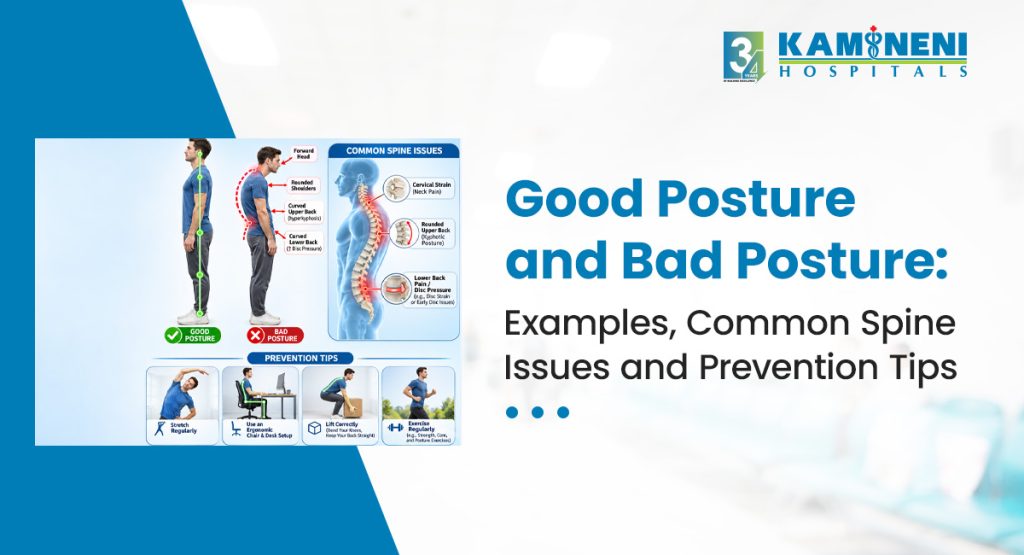
Much of it comes down to good posture and bad posture. In good posture, your ears sit over your shoulders. Your shoulders sit over your hips. In bad posture, your head drifts forward and your back curls into a ‘C’.
Does that sound like most of your day? Act now, before the ache becomes a lasting one. We’re the orthopaedics and physiotherapy experts at Kamineni Hospitals, LB Nagar and King Koti. We wrote this guide for you. We look for the cause, not just the pain. And we try non-surgical care first, with 34+ years of experience behind us.
What Is the Difference Between Good Posture and Bad Posture?
Good posture keeps your spine neutral. That means its three natural curves stay in place. Your neck curves gently in. Your upper back curves out. Your lower back curves in again. Bad posture flattens these curves or bends them too far. Then some muscles and joints carry extra load.
There’s no single perfect posture, though. NHS physiotherapy guidance says no one position is ‘correct’ for everyone. The bigger trouble is staying still for hours. Even a good position gets tiring if you don’t move.
| Good Posture | Bad Posture |
| Ears roughly in line with shoulders | Head pushed forward over the chest |
| Shoulders relaxed and back | Shoulders rounded and hunched |
| Lower back gently curved and supported | Lower back slumped into a ‘C’ shape |
| Weight spread on both feet or both hips | Leaning on one hip or one leg |
| Position changes often | Same position for hours |
Try This 30-Second Wall Check:
- Stand with your heels, hips, shoulders and head against a wall.
- Slide one flat hand behind your lower back. It should just fit.
- Check your head. Does it touch the wall only when you tilt your chin up? Then it may be drifting forward.
What Do Good Posture Examples Look Like in Daily Life?
Good posture examples are small habits that keep your head, shoulders and hips stacked. They change a little with each task. Here are the ones our patients ask about most. You can start most of them today.
At Your Desk or Laptop
- Keep the top of the screen at or just below eye level.
- Place the screen about an arm’s length away.
- Rest your feet flat on the floor, knees level with your hips.
- Sit back so the chair supports your lower back. A small cushion or rolled towel helps.
- Keep your elbows close and your shoulders loose.
Working on the bed or sofa? Your neck pays for it. Raise the laptop on a stand or a pile of books. Add a separate keyboard if you can.
On Your Phone
Your head weighs about as much as a small watermelon. Look down at your phone, and your neck works much harder to hold it. That’s what doctors call ‘text neck’.
- Lift the phone to eye level.
- Lower your eyes, not your head.
- For long chats, sit down and use a laptop or voice notes.
While Sleeping
- On your side, put a pillow between your knees.
- On your back, put a pillow under your knees.
- Pick a pillow that keeps your neck in line with your spine.
- Don’t sleep on your stomach. It twists your neck for hours.
- Choose a medium-firm mattress over a very soft or very hard one.
Lifting and Carrying
A water bucket, a gas cylinder or a toddler loads your lower back in a second. Before you lift:
- Bend at your knees and hips, not your waist.
- Hold the load close to your body.
- Turn with your feet instead of twisting your back.
- Split shopping into two bags, one in each hand.
On a Two-Wheeler
- Sit upright with your elbows slightly bent.
- Keep your back straight. Don’t hunch over the handles.
- Set your mirrors so you don’t crane your neck.
- Slow down before potholes and speed breakers. Each jolt travels up your spine.
- On long rides, stop every hour to stretch.
Cooking, Standing and Sitting on the Floor
- At the stove, rest one foot on a low stool. Swap feet every few minutes.
- Chop vegetables at a table instead of bending over a low counter.
- On the floor, sit on a firm cushion. It keeps your lower back curved.
- Lean against a wall, and shift position every 15 to 20 minutes.
Which Common Spine Issues Are Linked to Bad Posture?
Bad posture mostly causes muscle strain and stiffness in the neck and back. It can also make an old spine problem feel worse. But posture alone rarely causes serious disc disease. Age, genes, injuries and weight play a part too.
Back pain is also the world’s leading cause of disability, says the WHO. It expects cases to reach about 843 million by 2050.
Here are the spine problems we see most:
- Muscle Strain: The most common cause of everyday back and neck pain. It usually settles in days to weeks with gentle movement.
- Text Neck: Stiffness and aching from holding your head forward too long.
- Slipped Disc: Discs are soft cushions between the bones of your spine. In a slipped disc, the soft centre bulges out. It can press on a nerve.
- Sciatica: Pain that runs from the lower back down one leg. It starts when something presses on a nerve, often a slipped disc.
- Rounded Upper Back in Older Age: Often linked to weak bones, called osteoporosis. A DEXA scan, a low-dose X-ray, checks bone strength.
Not sure which one fits? Note when the pain starts, where it spreads and what eases it. Then share those notes with our orthopaedics team at LB Nagar.
When Is Back or Neck Pain More Than Just Posture?
Most posture aches ease within days or weeks once you move more. Some signs, though, point to a nerve problem or something more serious. Has one of them sent you searching for the best multi speciality hospital near me? Then it’s time to see a spine specialist.
See a doctor soon if you have:
- Pain that spreads down an arm or a leg
- Numbness, tingling or weakness in your hands, arms, legs or feet
- Pain that wakes you at night or doesn’t ease with rest
- Back pain after a fall or an accident
- Back pain with fever or weight loss you can’t explain
- Pain that hasn’t improved after four to six weeks
Go to an emergency department straight away if you:
- Lose control of your bladder or bowels
- Feel numb around your groin or inner thighs
These signs can mean serious pressure on the nerves at the base of your spine. Don’t wait to see if they pass.
Our spine care team in Hyderabad finds the cause with the right tests. Need urgent relief for a pressed nerve? Our neurosurgery team at LB Nagar works alongside the spine team.
How Can You Prevent Posture-Related Spine Problems?
You can prevent most posture aches by moving often and keeping your back and core strong. You don’t need special equipment. Pick two or three steps below and build from there.
- Move every 30 to 45 minutes. Stand up, fetch water or stretch for a minute. Set a phone reminder if you forget. Physiotherapists often say your next posture is your best posture.
- Strengthen your back and core. Try chin tucks, shoulder blade squeezes and bridges. Already in pain? Ask a physiotherapist to check your form first.
- Stay active every week. The WHO advises at least 150 minutes of moderate activity a week. A brisk 30-minute walk on five days covers it.
- Keep a healthy weight. Extra belly weight can pull your lower back forward. That’s extra load on it.
- Check your child’s school bag. It should sit on both shoulders. Pack only the books needed that day.
Want a plan that fits your work hours? Our physiotherapy and rehabilitation centre can build one with you.
Still Stiff After Fixing Your Posture? Let’s Find the Cause
A posture tip won’t fix lasting back pain. That needs spine surgeons, physiotherapists and imaging experts working together. At Kamineni Hospitals, a multi speciality hospital in Hyderabad, you’ll find:
- Spine physiotherapy and exercise plans at LB Nagar and King Koti
- MRI, CT, X-ray, nerve tests and DEXA scans through our diagnostic services
- Pain relief with medicines and spine injections when needed
- Endoscopic spine surgery and 24-hour emergency spine care at LB Nagar
- NABH and NABL accreditation, and cashless care with 150+ insurers
Looking for the best multi speciality hospital near me? Bring all your scans and reports. Call +91 70362 70362 (LB Nagar), or book a consultation.
This content is for general patient education only. It does not replace medical consultation, diagnosis, or treatment advice from a qualified orthopaedic specialist, physiotherapist or doctor. Please consult a specialist at Kamineni Hospitals for personalised guidance based on your symptoms and medical history.
Frequently Asked Questions
Can Bad Posture Be Corrected?
Yes, in most cases. Move often, adjust your desk and do simple strengthening exercises. Your posture can improve over a few weeks.
Can Bad Posture Cause Headaches?
It can. Holding your head forward for long periods tightens your neck muscles. That can trigger tension headaches. Frequent headaches still need a doctor’s check.
Which Doctor Should I See for Posture-Related Back Pain?
Start with an orthopaedic specialist or a physiotherapist. Have numbness, weakness or pain running down a leg? See a spine specialist.
Do Posture Corrector Belts Help?
They can remind you to sit up. But wearing one for long periods may weaken your muscles. Exercise and regular movement work better.
Is a Standing Desk Better Than Sitting?
Not on its own. Standing all day also strains your back. Switch between sitting, standing and walking through the day instead.