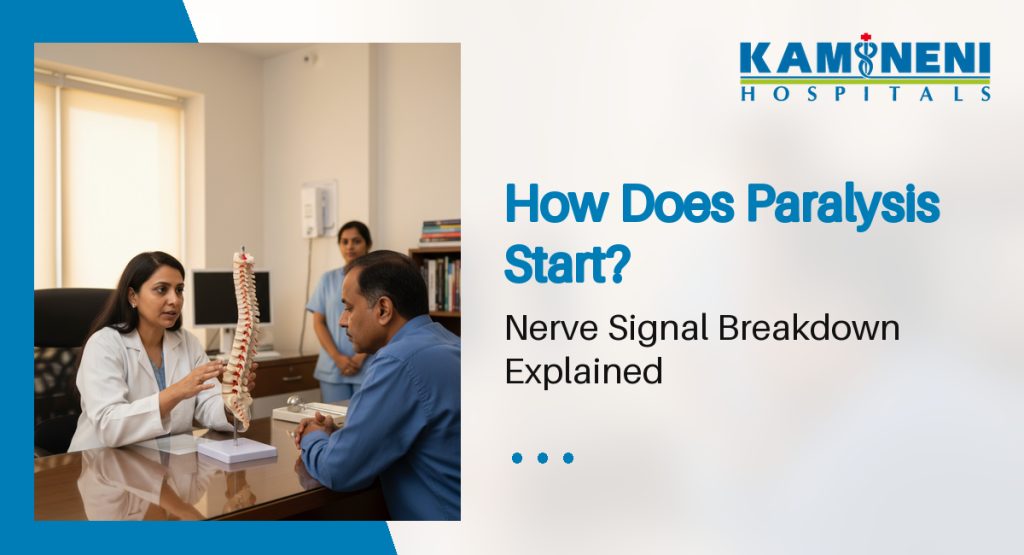
How does paralysis start? For most people, the first sign is a sudden weakness or numbness in one limb, or waking to find part of their face will not move. Paralysis starts when the chain of electrical signals running from your brain through your spinal cord to your muscles is cut or blocked. Something damages the nervous system, and the message to move simply cannot get through. At Kamineni Hospitals, our neurology and neurosurgery teams see this daily: a patient arrives unable to lift an arm or move a leg, and the first task is to find exactly where the signal stopped. This article explains what breaks that chain, what early symptoms look like, and why the first hours after onset matter so much for what recovery is possible.
Key takeaways
- Paralysis starts when nerve signals from brain to muscle are interrupted at any point along the pathway.
- Stroke and spinal cord injury together account for most paralysis cases.
- Early symptoms include sudden weakness, numbness, or loss of facial movement on one side.
- Permanent damage can become irreversible within hours, so emergency assessment is critical.
- Recovery depends on the cause, location, and speed of specialist intervention.
What happens in the body when paralysis starts?
Paralysis starts with a failure of communication. Your brain sends electrical impulses through the spinal cord and out along peripheral nerves; these tell muscles when to contract. When that pathway is damaged, the muscle receives no command and cannot move. The damage may sit in the brain itself, in the spinal cord, or in the nerves that branch out to limbs and organs. Cleveland Clinic overview of paralysis causes and management describes this as a nervous system problem where signals cannot reach muscles.
At Kamineni Hospitals, neurologists map this pathway step by step. They look for where the signal fails:
- Brain lesion: stroke, tumour, or trauma disrupts the motor cortex or internal capsule.
- Spinal cord compression or transection: fractures, disc herniation, or infections block descending pathways.
- Peripheral nerve injury: trauma or inflammation severs the final connection to muscle.
- Neuromuscular junction disease: conditions like myasthenia gravis interrupt chemical signalling at the nerve ending.
The location determines what goes limp. A brainstem stroke may freeze one side of the face and the opposite arm. A cervical spinal injury may stop both legs and both arms.
Which conditions most commonly trigger the start of paralysis?
Stroke and spinal cord injury are the two leading triggers. Strokes cause 33.7% of paralysis cases, while spinal cord injuries account for 27.3%. Other significant causes include multiple sclerosis at 18.6% and cerebral palsy at 8.3%. MedlinePlus summary of paralysis and its mechanisms notes that paralysis can be complete or partial, and may affect one or both sides of the body.
| Cause | Typical onset | What interrupts |
|---|---|---|
| Stroke | Sudden, minutes to hours | Blood clot or bleed in motor pathways |
| Spinal cord injury | Sudden, at moment of trauma | Vertebral fracture, dislocation, or compression |
| Multiple sclerosis | Gradual or stepwise over days | Autoimmune damage to nerve insulation |
| Cerebral palsy | Present from birth or early infancy | Brain malformation or perinatal injury |
Each of these demands a different emergency response. Stroke protocols focus on restoring blood flow within a narrow window. Spinal injuries require immobilisation to prevent further cord damage. Neurology specialists at Kamineni Hospitals coordinate with Neuro Surgery to decide whether a patient needs clot-dissolving therapy, decompression surgery, or intensive monitoring.
How does paralysis start: what are the first warning signs?
The first warning signs vary by cause, but sudden one-sided weakness is the most common. You may notice your face drooping on one side when you smile, or your arm drifting downward when you raise both. Speech may slur. Vision may blur or blacken in one eye. These minutes matter. NHS guidance on recognising paralysis symptoms lists inability to move part of the face or body, weakness, and numbness as key indicators.
For spinal causes, the pattern differs:
- Neck or back pain after a fall or jolt, with spreading numbness or tingling.
- Difficulty walking or a feeling of heaviness in the legs that climbs upward.
- Loss of bladder or bowel control alongside leg weakness.
- Breathing difficulty if the injury is high in the neck.
Gradual onset suggests demyelinating disease or compressive tumour rather than stroke or trauma. Either way, the right response is the same: reach a hospital with 24-hour emergency and critical care. Kamineni Hospitals runs round-the-clock emergency units at every branch, with NABH-accredited protocols for rapid neuroimaging and specialist consultation.
How do doctors trace where paralysis started?
Diagnosis is location-first. The neurologist asks when the weakness began, whether it is still spreading, and what preceded it. Then come targeted tests chosen from your symptoms and history, not from a fixed package. A patient with sudden facial droop gets urgent CT or MRI of the brain to distinguish clot from bleed. A patient with leg weakness after back pain gets MRI of the spine to find compression or disc herniation.
| Test | What it reveals | When it is used |
|---|---|---|
| CT brain (non-contrast) | Bleeding, large infarcts, skull fractures | First minutes of suspected stroke or head trauma |
| MRI brain or spine | Small strokes, demyelination, cord compression, tumours | When CT is normal but symptoms persist or worsen |
| Electromyography (EMG) | Nerve conduction and muscle response | Peripheral nerve or muscle disease suspected |
| Lumbar puncture | Infection, inflammation, or elevated pressure in CSF | When infection or multiple sclerosis is possible |
The Diagnostic Services team at Kamineni Hospitals works directly with neurology and neurosurgery so results reach the treating specialist without delay. Departments coordinate on complex cases, a necessity when paralysis spans multiple systems.
Can paralysis be stopped or reversed once it starts?
Whether paralysis can be reversed depends on what caused it and how quickly treatment begins. Ischemic stroke, if treated within 4.5 hours of onset, may respond to clot-dissolving therapy that restores blood flow and preserves function. Spinal cord compression from a prolapsed disc or abscess may recover fully if decompressed before permanent nerve death occurs. Inflammatory conditions like Guillain-Barre syndrome often improve with immunotherapy, though recovery takes weeks to months.
Some causes leave permanent deficit. Complete spinal cord transection, advanced motor neuron disease, or established cerebral palsy currently have no cure. Even here, early Physiotherapy And Rehabilitation preserves joint mobility, prevents contractures, and maximises whatever voluntary movement remains. Paralysis Attack: What Triggers It and How Can It Be Treated? explores specific interventions in more detail.
The honest answer is that no outcome is guaranteed. Most patients experience some improvement with prompt specialist care; the degree varies with the injury site and the treatment window.
When should you treat paralysis as an emergency?
Treat any sudden paralysis as an emergency. Do not wait to see if it passes. Do not drive yourself. Call for ambulance transport. The first hours after onset determine whether clot-dissolving drugs, surgical decompression, or other time-critical options remain available.
Call +91 70362 70362 for Kamineni Hospitals emergency services. Our emergency and critical care units operate 24/7 at every branch. Bring any information about when symptoms started, what you were doing, and any recent illness or injury. That timeline shapes every decision the team makes.
Recognising related warning signs early saves lives. Gas or Heart Attack? How Identifying the Warning Signs Can Save Your Life explains how similar rapid recognition applies to cardiac emergencies.
Paralysis starts when nerve signals fail somewhere between brain and muscle. Stroke, spinal injury, and demyelinating disease are the main culprits, and the first minutes to hours shape what recovery is possible. Watch for sudden weakness, facial droop, or numbness, and treat these as emergencies. Kamineni Hospitals provides 24/7 emergency neurology, neurosurgery, and diagnostic services. Call +91 70362 70362 for immediate assessment.
FAQs
How does paralysis start suddenly?
Sudden paralysis starts when a blood vessel in the brain is blocked or bleeds, or when the spinal cord is injured by trauma. The nerve signal stops instantly, and the affected muscles lose all voluntary movement within seconds to minutes.
Can paralysis start gradually?
Yes. Conditions like multiple sclerosis, spinal tumours, or chronic nerve compression can cause weakness that worsens over days or weeks. The gradual onset often includes tingling, heaviness, or increasing clumsiness before full loss of movement.
What is the first sign of paralysis from a stroke?
The first sign is usually sudden weakness or numbness on one side of the body, often with facial drooping, slurred speech, or vision loss. These symptoms appear without warning and demand immediate emergency care.
How do doctors find where paralysis started?
Doctors use your symptom pattern to locate the problem: face and arm suggest brain, both legs suggest spinal cord, single limb suggests peripheral nerve. They confirm with CT, MRI, or nerve conduction studies chosen from your specific presentation.
Is paralysis always permanent once it starts?
No. Paralysis from stroke may reverse if treated within hours. Spinal cord compression may recover if decompressed early. Some conditions like Guillain-Barre syndrome improve with treatment. Permanent damage is more likely when treatment is delayed.
What should I do if I notice paralysis starting in myself or someone else?
Call emergency services immediately. Note the exact time symptoms began. Do not drive yourself. Rapid transport to a hospital with neurology and neurosurgery capabilities, such as Kamineni Hospitals, preserves treatment options.