
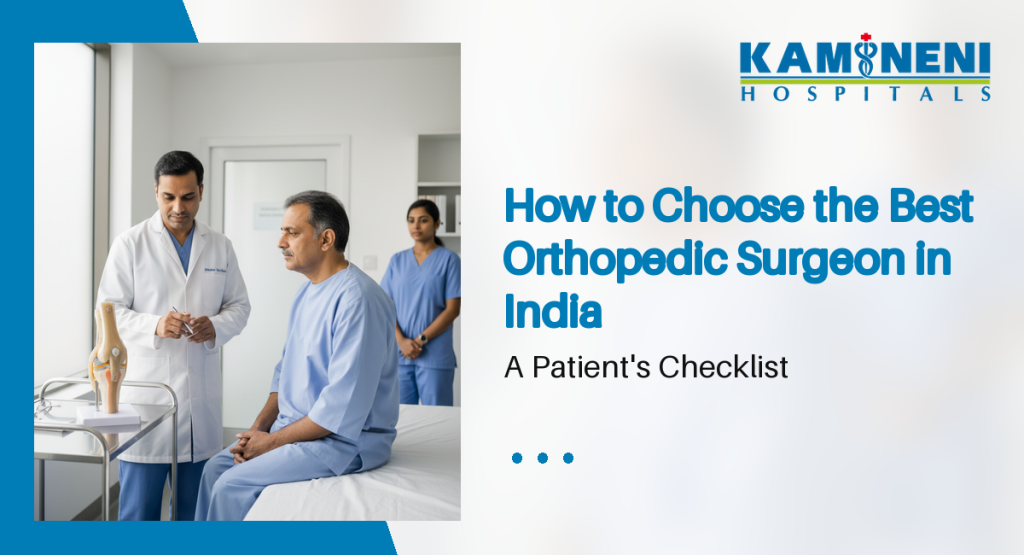
Best orthopedic surgeon in india is what you type when pain limits your walk, sleep, or work, and you need someone who can actually fix it. The right surgeon is not the one with the most ads, but the one whose daily practice matches your exact problem, whether that is a worn knee joint, a slipped disc, or a child’s curved spine. India has over 15,000 orthopedic surgeons registered with the Indian Orthopedic Association, so the challenge is filtering, not finding. At Kamineni Hospitals, our orthopedic team has handled complex joint replacements, spine procedures, and sports injuries for 34 years, with NABH and NABL accreditation backing every operation. This guide shows you the five specific checks that separate a qualified specialist from a general claim, so you book the right consultation the first time.
Key takeaways
- Subspecialty match matters more than reputation: a spine specialist will not give you the same result for a knee replacement as a joint surgeon.
- NABH hospital accreditation and surgeon board certification are verifiable credentials you should demand before consenting to surgery.
- Robotic-arm assisted surgery and minimally invasive techniques reduce incision size and recovery time when the surgeon is certified in that specific system.
- Cashless insurance coverage through 150 plus TPAs removes payment stress so you can focus on choosing care, not calculating costs.
- Emergency orthopedic access 24 hours a day protects you if post-operative complications or acute injuries arise outside office hours.
What does an orthopedic surgeon actually do?
An orthopedic surgeon treats disorders of bones, joints, muscles, ligaments, and tendons. The field splits into subspecialties, and most surgeons concentrate on one area after their core training. You should know which subspecialty matches your condition before you book.
- Joint replacement: hip, knee, and shoulder arthroplasty, including revision of failed earlier implants.
- Spine surgery: disc herniation, spinal stenosis, scoliosis, and trauma fractures of the vertebral column.
- Sports medicine: ligament tears, meniscus injuries, and shoulder rotator cuff repairs, often through arthroscopy.
- Pediatric orthopedics: congenital deformities, growth plate injuries, and adolescent scoliosis correction.
- Trauma and limb reconstruction: complex fractures, non-unions, and bone lengthening procedures.
- Hand and upper extremity: carpal tunnel, tendon repairs, and microvascular reconstruction.
The National Institutes of Health research in orthopedics notes that the specialty became independent from general surgery in India only in 1986, so experienced departments have decades of accumulated case complexity that newer units may lack. At Kamineni Hospitals, our Orthopedics department coordinates across joint replacement, spine, sports medicine, and trauma teams.
Which credentials prove a surgeon is qualified?
Board certification and hospital accreditation are the two credentials you can verify yourself. A surgeon should hold an MS Orthopedics or DNB Orthopedics degree, with additional fellowship training in their subspecialty. The hospital where they operate should carry NABH accreditation for patient safety standards and NABL accreditation for laboratory accuracy.
| Credential to check | What it means for you | How to verify |
|---|---|---|
| MS or DNB Orthopedics | Core surgical training in bone and joint disorders | Ask directly; check Medical Council of India registration |
| Fellowship in subspecialty | Additional year or more focused on spine, joint replacement, or sports medicine | Hospital website or direct question at consultation |
| NABH hospital accreditation | Audited standards for infection control, surgical safety, and patient rights | NABH website directory or hospital reception |
| NABL lab accreditation | Accurate pre-operative blood work, biopsy, and imaging reports | NABL website or hospital quality desk |
Kamineni Hospitals holds both NABH and NABL accreditation, and our orthopedic surgeons select tests from your symptoms and history rather than selling fixed packages. This diagnosis-first approach means you get the imaging and blood work your case actually needs. For patients also managing other conditions, our Cardiology and Neurology teams coordinate on complex cases where heart or nerve status affects surgical planning.
Does robotic or minimally invasive surgery mean a better surgeon?
Robotic-arm assisted surgery and minimally invasive surgery reduce tissue damage and blood loss when the surgeon is specifically certified on that system. The technology itself does not guarantee outcome; the surgeon’s case volume on that platform does. Ask how many procedures they have performed with the specific robotic system, not whether the hospital owns one.
- Mako or NAVIO robotic systems for knee and hip replacement require separate training modules and proctored cases.
- Arthroscopic repair uses a camera and small instruments; the surgeon’s hand skill matters more than the screen size.
- Minimally invasive spine surgery demands specialized retractors and imaging, with a learning curve of 50 to 100 cases for proficiency.
According to the National Institutes of Health review of orthopedic surgery practice patterns, most surgeons who publish and teach work in either private practice or academic centers with high case volumes. At Kamineni Hospitals, our joint replacement program includes both conventional and robotic-assisted approaches, chosen based on your bone quality, deformity severity, and activity goals, not as a default.
How do I know if a surgeon is the best orthopedic surgeon in india for my specific condition?
The best orthopedic surgeon in india for you is the one whose weekly practice closely matches your diagnosis. A surgeon who performs 200 knee replacements yearly will likely give you a smoother result for osteoarthritis than one who does 20 knees and 180 spine cases. Ask directly: “How many of my specific procedure did you perform last year?”
| Your condition | Subspecialty to seek | Question to ask |
|---|---|---|
| Knee or hip osteoarthritis | Joint replacement arthroplasty surgeon | “How many total knee replacements did you do last year?” |
| Slipped disc or spinal stenosis | Spine surgeon | “Do you perform microdiscectomy or laminectomy regularly?” |
| Sports injury, ligament tear | Sports medicine or arthroscopy specialist | “What is your ACL reconstruction volume annually?” |
| Child with scoliosis or limb deformity | Pediatric orthopedic surgeon | “Do you manage adolescent idiopathic scoliosis with bracing or surgery?” |
Our Spine Hospital team at Kamineni Hospitals focuses specifically on degenerative spine conditions, deformity, and trauma, with cross-consultation from Neuro Surgery when tumors or nerve compression require combined approaches. For joint problems, our Joint Replacement Hospital program handles primary and revision arthroplasty.
What should I ask about costs, insurance, and emergency coverage?
Financial transparency and emergency backup matter as much as surgical skill. A qualified surgeon at an accredited hospital should give you a written estimate, confirm cashless insurance coverage, and explain who covers you if complications arise at 2 a.m.
- Cost estimate: itemized breakdown of surgeon fee, implant cost, hospital stay, and physiotherapy.
- Insurance: confirmation that your TPA is recognized for cashless treatment; Kamineni Hospitals is recognized by 150 plus insurance TPAs.
- Emergency access: 24-hour critical care unit with orthopedic coverage for post-operative bleeding, infection, or fracture displacement.
- Rehabilitation: in-house physiotherapy and rehabilitation program with scheduled follow-up protocol.
Kamineni Hospitals runs its own emergency and critical care unit round the clock at each branch. Our Physiotherapy And Rehabilitation centre works with the orthopedic team from day one post-surgery, so your recovery plan starts before you leave the operating room. For patients traveling from Maharashtra’s manufacturing and BFSI sectors, where prolonged absence from work carries career cost, this coordinated recovery timeline protects both health and livelihood.
When should I see an orthopedic doctor instead of waiting?
Do not wait if joint pain prevents weight-bearing, back pain radiates down your leg with numbness, or a child’s walk looks uneven. These signs suggest structural problems that physiotherapy alone will not fix. Early specialist consultation preserves treatment options; delayed presentation often means more complex surgery later.
Specific warning signs:
- Knee or hip: pain at rest, night pain, visible deformity, or inability to climb stairs.
- Spine: leg weakness, loss of bladder or bowel control, or numbness in the saddle area.
- Trauma: bone visible through skin, limb angled abnormally, or severe swelling after injury.
- Child: limp that persists beyond two weeks, one leg visibly shorter, or progressive spinal curve.
If you notice any of these, contact Kamineni Hospitals at +91 70362 70362 for same-day orthopedic evaluation. Do not drive yourself if pain is severe or if you suspect fracture; arrange transport or call emergency services. Our Best Heart Hospitals in Hyderabad, India cardiac team also stands ready for patients whose orthopedic condition coexists with cardiac risk factors, ensuring safe anesthesia planning.
Choosing the best orthopedic surgeon in india means matching subspecialty expertise to your condition, verifying NABH accreditation and surgeon credentials, and confirming emergency coverage and insurance recognition. Kamineni Hospitals brings 34 years of multispeciality care, 40 plus specialty departments, and round-the-clock emergency units to every orthopedic consultation. Call +91 70362 70362 to book an evaluation with our joint replacement, spine, or sports medicine team.
FAQs
When to see an orthopedic doctor?
See an orthopedic doctor when joint pain limits walking or daily activities, back pain radiates to the legs with numbness, a limb looks deformed after injury, or a child's limp persists beyond two weeks. These signs suggest structural bone or joint problems that need specialist imaging and possible intervention.
Do I need a referral to see an orthopedic doctor?
Most hospitals in India accept direct orthopedic appointments without a referral. Kamineni Hospitals schedules direct consultations; bring any prior X-rays, MRI reports, and a list of current medications to your first visit.
What do orthopedic surgeons do differently from general physicians?
Orthopedic surgeons operate on bones, joints, muscles, and tendons after completing five and a half years of MBBS plus three years of MS or DNB Orthopedics training. General physicians manage medical conditions with medication; orthopedic surgeons use both surgical and non-surgical methods for musculoskeletal disorders.
How do I verify a surgeon's robotic surgery certification?
Ask the surgeon directly which robotic system they are certified on, how many proctored cases they completed, and their annual volume on that platform. Certification is device-specific; a surgeon trained on Mako is not automatically qualified on NAVIO.
What questions should I ask at my first orthopedic consultation?
Ask: What is my exact diagnosis? What are non-surgical and surgical options? How many of this specific procedure do you perform yearly? What implant brand and warranty do you use? What does recovery look like week by week? What complications should I watch for?
Does health insurance cover joint replacement surgery in India?
Most health insurance policies cover joint replacement after a waiting period, typically two to four years from policy start. Kamineni Hospitals is recognized by 150 plus insurance TPAs for cashless treatment; bring your policy card and TPA details to the hospital's insurance desk for pre-authorization before admission.