

Legs felt heavy two days after a stomach bug. By the next morning, climbing stairs wasn’t possible. And by evening, the floor couldn’t be felt properly. That progression is the pattern that defines Guillain-Barré Syndrome.
While fighting an infection, the immune system turns on the body’s own peripheral nerves, stripping away the myelin sheath that allows nerves to carry signals. When those signals slow or stop, muscles stop receiving instructions. Weakness follows and it can reach the breathing muscles within days.
At Kamineni Hospitals, LB Nagar, the Neurology team manages neuromuscular conditions including GBS with NCS, MRI, CSF analysis, IVIg therapy, ICU support, and rehabilitation with 34+ years of multispeciality care experience.
This guide by our specialists covers everything families and patients need to understand about GBS : symptoms, causes, diagnosis, treatment, and recovery.
What Is Guillain-Barré Syndrome?
Guillain-Barré Syndrome is an autoimmune condition where the body’s immune system mistakenly attacks the peripheral nerves causing weakness, numbness, and in severe cases, paralysis.
Peripheral nerves carry signals between the brain and the rest of the body.
- In GBS, the immune system damages the myelin sheath surrounding those nerves.
- When that sheath is stripped away, signals slow down or stop altogether.
- Muscles stop receiving instructions.
- Weakness follows.
What makes GBS dangerous is how fast it moves. Because early guillain-barré syndrome symptoms are subtle : a bit of numbness, clumsy fingers, a heavy feeling in the legs and many patients lose 24 to 48 hours before they reach a neurologist.
What Are the Symptoms of Guillain-Barré Syndrome?
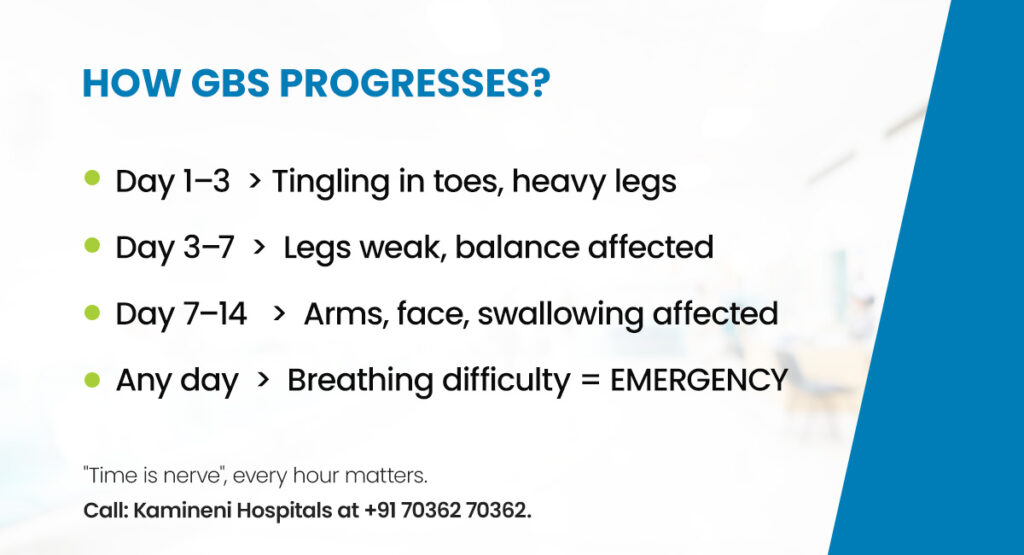
Guillain-Barré Syndrome symptoms follow a predictable ascending pattern, tingling and weakness starting in the legs and feet, moving upward through the body over days, sometimes reaching the face and breathing muscles within two weeks.
How Symptoms Progress Day By Day:
- Days 1–3: Tingling or numbness in the toes and fingertips. A heavy, tired feeling in the legs.
- Days 3–7: Leg weakness becomes harder to ignore. Climbing stairs is difficult. Balance is affected. Arms begin to weaken.
- Days 7–14: Weakness continues moving upward. Face muscles may be affected, difficulty smiling, swallowing food, or speaking clearly.
The Red Flag That Makes GBS An Emergency
When weakness reaches the respiratory muscles, the patient can no longer breathe deeply. This is when GBS becomes immediately life-threatening and it can happen within a week of the first symptom.
Watch for:
- Breathlessness that wasn’t there before
- Speaking in short sentences because a full breath isn’t possible
- Inability to count to 20 in one breath.
If it’s happening, visit the best multispeciality hospital in LB Nagar now.
What Causes Guillain-Barré Syndrome?
Guillain-Barré Syndrome is almost always triggered by an infection that occurred 2 to 6 weeks earlier. The immune system, while clearing that infection, produces antibodies that mistakenly attack the peripheral nerves.
Common Guillain- Barré Causes:
- Campylobacter Jejuni (Bacterial) : Found in contaminated water and undercooked chicken. A mild diarrhoeal illness from this bacteria can lead to GBS weeks later without the connection being obvious.
- Viral Respiratory Infections : Influenza, COVID-19, Epstein-Barr virus, cytomegalovirus. A routine flu or cold can trigger GBS in susceptible individuals.
- Gastroenteritis : Any diarrhoeal illness, even one that felt mild and resolved quickly can set off the immune response that leads to GBS two to six weeks later.
- Rarely: Surgery, trauma, or vaccination.
Prevention After The 2025 Pune Outbreak:
- Drink safe water : boil, filter with RO or UV, or use bottled water in areas with uncertain supply
- Cook chicken thoroughly at internal temperature of at least 75°C
- Wash hands with soap for 20 seconds before eating and after using the toilet
How Is Guillain-Barré Syndrome Diagnosed?
Guillain-Barré Syndrome is diagnosed clinically first, ascending bilateral weakness after a recent infection, with absent or reduced reflexes and confirmed through nerve conduction studies and cerebrospinal fluid analysis.
A neurologist who sees ascending weakness, absent knee-jerk reflexes, and a history of recent infection has strong grounds for a GBS diagnosis before any test’s back.
Confirming tests:
- Nerve conduction studies (NCS)
- CSF analysis (lumbar puncture)
- MRI spine
- Anti-ganglioside antibody blood tests
How Is Guillain-Barré Syndrome Treated at Kamineni Hospitals?
GBS treatment at Kamineni Hospitals works on one principle : the concept of “time is nerve” should be rooted in practice, and immunomodulatory therapy should be initiated at the earliest. Every day of delay means more nerve damage and a longer recovery.
Two Evidence-Based Guillain-Barré Treatment:
- IVIg (Intravenous Immunoglobulin) : Concentrated antibodies from healthy donors, given intravenously over five days; they neutralise the ones attacking the peripheral nerves; it’s the most commonly used treatment in India.
- Plasma exchange (plasmapheresis) : Blood plasma is removed and replaced, eliminating the harmful antibodies from circulation; equally effective as IVIg.
Both treatments reduce GBS severity and shorten recovery time. They don’t cure the condition, the nerve repair happens through the body’s own healing .
At Kamineni Hospitals NCS, MRI, CSF analysis, IVIg therapy, ICU care, and rehabilitation are all available under one roof so assessment, treatment, and recovery happen in one place.
Can You Recover from Guillain-Barré Syndrome?
Recovery from Guillain-Barré Syndrome depends on how quickly treatment started, which subtype of GBS the patient has, how severe the peak weakness was and most patients do regain functional independence with time and rehabilitation.
Recovery Timeline:
- Weeks 1–4: Symptoms peak, then plateau. Upward progression stops. Symptoms plateau.
- Months 1–6: Slow improvement begins. Most patients regain the ability to walk within 6 months of onset.
- Months 6–24: Continued improvement. Nerve repair takes time, recovery can continue for up to 2 years.
What Helps Recovery:
- Earlier treatment, less nerve damage to repair
- Less severe peak weakness
- Age under 60, nerves regenerate faster in younger patients
- Consistent physiotherapy and rehabilitation from early in the illness
Expert Neurology Care for GBS at Kamineni Hospitals.
GBS moves fast. Assessment, diagnosis, and treatment decisions all need to happen within hours not days of recognising the symptoms.
At Kamineni Hospitals, the Neurology team provides same-day emergency neurological evaluation, NCS, MRI, CSF analysis, IVIg therapy, ICU support, and physiotherapy within a NABH and NABL-accredited multispeciality hospital with 34+ years of clinical experience and 150+ insurance TPA recognition.
Dr. M. Lakshmi Lavanya (MBBS, MD, DM Neurology, Gold Medalist : Sr. Consultant Neurologist), Dr. Kamlesh M Chawda (MBBS, MD : Consultant Neurologist), and Dr. Nareddy Sandeep Reddy (MD, DM Neurology, PGIMER Chandigarh : Consultant Neurologist) lead the neurology team.
Call to book an appointment: +91 70362 70362.
Disclaimer: This content is for general patient education only. Guillain-Barré Syndrome is a medical emergency. Do not use this content to delay seeking immediate neurological evaluation. If someone shows signs of ascending weakness after a recent infection, go to the nearest hospital immediately. This does not replace consultation, diagnosis, or treatment from a qualified neurologist. Please consult the specialists at Kamineni Hospitals for personalised guidance.
Frequently Asked Questions
How do I know if I have Guillain-Barré Syndrome?
Ascending weakness starting in the legs and feet, moving upward after a stomach bug or respiratory infection in the past 2 to 6 weeks. Tingling, clumsiness, and disappearing knee-jerk reflex are early signs. Go to a neurologist the same day.
How long does GBS last?
Symptoms peak within 2 to 4 weeks, then plateau. Most patients start improving within one to three months. Walking’s returned for most within six months. Full recovery can take up to two years.
Is GBS contagious?
GBS itself isn’t contagious, it can’t spread from person to person. Infections that trigger it, like Campylobacter from contaminated water or food, can spread.
What is the best neurology hospital in LB Nagar for GBS treatment?
Kamineni Hospitals offer NCS, MRI, CSF analysis, IVIg therapy, ICU support, physiotherapy, NABH and NABL accredited, 34+ years, led by Dr. M. Lakshmi Lavanya and team. Call +91 70362 70362.