



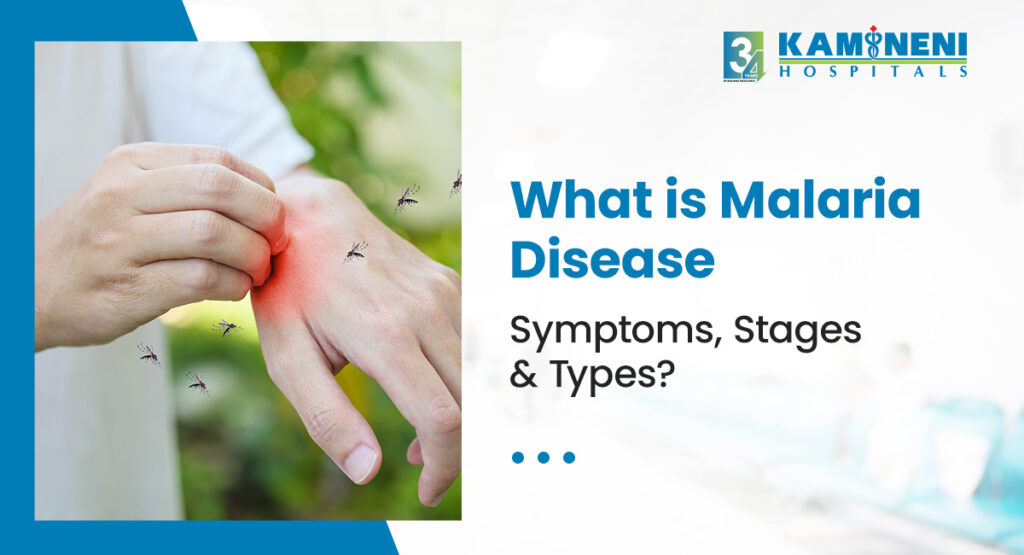
The fever broke last night. This morning it’s back with chills so bad that the patient is shaking under two blankets. That pattern is the clue to malaria.
Malaria is a parasitic infection that spreads through the bite of an infected Anopheles mosquito. Once the parasite enters the blood, it invades red blood cells and multiplies until the cells burst. That’s what causes the fever cycle.
Our general medicine and emergency teams at Kamineni Hospitals run same-day malaria smear and rapid diagnostic tests so the species is confirmed before treatment starts. Backed by 34+ years of multispeciality care, we’re here when the fever keeps returning.
What Are the Symptoms of Malaria Disease?
Malaria disease symptoms in Hyderabad typically appear 7 to 30 days after a mosquito bite and unlike most fevers, they come and go in predictable cycles rather than staying constant.
Early Symptoms : What the First Episode Feels Like?
- Sudden, intense chills and shivering
- High fever : 38.5°C to 40°C, sometimes higher
- Severe headache
- Muscle and joint pain
- Nausea and vomiting
- Fatigue and weakness
Why the Fever Cycles Joins?
The fever isn’t constant. It comes in episodes.
Chills hit first ➡ ️ temperature spikes ➡ ️ sweating begins ➡ the fever drops briefly ➡ then it starts again.
Cycling happens every 48 hours in P. vivax and P. ovale, and every 72 hours in P. malariae. That repetition is what separates malaria from dengue and a standard viral fever .
Severe Malaria Warning Signs : Go to Emergency Immediately:
These aren’t regular malaria symptoms. They mean the infection has advanced.
- Confusion, seizures, or loss of consciousness
- Difficulty breathing or rapid breathing
- No urination for several hours
- Skin turning yellow (jaundice)
- Vomiting that won’t stop
- Fever above 39°C not responding to paracetamol after 24 hours
Children under 5, pregnant women, adults over 60, and anyone with diabetes or kidney disease deteriorate faster than healthy adults. Don’t wait to see whether these symptoms settle.
What Are the Three Stages of Malaria Disease?
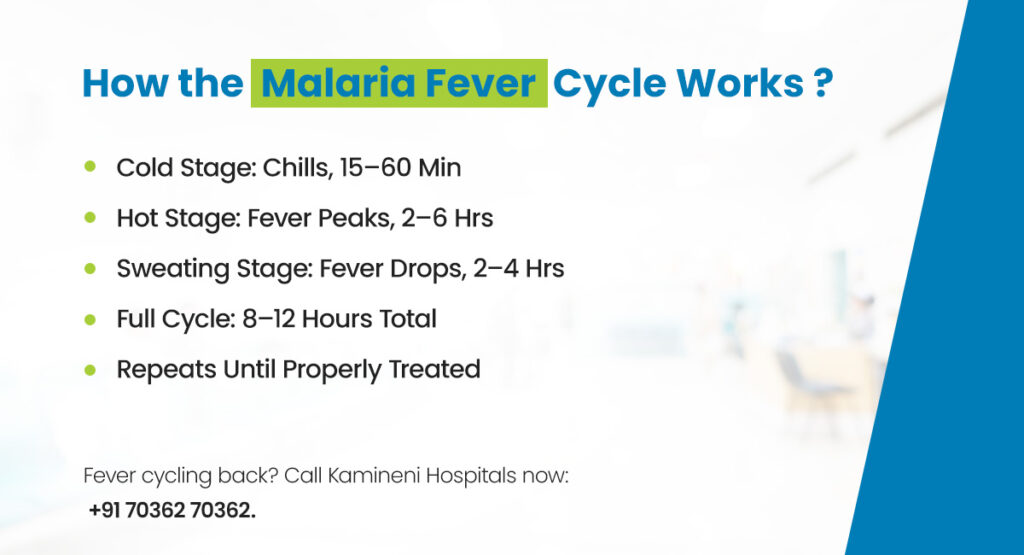
Malaria disease progresses through three clinical stages : cold, hot, and sweating and each malaria disease stages follow the other in a sequence.
Cold Stage : 15 to 60 minutes
Sudden intense chills arrive without warning. Skin feels cold and the patient shivers uncontrollably. Confusing part: the body’s temperature is actually rising internally while the skin feels cold.
Hot Stage : 2 to 6 hours
Fever peaks. Temperature climbs to 39°C to 41°C. Headache becomes severe. Nausea and vomiting are common. Skin turns hot, dry, and flushed. This is the stage where most people reach for paracetamol.
Sweating Stage : 2 to 4 hours
Fever drops rapidly. Exhaustion sets in but briefly, the patient feels almost normal. This is the window many people mistake for recovery. But that’s wrong. The cycle repeats.
Running through cold, hot, and sweating stages takes 8 to 12 hours. Then back to the beginning. Every repetition destroys more red blood cells and depletes the body further.
What Are the Types of Malaria Disease?
Five plasmodium parasite species cause malaria in humans where P. vivax accounts for more than half of all malaria infections, while P. falciparum is the most dangerous.
| Species | Risk Level | What Makes It Different | India Prevalence |
| P. vivax | Moderate | Dormant liver stage, can relapse months to years later | Most common |
| P. falciparum | Highest | Causes cerebral malaria and organ failure | Most dangerous |
| P. malariae | Low to moderate | Chronic, long-lasting; 72-hour fever cycle | Uncommon |
| P. ovale | Low | Similar to vivax and can also relapse | Rare in India |
| P. knowlesi | Variable | Spreads from monkeys to humans | Very rare |
P. vivax:
Most people think malaria ends with treatment. With P. vivax, sometimes it doesn’t. Dormant parasites sitting in the liver can reactivate weeks or months after the original infection. That second fever episode is a relapse, and clearing it requires a specific medicine called primaquine e.
P. falciparum:
Fever from malaria disease types P. falciparum doesn’t cycle as clearly. Cerebral malaria can develop within 24 to 72 hours of untreated infection. Any suspected falciparum case is a medical emergency from the moment the diagnosis is considered.
How Is Malaria Diagnosed and When Should You Go to a Hospital?
Malaria diagnosis requires a blood test, either a rapid diagnostic test or a blood smear because symptoms alone can’t confirm the species or rule out a co-infection with dengue.
Two Tests Used And What Each Does:
- Rapid Diagnostic Test (RDT) : Detects malaria antigens in the blood within 15 to 20 minutes.
- Blood smear (peripheral smear) : A stained blood sample examined under a microscope, it identifies the exact Plasmodium species and parasite density.
Starting the wrong antimalarial drug wastes time the patient may not have.
Go to a multi speciality hospital in Hyderabad if:
- Fever comes and goes in cycles of chills, peak, and sweating
- Fever above 39°C not responding to paracetamol
- Fever in a child under 5 or adult over 60
- Fever returning weeks after a previous malaria
Fast Track to Malaria Diagnosis and Treatment with Kamineni Hospitals.
Malaria is treatable. Cases that go wrong are almost always ones where the cyclic fever got mistaken for a viral infection, or where P. falciparum was given 48 hours to progress unchecked.
At Kamineni Hospitals, same-day malaria smear and RDT are run so the species is identified and treatment is started without delay. Patients access the LB Nagar unit regularly for fever evaluation and monsoon illness management. If you are searching for the best emergency hospital near me with round-the-clock diagnostics and specialist backup, call +91 70362 70362.
Disclaimer: This content is for general patient education only. It does not replace medical consultation, diagnosis, or treatment advice from a qualified doctor. Please consult a specialist at Kamineni Hospitals for personalised guidance based on your symptoms and medical history.
Frequently Asked Questions
How is malaria different from dengue fever?
Malaria fever cycles include chills, peak, sweating, brief relief, then it starts again. Dengue hits hard and stays constant. Malaria’s mosquito bites at night; dengue’s bites during the day.
What does malaria feel like on the first day?
Sudden chills that won’t stop, followed by a spiking fever and bad headache. It often feels like a severe flu at first. What’s unusual is the shivering, intense enough that the body shakes.
Can malaria come back after treatment?
With P. vivax and P. ovale, yes. These species leave dormant parasites in the liver even after the blood-stage infection clears. Weeks or months later, those parasites reactivate and cause another fever episode.
What is the most dangerous type of malaria?
P. falciparum. It progresses faster than other types, doesn’t always follow a clear cycle, and can cause cerebral malaria. It can also cause kidney failure, severe anaemia, and respiratory distress.
What is the best emergency hospital near me for malaria in Hyderabad?
For patients in East Hyderabad, LB Nagar, Dilsukhnagar, Nagole, and surrounding areas Kamineni Hospitals, runs round-the-clock emergency care with same-day malaria smear and RDT, fever evaluation, and multispeciality backup. Call +91 70362 70362.