




Most of the time the first clue is very small. Swelling in the feet, a tiredness that does not improve even after rest. Or a routine blood report that suddenly shows something abnormal.
This is how chronic kidney disease appears in real cases. Not as a sudden illness, but as scattered symptoms that do not feel connected initially.
Chronic Kidney Disease is a condition where the kidneys lose their ability to filter waste from the blood slowly, but still the body keeps adjusting to it as long as possible.
Patients at Kamineni Hospitals are diagnosed at different stages. Some arrive early during routine tests. Others arrive when kidney function has already dropped a lot. The treatment approach changes depending on the stage, but the goal remains the same. To protect the remaining kidney function and guide clearly about what comes next.
Thus, understanding the chronic kidney disease causes, and chronic kidney disease symptoms becomes important before looking at treatment options or transplant discussions.
What Actually Causes Chronic Kidney Disease?
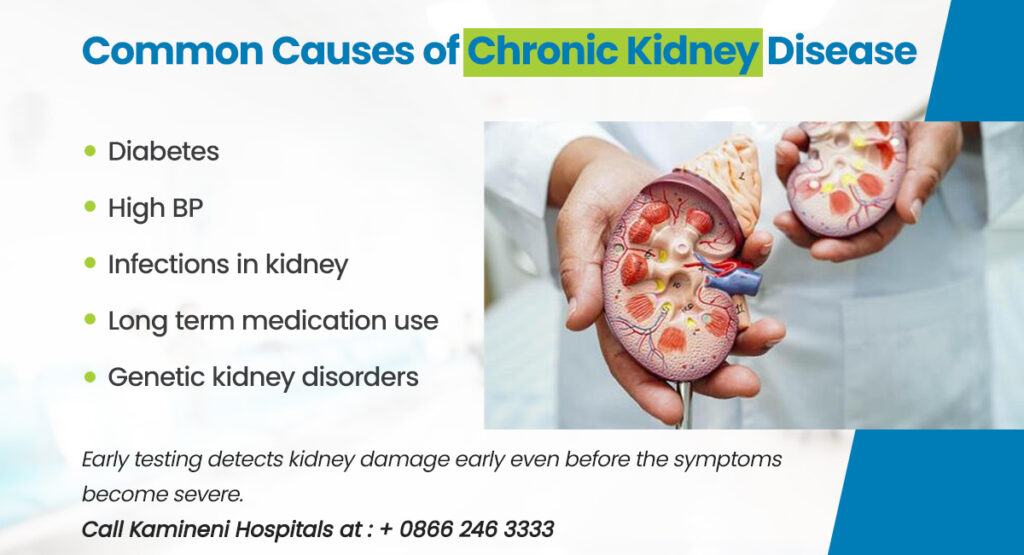
Most patients have a combination of long term conditions that slowly affect kidney function. The most common chronic kidney disease causes doctors see every day, include diabetes and high blood pressure. These two silently damage the tiny filtering units of the kidneys over time.
Even moderately uncontrolled diabetes for years can gradually weaken kidney function. And a high BP works in a similar way. Constant pressure inside blood vessels slowly reduces kidney efficiency.
Other causes doctors often find are:
- Repeated kidney infections
- Long standing kidney stones causing blockage
- Certain painkiller overuse
- Genetic kidney conditions in some families
What are the Symptoms Patients Usually Notice?
This is where most confusion begins. Because symptoms are not obvious at first. A patient may just feel slightly more tired than usual. Or notice mild swelling in the ankles in the evening. Some people ignore it thinking it is heat, travel, or workload.
But with time, the repeated patterns start appearing.
Some common chronic kidney disease symptoms are:
- Swelling in feet or face that keeps returning
- Unusual fatigue
- Appetite loss
- Changes in urine amount or frequency
- Foamy urine in some cases
- Difficulty concentrating
- Uncontrolled BP
One important thing doctors at the best kidney transplant hospital in Hyderabad tell families is this; the body adjusts quietly. So even when kidney function is dropping, patients may feel “mostly fine” until a significant stage is reached.
That is why diagnosis often comes late.
How do Doctors Confirm Chronic Kidney Disease?
Simple tests help doctors understand and decide Whether the kidney damage is reversible, stable, or progressing. And the kidney transplant in Vijayawada depends heavily on this answer.
Doctors look at:
- Creatinine levels in blood
- eGFR (kidney function percentage)
- Urine protein leakage
- Ultrasound changes in kidney size
- Blood pressure patterns
How is Chronic Kidney Disease Treated in Real Clinical Practice?
The chronic kidney disease treatment plan is never the same for every patient. Doctors divide it into stages.
In early stages, treatment is mostly about control. Blood sugar is managed carefully. Blood pressure is stabilised. Diet becomes more structured, especially salt and protein intake. Patients are also asked to avoid unnecessary painkillers as they can add stress on the kidneys.
At this stage, many patients live stable lives for years if follow-up is regular.
But when kidney function declines further, treatment shifts.
Some patients require dialysis. Dialysis is not a cure. It is support. It replaces some functions of the kidney like cleaning waste and balancing fluids.
And in advanced stages, doctors may discuss a kidney transplant.
When kidney function becomes very low, and dialysis is long term, transplant becomes the option that offers better long-term quality of life in suitable patients.
Families sometimes explore options for the best kidney transplant hospital in Hyderabad, depending on accessibility and specialist availability. Each case is evaluated carefully before any decision.
When Should Families Worry And Consult a Doctor?
Not every symptom means kidney disease, but some patterns should not be ignored. If swelling returns, fatigue increases without any clear reason, or blood pressure becomes difficult to control, it is worth checking and considering a kidney transplant in Vijayawada.
Especially in patients with diabetes or hypertension.
Because early detection changes everything in kidney disease. Late detection limits options.
Can Chronic Kidney Disease be Slowed Down?
In many patients, chronic kidney disease can be slowed down. But it depends on when it is diagnosed. Doctors usually focus on:
- Strict diabetes control
- Stable BP management
- Avoiding medications that stress the kidneys
- Regular monitoring
- Diet changes based on stage
As kidney disease progresses slowly, small changes matter more because they work slowly but consistently.
Book Kidney Consultation at Kamineni Hospitals
Chronic kidney disease is not a sudden illness. It is a gradual decline in kidney function that often goes unnoticed in the beginning. What matters most is timing.
When detected early, progression can be slowed significantly with medical management. When detected late, treatment focuses more on dialysis and transplant planning.
At Kamineni Hospitals, kidney care is managed through nephrologists, dialysis specialists, and transplant teams working together. The aim is not just treatment, but helping families understand what stage the disease is in and what can realistically be done next.
If symptoms like swelling, fatigue, or long standing diabetes and hypertension are present, early evaluation can give clarity before the condition progresses further.
Call : +91 70362 70362
Disclaimer: This blog is intended for educational and informational purposes only. It should not be considered medical advice, diagnosis, or treatment. Please consult a qualified healthcare professional for any medical concerns or decisions.
Frequently Asked Questions
What is the most common cause of kidney disease?
Diabetes and high blood pressure are the most common causes. They slowly damage kidney filtering units over time without early symptoms.
Can kidney disease be detected early?
Yes, simple blood and urine tests can detect it early. The challenge is that symptoms often appear late.
Is kidney transplant always required in CKD?
No. Transplant is only needed in advanced stages. Many patients are managed for years with medication and monitoring.
What happens if kidney disease is ignored?
It can gradually progress to kidney failure, requiring dialysis or transplant in later stages.