

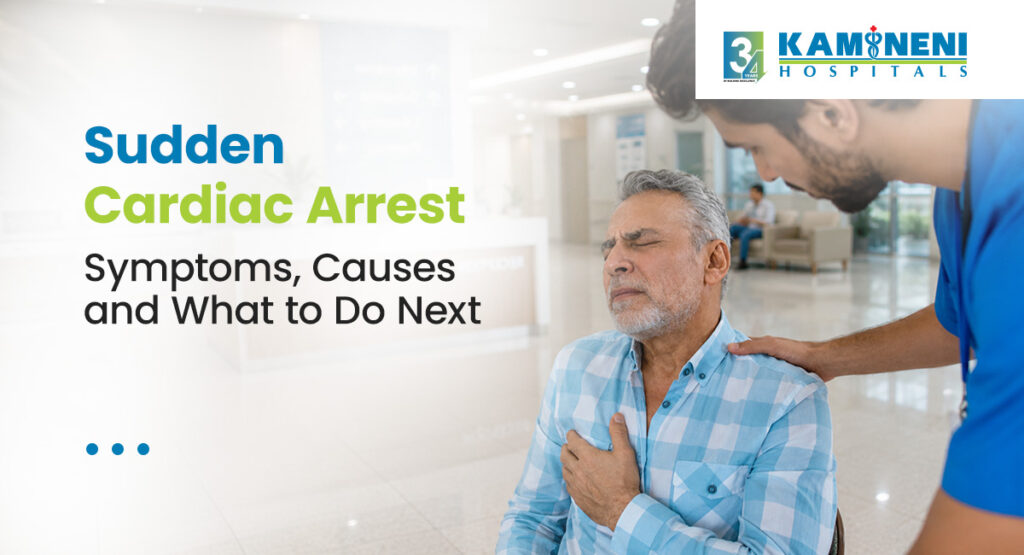
We read about it in the news more than we should. A 42-year-old collapses at the gym. A person drops mid-conversation. No prior diagnosis. No warning. Just sudden unconsciousness, and cardiac death within minutes if no one steps in.
Most people assume this is a heart attack. It is not. Sudden cardiac arrest is a different emergency with different causes, and the warning signs appear hours or days before, in most cases, if you know what to look for.
At Kamineni Hospitals, our cardiology teams at LB Nagar and King Koti have managed cardiac emergencies for 34+ years. What we see most often: patients who had warning signs they either ignored or misread.
This blog covers what those signs are, what causes cardiac arrest and what to do when it happens.
What Is Sudden Cardiac Arrest?
Sudden cardiac arrest happens when the heart’s electrical system fails. The heart stops beating. Blood stops reaching the brain and the rest of the body. Brain damage starts in four to six minutes. Death follows if no treatment arrives. This is not a slow emergency.
Most people link cardiac arrest to a heart attack, but they work differently.
Sudden Cardiac Arrest vs Heart Attack: What’s the Difference!
| Sudden Cardiac Arrest | Heart Attack | |
| What happens | Electrical failure; heart stops beating | Blocked artery; heart muscle loses blood supply |
| Consciousness | Person collapses, becomes unresponsive | Person is usually conscious and in pain |
| Pulse | Absent | Usually present |
| Breathing | Absent or gasping | Usually present |
| Immediate action | CPR + defibrillation | Emergency hospital care |
| Link between them | A heart attack can trigger SCA | Does not directly cause SCA always |
A heart attack increases the risk of cardiac arrest. But cardiac arrest can also happen in people with no known heart disease, which is what makes it so dangerous.
What Are the Symptoms of Sudden Cardiac Arrest?
Cardiac arrest does not always come without warning. The body often signals something is wrong well before the event. The trouble is that most people miss it or explain it away.
Warning Signs That Can Appear Before Cardiac Arrest
These sudden cardiac arrest symptoms may show up in the hours or days before an event:
- Chest discomfort or pressure that comes and goes
- Shortness of breath with no obvious cause, even at rest
- Heart palpitations: a racing, fluttering or pounding feeling in the chest
- Dizziness or lightheadedness without a clear reason
- Fainting or near-fainting episodes
- Fatigue that feels different from normal tiredness, heavier and harder to explain
None of these symptoms confirms cardiac arrest on its own. But for someone with known heart disease, high blood pressure, or a family history of cardiac events, these signs need attention the same day.
Symptoms at the Moment of Cardiac Arrest
When cardiac arrest occurs:
- The person collapses suddenly
- No pulse
- No normal breathing, or only occasional gasping
- Complete loss of consciousness
- No response to voice or physical touch
At this point, minutes matter more than anything else. Start CPR and call emergency services. Those two actions, started fast, are what determine whether someone survives.
What Causes Sudden Cardiac Arrest?
Sudden cardiac arrest causes trace back to an electrical failure in the heart, not a blocked artery. That distinction changes everything about how it is treated.
What Is Ventricular Fibrillation and Why Does It Cause Cardiac Arrest?
The heart runs on electrical signals that coordinate each beat. In most SCA cases, those signals go chaotic. The ventricles, the heart’s main pumping chambers, fire rapidly and out of sync instead of in a steady rhythm. Doctors call this ventricular fibrillation (VF).
The heart quivers. It does not pump. Blood stops. The brain loses oxygen within seconds.
A defibrillator delivers a controlled electric shock to reset the rhythm. AEDs in public spaces exist for exactly this reason.
What Other Conditions Trigger Sudden Cardiac Arrest?
Beyond ventricular fibrillation, these conditions drive sudden cardiac arrest:
- Coronary artery disease: Narrowed arteries reduce blood supply to the heart and trigger dangerous rhythms. This is the most common underlying condition.
- Previous heart attack: Scar tissue from an old heart attack disrupts electrical pathways. The first six months after a heart attack carry the highest SCA risk.
- Cardiomyopathy: A thickened or enlarged heart muscle develops arrhythmias more easily and does not pump well.
- Congenital heart defects: Some people are born with electrical abnormalities that cause no symptoms until an event occurs. This is the leading cause of SCA in adults under 35.
- Uncontrolled hypertension: Years of high blood pressure change the heart’s structure and disrupt its electrical system.
- Low potassium or magnesium: Electrolyte imbalances from dehydration or certain medicines can trigger fatal rhythms.
- Drug-induced arrhythmia: Some medicines prescribed for arrhythmia can, in certain patients, cause dangerous rhythms rather than prevent them.
After a cardiac arrest event, identifying which of these caused it guides the prevention plan. That is why evaluation after SCA always includes finding the root trigger, not just treating what happened.
What Should You Do When Someone Has a Cardiac Arrest?
A person in cardiac arrest needs CPR to be started within the first two minutes. Every minute it is delayed reduces survival by roughly 10%.
- Check responsiveness. Tap the shoulder, call the name loudly. No response means act now.
- Call for emergency help. In India, dial 112 or the hospital emergency number. If someone else is nearby, send them to call while you start CPR.
- Start CPR. Both hands on the centre of the chest. Push hard and fast, 100 to 120 compressions per minute. Keep going.
- Use an AED if one is available. Turn it on. Follow the voice instructions. It will guide you through exactly what to do.
- Do not stop. Continue until emergency help takes over or the person regains responsiveness.
You do not need medical training for this. Starting CPR immediately, even imperfectly, keeps oxygen moving to the brain until trained help arrives.
Who Is at Risk of Sudden Cardiac Arrest?
Sudden cardiac arrest does not only affect elderly or unwell people. Several groups face higher risk:
- People with a prior heart attack or coronary artery disease
- People diagnosed with arrhythmia or cardiomyopathy
- People with uncontrolled high blood pressure
- People with a family history of sudden cardiac death before age 50
- Men over 45 and women over 55, though younger adults are not exempt
- Athletes and active individuals with undetected congenital electrical abnormalities
- People with diabetes or chronic kidney disease affecting heart function
- People who smoke, are sedentary or have untreated obstructive sleep apnea
In India, sudden cardiac arrest in men between 30 and 50 is rising.
Hypertension goes undiagnosed for years. Stress levels are high. Preventive cardiac screening remains low. These factors together create risk that accumulates silently.
When Should You See a Cardiologist Before It Happens?
Most cardiac arrest survivors had no formal heart diagnosis before the event. That is the case that keeps cardiologists up at night, because those events are often preventable with earlier evaluation.
See a cardiologist if any of these apply to you:
- Unexplained palpitations, dizziness or fainting episodes, even once
- High blood pressure with no full cardiac assessment done yet
- A parent or sibling had a cardiac event or sudden cardiac death before age 50
- Diabetes, kidney disease or a prior heart attack on your history
- Chest discomfort during or after physical activity
- A previous doctor flagged an irregular heartbeat
A cardiac evaluation does not mean something is wrong. It means finding out while there is still time to act. Tests like an ECG, echocardiogram, and Holter monitor detect electrical abnormalities and structural problems that raise SCA risk, sometimes years before anything happens.
If you already had a cardiac event and want a second look at your diagnosis or treatment plan, a cardiac second opinion at Kamineni Hospitals gives you clarity from a different specialist team, on your terms.
Book Your Consultation at the Best Cardiac Hospital in Hyderabad
Cardiac arrest risk does not announce itself. It accumulates, and a cardiologist can find it before it becomes an emergency.
Kamineni Hospitals, one of the best cardiac hospitals in Hyderabad, has dedicated cardiology departments at LB Nagar and King Koti. Each unit offers ECG, echocardiography, Holter monitoring, and angiography on-site, alongside experienced cardiologists, cardiothoracic surgeons, and 24/7 emergency cardiac care.
With 34+ years of experience, 40+ specialty departments, and 16 million+ lives cared for across South India, Kamineni Hospitals treats SCA risk linked to arrhythmia, hypertension, diabetes, and coronary artery disease, all within the same hospital.
Cardiac second opinions are available at all three units. Our specialists review your reports, walk you through your options, and help you understand your diagnosis clearly before you make any decisions.
LB Nagar: +91 70362 70362 | King Koti: +91 78159 78159
Disclaimer: This blog is intended for educational and informational purposes only. It should not be considered medical advice, diagnosis, or treatment. Please consult a qualified healthcare professional for any medical concerns or decisions.
Frequently Asked Questions About Sudden Cardiac Arrest
Can sudden cardiac arrest happen to young people?
Yes. In people under 35, congenital electrical abnormalities in the heart are the leading cause of sudden cardiac arrest. These conditions often go undetected because they cause no symptoms until an event occurs. Athletes are particularly affected because intense physical activity can trigger arrhythmias in a structurally abnormal heart.
Is sudden cardiac arrest always fatal?
No. Survival depends entirely on how fast treatment begins. CPR within the first two minutes and defibrillation within five minutes can increase survival rates significantly. Most out-of-hospital cardiac arrests are fatal because bystanders do not start CPR and no AED is available nearby.
What is a cardiac second opinion and when do you need one?
A cardiac second opinion is a consultation with a different cardiologist or cardiac team to review your diagnosis, test results and proposed treatment. You need one if you have been told you need cardiac surgery, if your symptoms continue despite treatment, if your diagnosis feels unclear, or if you want to better understand your risk before making a treatment decision. Kamineni Hospitals offers cardiac second opinions at LB Nagar and King Koti.
Can sudden cardiac arrest be prevented?
Not always. But risk can be significantly reduced. Treating hypertension and diabetes, managing cholesterol, getting regular cardiac check-ups, avoiding smoking and knowing your family history are all proven steps. People with known arrhythmias may be advised to have an implantable defibrillator fitted, which can detect and correct a dangerous rhythm before cardiac arrest occurs.
What tests detect sudden cardiac arrest risk before it happens?
An ECG checks the heart’s electrical pattern at rest. A Holter monitor records the heart rhythm over 24 to 48 hours to capture intermittent arrhythmias. An echocardiogram shows the heart’s structure and pumping function. A stress test checks how the heart behaves during exertion. If an arrhythmia is suspected, an electrophysiology study maps the heart’s electrical pathways in detail. Your cardiologist will recommend the right tests based on your symptoms and risk profile.