



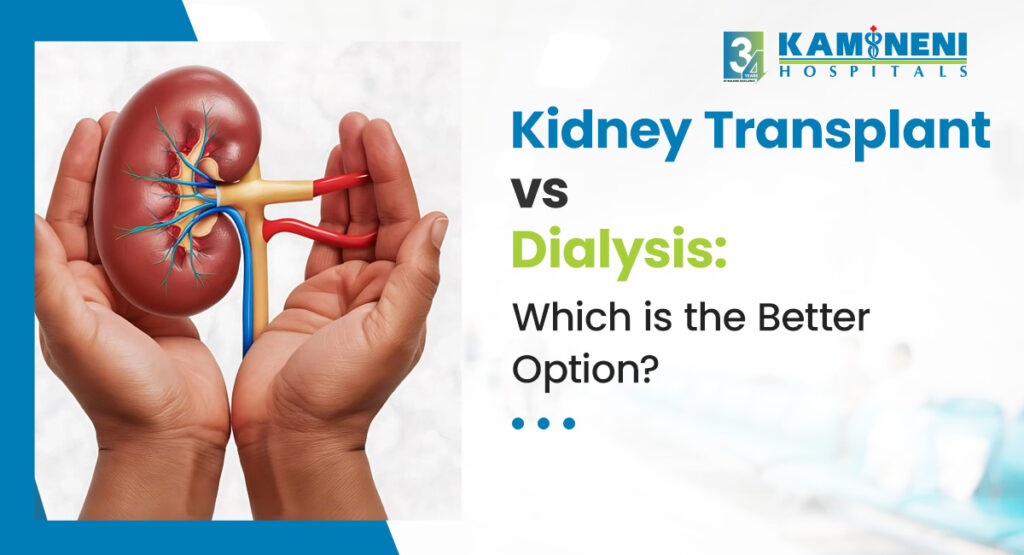
The moment the doctor says your kidneys are failing, 2 options come up: a kidney transplant vs dialysis. Both sound serious and raise the same questions across families.
For patients who qualify medically, a kidney transplant offers better long-term survival and quality of life. Dialysis is reliable and lifesaving, but it cannot replace a kidney. It replaces what a kidney does for as long as you need it.
The nephrologists and transplant surgeons at Kamineni Hospitals have been supporting families through this exact decision for 34+ years. The answer is never one-size. It depends on your health, your donor options, and what your specialist finds after a full evaluation.
This blog compares both options, so you know what to ask and what to expect.
What Is the Difference Between Dialysis and a Kidney Transplant?
Dialysis is a machine-based treatment. The blood goes in, it filters out the waste and extra fluid, and it comes back. Your kidneys used to do that; now the machine does it.
While a kidney transplant places a working donated kidney inside your body through surgery. That kidney filters your blood instead of a machine.
How does Dialysis Work?
Two types of dialysis exist:
- Hemodialysis: Through a machine, blood goes out , gets filtered, and comes back. It is done in 3 sessions a week at a dialysis centre and each session takes three to five hours.
- Peritoneal dialysis: A catheter is used and fluid goes into your abdomen, pulls out waste, and drains.It can be done at home, daily.
Neither type heals the kidneys. Both manage kidney failure on an ongoing basis.
How the Transplant Works?
A donor kidney goes into the lower abdomen. The surgeon connects it to your blood vessels and ureter. Most transplanted kidneys start working within a few days.
After surgery, you take immunosuppressant medicines every day for life. These stop your immune system from attacking the new kidney.
How Do Dialysis and Kidney Transplant Compare on Quality of Life?
Dialysis keeps you stable, but organises your week around treatment. A transplant, once you recover, takes that schedule away.
As per the United States Renal Data System (USRDS), transplant recipients have long-term survival and quality of life scores compared to patients under 60 on long-term dialysis.
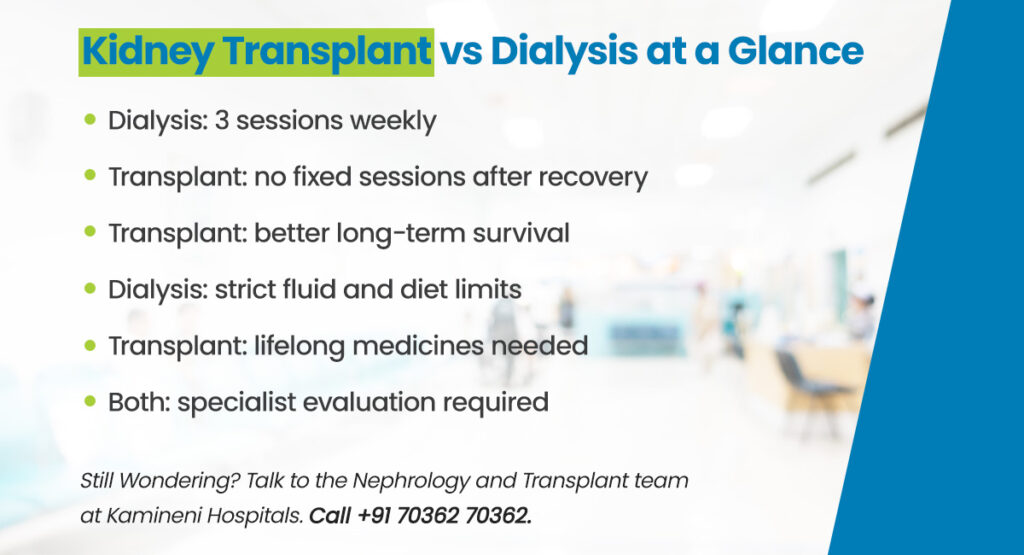
| Factor | Dialysis | Kidney Transplant |
| Treatment sessions | 3 per week or daily | None after recovery |
| Diet restrictions | Strict, fluid, potassium, phosphorus | Less restrictive once stable |
| Energy levels | Fatigue is common after sessions | Improved for most patients |
| Travel | Needs to be planned around sessions | Flexible after recovery |
| Long-term survival | Manageable for years | Better outcomes for suitable patients |
| Lifelong medicines | Supportive medications required | Yes, immunosuppressants |
| Hospital dependence | Fixed scheduled sessions | Follow-up visits only |
The dialysis schedule is what patients feel most. Three sessions a week, every week, for years. A successful transplant removes that entirely.
Who Is Eligible for a Kidney Transplant?
People with kidney failure need to get an eligibility check for surgery based on overall health, and not just kidney condition alone.
What Supports Eligibility?
- Good heart and lung function
- No active infection or untreated cancer
- Health stable enough to handle major surgery
- Ability and willingness to take daily medicines for life
- Psychological readiness for the process and the recovery
What May Affect Eligibility?
- Severe heart disease or heart failure
- Active cancer (each case is evaluated individually)
- Poorly controlled diabetes with serious complications
- Unresolved severe infections
Age is not the only factor. Patients above 60 also get successful transplants. Thus, an expert transplant team assesses your specific picture based on heart function, organ health, surgical fitness.
What Are the Real Risks of Each Treatment?
Here’s the complete list of long-term risks of dialysis and kidney treatment.
Long-Term Risks of Dialysis
- Heart disease: Long-term hemodialysis patients face a higher risk.
- Infections: The access point, fistula, catheter, or graft is a repetitive infection risk.
- Anaemia and bone disease: The red blood cell production is reduced and calcium balance disrupts due to Dialysis .
- Fatigue and cramps: Low blood pressure, tiredness, and muscle cramps are common during and after sessions.
- Lifestyle restriction: Years of sessions, dietary limits, and fixed schedules affect work, travel, and family life.
Risks of a Kidney Transplant
- Surgical risks: Bleeding, wound infection, anaesthesia reactions. An experienced team manages these.
- Rejection: The immune system may attack the new kidney. Acute rejection, and chronic rejection may cause transplant failure.
- Immunosuppressant effects: Lower immunity increases infection risk.
- Transplant lifespan: A living donor kidney typically works for 15 to 20 years. A deceased donor kidney averages 10 to 15 years.
What Do Families in India Need to Know About Kidney Donation?
In India, most transplants come from living donors, usually a close blood relative. Living donor kidney transplants happen faster and produce better outcomes than waiting for a deceased donor organ.
Living Donor Transplant
A person with two healthy kidneys can donate one. The body functions normally on a single kidney.
Who can donate?
- Parents, siblings, children, grandparents
- Spouses, after legal and medical clearance
- Any person approved by the hospital transplant committee and the state authorisation committee
The donor goes through a complete evaluation: blood type and tissue match, kidney function tests, heart assessment, and a psychological review. Donor safety is non-negotiable.
Deceased Donor Transplant
No living donor available? Patients go on a deceased donor waiting list. The state government system allocates organs based on blood type compatibility, tissue match, waiting time, and medical urgency.
The transplant team at the best kidney hospital in Hyderabad will walk your family through both routes and tell you where you stand.
Can You Start Dialysis Now and Still Get a Transplant Later?
Yes. Starting dialysis does not close the transplant door.
Many patients begin dialysis while the transplant evaluation runs in parallel. Dialysis keeps you stable and strong enough for surgery when the time comes.
Some patients get a preemptive transplant, meaning surgery happens before dialysis is ever needed. That is the best-case path. It avoids dialysis complications entirely.
Whether you are already on dialysis or just diagnosed, start the transplant conversation now. The earlier your nephrologist evaluates you, the more options stay open.
For The Right Option, Consult the Kidney Care Team at Kamineni Hospitals
Dialysis and kidney transplant are both real, proven treatments. Dialysis works reliably for years and is the right choice for many patients. A transplant gives more daily freedom for those who qualify.
Neither decision should be made without a specialist looking at your full picture.
At Kamineni Hospitals, the nephrology team evaluates and manages chronic kidney disease, acute kidney injury, and end-stage renal disease. The kidney transplantation department handles transplant eligibility assessment, living donor evaluation, and the full transplant process alongside the nephrology team.
Book an appointment with a kidney specialist at the best hospital in Hyderabad. One consultation can tell you what the right next step is. Call +91 70362 70362 .
Disclaimer: This blog is intended for educational and informational purposes only. It should not be considered medical advice, diagnosis, or treatment. Please consult a qualified healthcare professional for any medical concerns or decisions.
Frequently Asked Questions
What happens if the transplanted kidney is rejected?
Acute rejection caught early can often be treated with medicines. Chronic rejection develops gradually and may cause transplant failure. Daily immunosuppressants are the main protection against both.
How long does a transplanted kidney last?
A living donor kidney typically lasts 15 to 20 years. A deceased donor kidney averages 10 to 15 years. The actual span depends on donor match, patient health, and consistent medicine use after surgery.
Can a family member donate a kidney in India?
Yes. Parents, siblings, children, grandparents, and spouses can donate after legal and medical clearance. The donor needs approval from the hospital transplant committee and the state authorisation committee.
Is dialysis permanent?
It can be. For patients who cannot have a transplant, dialysis is a long-term treatment. For those waiting for a donor, it keeps the body stable until a match becomes available.