



When a doctor tells you or someone in your family that a liver transplant is needed, the first thing most people feel isn’t clarity, it’s fear. What does the surgery will involve? How serious are the risks? Will life look normal after the transplant?
A liver transplant is the removal of a failed liver and replacing it with a healthy one from a donor. According to Cleveland Clinic, about 90% of people who go through a liver transplant procedure survive the surgery and the recovery process successfully.
The hepatology and liver transplant team at Kamineni Hospitals, has been working with such patients through liver disease, evaluation, and transplant care for over 34 years. If this is where your family is right now, this blog covers what happens in liver transplant surgery, what are the real risks, and what the weeks after surgery and recovery look like.
Who Needs a Liver Transplant?
When the liver has failed or is close to failing and nothing else is working to slow that down, a liver transplant is needed. The liver filters the blood, produces proteins the body needs, and breaks down substances the body can’t store. When it stops, things go wrong fast.
The conditions that most commonly lead to a transplant:
- Cirrhosis : Long-term scarring of the liver caused by hepatitis B, hepatitis C, alcohol use, fatty liver disease, or autoimmune conditions
- Acute Liver Failure : Sudden, severe damage that can develop within days, sometimes without warning.
- Hepatocellular Carcinoma (HCC) : Primary liver cancer, in selected cases where it hasn’t spread outside the liver.
- Non-Alcoholic Fatty Liver Disease (NAFLD) : When it progresses to the end-stage of liver failure.
- Biliary Diseases: Such as primary biliary cholangitis or primary sclerosing cholangitis
Doctors use the MELD score the Model for End-stage Liver Disease to decide who gets priority on the transplant waiting list. It’s a number worked out from blood tests: bilirubin, creatinine, and clotting factors. A higher number means the patient is sicker and moves up the list faster.
Living Donor vs. Deceased Donor: What’s the Difference?
In India, most liver transplants use a living donor. Deceased donor availability here is very low compared to Western countries, so families usually step in. A portion of a family member’s liver is removed and transplanted into the patient.
| Living Donor Transplant | Deceased Donor Transplant | |
| Donor | Family member or close relative | Person who has passed away |
| Timing | Surgery is planned in advance | Hospital calls when a match is found |
| Liver portion | One lobe of the donor’s liver | Full liver is used |
| Waiting time | Shorter no waitlist needed | Longer depends on priority score |
| Donor recovery | Liver regrows within weeks | Not applicable |
Worth Knowing: the liver is one of the only organs that regrows. A donor who gives a portion can expect their liver to get back to near its original size within about 6 to 8 weeks.
What Happens During a Liver Transplant Procedure?
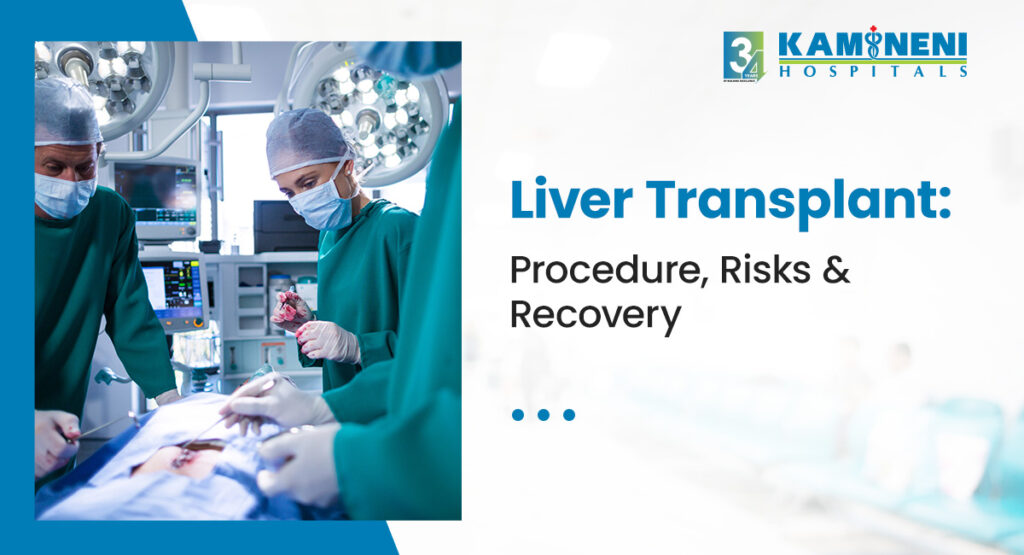
The liver transplant procedure runs between 6 and 12 hours. In a living donor transplant, two operation theatres are running at the same time one for the donor, one for the patient.
The patient’s surgery goes like this:
- Anaesthesia : General anaesthesia is given and a breathing tube is placed. The patient won’t be aware of anything during surgery.
- Incision : A cut is made across the abdomen to reach the liver.
- Diseased Liver Removed : Blood vessels are clamped carefully and the failing liver is taken out.
- Donor Liver Placed : The new liver, or the donated portion, is positioned and the blood vessels are connected.
- Bile Duct Attached : The bile duct carries digestive fluid from the liver to the intestine; it’s reconnected to the donor liver at this stage.
- Incision Closed : The abdomen is sutured and stapled. The patient goes to the ICU of the best hospital in Hyderabad for care.
What Are the Real Risks of a Liver Transplant?
The surgery carries real liver transplant risks. So does the recovery. The job of the transplant team is to watch for each one and act before it becomes a crisis.
Risks During and Just After Surgery:
- The liver sits at the junction of several large blood vessels, and reconnecting them during surgery causes blood loss.
- Infection because of the medicines
- Bile duct leak or narrowing
- Blood clots in the vessels attached to the new liver
Risks in the Weeks and Months After:
- Organ Rejection : The body’s immune system sees the new liver as foreign and starts attacking it.
- Immunosuppressant Effects : The anti-rejection medicines lower immune activity. That keeps the liver safe, but it also leaves the patient more vulnerable to infections.
- Original Disease Returning : Conditions like hepatitis B or fatty liver can come back and affect the new liver if not treated properly.
Blood tests catch most problems before they worsen. That’s why the follow-up schedule at the best liver transplant hospital in Hyderabad after a transplant is important.
What Does Recovery After a Liver Transplant Look Like?
Hospital stay is usually 10 to 14 days. Getting back to daily life takes 3 to 6 months for most people. NHS guidance notes that some patients need up to 12 months before they feel fully themselves again.
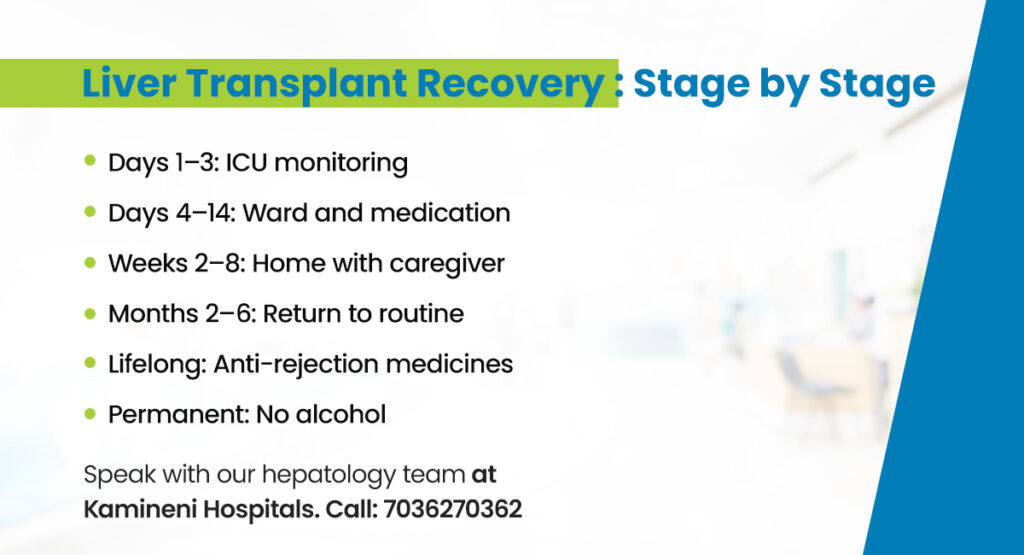
Liver Transplant Recovery moves through these stages:
- Days 1 to 3 : ICU- The patient’s vitals and liver function are watched around the clock. The breathing tube comes out when the patient is stable enough and most people take a short walk by day two or three.
- Days 4 to 14 : Transplant Ward– Medicines are started, anti-rejection, anti-infective, and others. Before discharge, the patient and caregiver learn how to manage the medication schedule at home.
- Weeks 2 to 8 : Home – A caregiver is needed full-time through this stretch. Clinic visits are weekly to start, dropping to fortnightly.
- Months 2 to 6 : Getting Back – Light movement becomes regular movement. Most patients are back at work and managing their days normally by month four or five.
Anti-rejection medicines don’t stop. The dose gets adjusted as the body settles in, but the medicines stay. Stopping them even years later puts the transplant at risk.
Kamineni Hospitals is the Right Hospital for Your Liver Transplant Care.
A liver transplant surgery is serious, the recovery is long, and the medicines are for life. It isn’t one doctor’s decision or one surgeon’s job. It takes hepatologists, transplant surgeons, anaesthetists, intensivists, and a follow-up team working through the same case from evaluation to discharge and beyond.
At Kamineni Hospitals the Hepatology and Liver Transplant department works within a NABH-accredited multispeciality hospital with over 34 years of clinical experience, 40+ speciality departments and 3,000+ beds across Hyderabad.
If this is the road you’re on, start by understanding what it actually involves. The conversation with the right team at Kamineni Hospitals is just a call away: +91 70362 70362
Disclaimer: This content is for general patient education only. It does not replace medical consultation, diagnosis, or treatment advice from a qualified hepatologist or liver transplant specialist. Please consult a specialist at Kamineni Hospitals for personalised guidance based on your symptoms, diagnosis, and medical history.
Frequently Asked Questions
What is the recovery time after a liver transplant?
Hospital discharge is usually around 10 to 14 days after surgery. Most people are back to a normal routine within 3 to 6 months. A few take longer; it depends on how sick they were going in and how the new liver adjusts in the early weeks.
Can a liver transplant patient live a normal life?
Most do, yes. Work, travel, exercise, these come back after recovery. Two things change permanently: daily anti-rejection medicine for life, and no alcohol ever again. Beyond that, life after a successful transplant is generally much better than what it was during end-stage liver disease.
What happens if the body rejects the new liver?
The early kind, called acute rejection, happens in the first weeks and months and is often caught through routine blood tests. The transplant team adjusts the anti-rejection medication and most patients come through it without losing the liver. Chronic rejection, longer-term is harder to reverse, which is why monitoring never really stops.
Who can be a living donor for a liver transplant?
Usually a family member or close relative, aged 18 to 55, with a matching blood type. Before anything goes forward, the donor goes through full medical testing and a separate assessment to make sure they’re ready for a major surgery and what comes after. The portion of their liver given to the patient typically grows back to close to its original size within 6 to 8 weeks.