



When a doctor recommends a kidney transplant, most families think about the cost, the hospital stay, the medicines, and whether they can manage the months after surgery. That worry is normal because kidney transplant cost in Hyderabad is not one fixed number. It changes based on the patient’s condition, donor evaluation, ICU stay, medicines, complications, and follow-up care.
The ₹6 lakh to ₹10 lakh figure often seen online usually refers only to the surgery package. And for many patients, the total cost may range from ₹11 lakh to ₹22 lakh depending on the case.
At Kamineni Hospitals, we’ve been doing kidney transplants for 34 years across our units in LB Nagar and Vijayawada. We handle HOTA paperwork, PMJAY and Aarogyasri pre-authorisation, and donor evaluation as part of the consultation. Families don’t have to chase these separately.
This guide gives you the full picture on the cost of kidney transplant in Hyderabad: what each phase costs, month by month, and what financial support exists.
How Much Does a Kidney Transplant Cost in Hyderabad?
The surgery quote is ₹6 lakh to ₹12 lakh. The surgery quote covers what happens on the day: surgeon’s fees, operation theatre, anaesthesia, and the hospital stay. That’s it. Four things come on top of it:
- Pre-surgery tests and HOTA clearance (blood work, compatibility testing, legal documents): ₹60,000 to ₹1,30,000
- ICU after surgery, 5 to 10 days at ₹40,000 to ₹80,000 per day: ₹2,80,000 to ₹5,60,000
- Immunosuppressant drugs from surgery day (the medicines that stop the body rejecting the new kidney): ₹5,000 to ₹15,000 per month
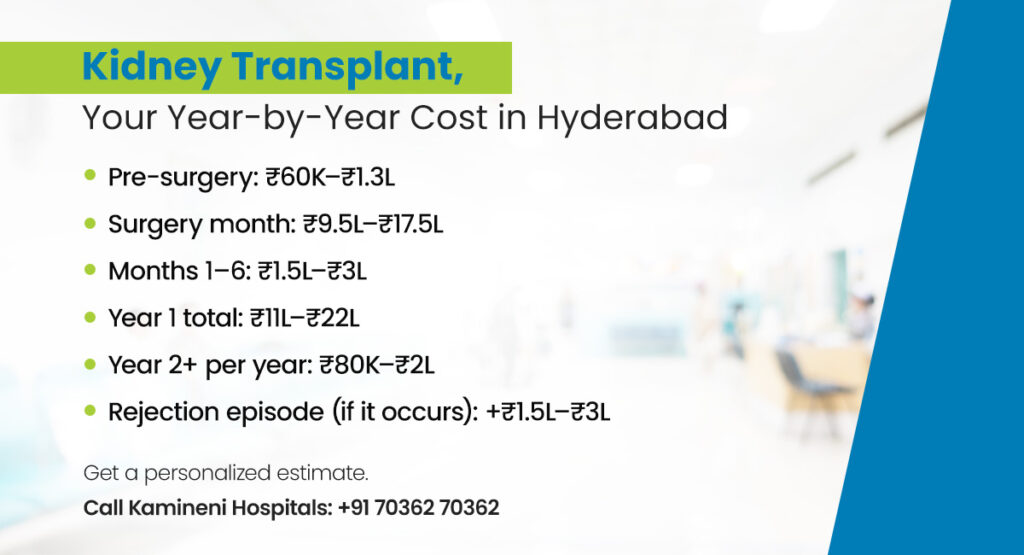
- First-year monitoring, tests and clinic visits every two weeks in the first three months: ₹1,50,000 to ₹3,00,000
Note: The costs provided are approximate and for general reference only. Actual charges may vary based on the clinic, treatment requirements, case complexity, and individual patient conditions.
| What It Covers | Approximate Cost |
| Pre-surgery tests + HOTA clearance | ₹60K–₹1.3L |
| Surgery + hospital stay | ₹6L–₹12L |
| ICU (recipient and donor) | ₹3.5L–₹5.5L |
| First 6 months, drugs and monitoring | ₹1.5L–₹3L |
| Year 1 total | ₹11L–₹22L |
| Year 2 and beyond (per year) | ₹80K–₹2L |
Does a Family Donor Make Kidney Transplant Cheaper or Not?
A family donor doesn’t always make the surgery cheaper. But with wait for over two years, it usually does.
- Living donor kidney transplant (LDKT) uses a kidney from a compatible family member, usually a parent or sibling. The donor lives normally on one kidney. Surgery costs ₹7 lakh to ₹12 lakh because two operations run the same day. The donor’s procedure adds ₹1.5 lakh to ₹3 lakh on top.
But it can be scheduled. No waiting. No months of dialysis building up before surgery.
- Deceased donor kidney transplant (DDKT) uses a kidney from a brain-dead donor through the Jeevandan network. Surgery costs ₹6 lakh to ₹10 lakh, slightly less upfront. The catch is the wait. Dialysis (the machine that does the kidney’s job while waiting) costs ₹1 lakh to ₹1.8 lakh every year. A two-year wait adds ₹2 lakh to ₹3.6 lakh before surgery even starts.
That often closes the gap with LDKT entirely.
What HOTA means for living donor cases:
HOTA is the Human Organ Transplant Act, India’s legal process for living donor transplants. It requires:
- Legal affidavits proving the donor-recipient relationship
- District medical board clearance
- Sometimes a committee hearing
This adds 2 to 6 weeks and ₹10,000 to ₹30,000. At Kamineni, we handle this documentation in-house.
How Much Does Monthly Care Cost After Kidney Transplant Surgery?
The first year after kidney transplant surgery is usually the most expensive, because infection risk, tests, doctor visits, and medicines are closely monitored. Costs usually reduce from Year 2 once the patient becomes stable.
Months 1 to 3 (highest risk window):
This is when the body is most likely to reject the new kidney. Visits are every two weeks. Each visit includes a creatinine test (a blood test showing how well the kidney filters waste) and drug level check. Drugs cost ₹5,000 to ₹15,000 per month.
Watch for rejection signs: fever, reduced urine output, tenderness near the kidney. Each rejection episode costs ₹1.5 lakh to ₹3 lakh to treat.
Months 4 to 12:
Visits reduce to once a month. Drug doses start coming down. Cost stays at ₹5,000 to ₹12,000 per month.
Year 2 onward:
Prednisolone (one of the three drugs) is usually stopped. Two drugs remain: tacrolimus and mycophenolate. Cost drops to ₹5,000 to ₹12,000 per month.
| Year | Monthly Drug Cost | Annual Monitoring | Notes |
| Year 1 | ₹5K–₹15K | ₹1.5L–₹3L | Highest risk, frequent visits |
| Year 2 | ₹5K–₹12K | ₹60K–₹1.2L | One drug stopped |
| Year 3+ | ₹3K–₹10K | ₹30K–₹80K | Doses reduce |
| Year 5+ (stable) | ₹3K–₹8K | ₹30K–₹60K | Minimal intervention needed |
Is Insurance or a Government Scheme Available for Kidney Transplant?
Yes, some schemes are available partially for kidney transplant surgery. Here’s what each option actually covers and where the gaps are.
PMJAY (Ayushman Bharat)
Covers kidney transplant surgery. Cap is ₹5 lakh per family per year. That’s roughly 25 to 45% of LDKT surgery cost. Post-discharge immunosuppressant drugs aren’t covered. The ₹5,000 to ₹15,000 monthly drug cost from discharge onward is a self-funded expense regardless of PMJAY eligibility.
Aarogyasri
Covers specific procedures at empanelled hospitals. Kamineni Hospitals handles pre-authorisation for Aarogyasri eligible patients during the pre-transplant consultation.
Private health insurance
Most comprehensive plans cover surgery at 50 to 70% of sum insured. Post-discharge drugs are excluded from almost every standard policy. Check the fine print before assuming full coverage.
Medical loans
Bajaj Finserv and HDFC offer healthcare financing up to ₹40 lakh at 12 to 18% annual interest over 3 to 5 years. We have financing tie-ups at Kamineni that reduce approval time.
Choose Kamineni Hospitals for Kidney Transplant in Hyderabad and Vijayawada.
You now know what kidney transplant actually costs in Hyderabad and the smartest thing to do now is get a case-specific estimate. Kamineni Hospitals has been doing this for 34 years. One call starts that conversation.
Here’s what makes the process different at Kamineni:
- HOTA documentation handled by us
- Cost plan with phase-by-phase costs
- Same nephrology team from evaluation to Year 5
- Free second opinion
We’re recognised as the best kidney transplant hospital in Hyderabad, with a dedicated unit at our kidney transplant hospital in LB Nagar. Our Vijayawada unit is the best kidney transplant hospital in Vijayawada for patients across Andhra Pradesh. It operates as a full kidney transplant hospital in Vijayawada with the same nephrology team and HOTA support.
Call +91 70362 70362 to speak with our team.
Frequently Asked Questions
What is the total kidney transplant cost in Hyderabad for Year 1?
₹11 lakh to ₹22 lakh for most living donor cases. This covers pre-surgery evaluation and HOTA clearance, surgery, ICU for recipient and donor, and first six months of drugs and monitoring. The surgery quote typically covers 55 to 65% of this total.
Does PMJAY fully cover kidney transplant in Hyderabad?
No. PMJAY covers surgery up to ₹5 lakh per family per year. That’s roughly 25 to 45% of surgery cost. Post-discharge immunosuppressant drugs aren’t covered under PMJAY or Aarogyasri. The monthly drug cost from discharge is a self-funded expense.
Is a living donor transplant always cheaper than waiting for a deceased donor?
Not always upfront. LDKT surgery costs ₹1.5 lakh to ₹3 lakh more due to the donor procedure. But DDKT patients spend ₹1 lakh to ₹1.8 lakh per year on dialysis while waiting. A two-year wait costs ₹2 lakh to ₹3.6 lakh before surgery starts. In most cases, LDKT is cheaper when you count the full two-year picture.
How long do medicines continue after kidney transplant?
Lifelong, but the dose reduces. Prednisolone is usually stopped by month 3 to 6. Tacrolimus and mycophenolate reduce after year 3 in stable cases. Our nephrology team manages dosing based on creatinine levels and drug trough levels at every visit.