


You felt fine this morning. By noon, you snapped at someone over nothing. Last week you cried in the car and could not explain why.
Nothing is wrong. But something is happening.
The causes of mood swings in females almost always trace back to hormones. Estrogen and progesterone fall before your period, surge in pregnancy, and crash after delivery. Each time they drop, serotonin, the chemical keeping your mood steady, drops with them.
At Kamineni Hospitals, consistently recognised as having some of the best gynecologist in Hyderabad for women’s hormonal health, our obstetrics and gynaecology team sees this every day. This blog covers what drives mood swings at each stage and when to see a doctor
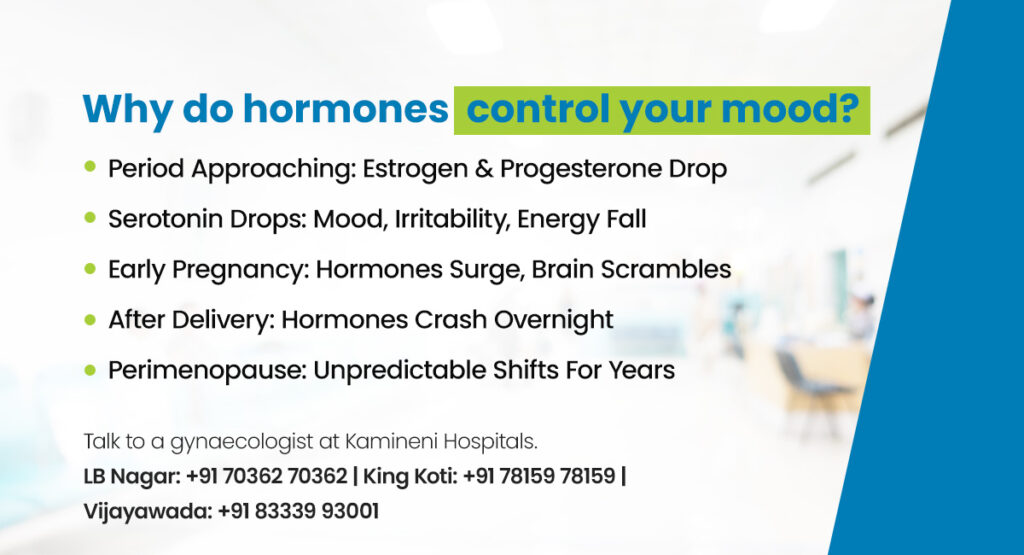
Why Do Hormones Cause Mood Swings in Women?
Estrogen helps your brain produce serotonin. When estrogen falls, serotonin slows down with it.
Less serotonin means lower mood, more irritability, and a shorter fuse. This is not a personality problem. It is your brain responding to a chemical shift.
The same pattern plays out at different points:
- Before a period, hormones drop sharply in the two weeks leading up to it
- In early pregnancy, they spike faster than your brain can adjust
- After delivery, they fall almost overnight
- Around perimenopause, they fluctuate unpredictably for months or years
What Causes Mood Swings Before and During Your Period?
In the days before your period, estrogen and progesterone drop to their lowest point. This window is called the luteal phase, and the serotonin dip it causes produces the irritability and low mood many women feel every month.
What PMS Actually Feels Like?
Premenstrual Syndrome (PMS) brings emotional and physical symptoms one to two weeks before a period. Most clear once the period starts.
Women describe it as:
- Irritability that feels bigger than the situation deserves
- Sadness that appears without a clear reason
- Anxiety or a restless, unsettled feeling
- Getting overwhelmed by things that are usually manageable
A 2024 Cureus study (AIIMS Deoghar) found 23.5% of young Indian women had moderate to severe PMS, severe enough to affect work and relationships every month. Mild PMS does not always need treatment, but you are not supposed to endure it silently.
When does PMS become PMDD?
Some women feel like a different person for one to two weeks every month: rage, deep sadness, emotional withdrawal, complete inability to function. That is Premenstrual Dysphoric Disorder (PMDD), not standard PMS.
The MGH Center for Women’s Mental Health estimates PMDD affects 3 to 8% of women in their reproductive years. A gynaecologist can diagnose and treat it.
What Causes Mood Swings During Pregnancy?
Mood swings in pregnancy are caused by the fastest hormonal rise most women will ever experience. Estrogen and progesterone climb sharply in the first trimester, and serotonin struggles to keep up.
Why the First Trimester Hits Hardest?
In weeks 6 to 12, most women are also dealing with:
- Nausea and exhaustion
- Broken sleep
- Anxiety about whether the pregnancy is going well
- Carrying all of it quietly, before telling anyone
Feeling emotionally volatile at this stage is not a sign something is wrong. Your body is working incredibly hard.
Second and Third Trimesters
Mood settles between weeks 14 and 27 as hormones plateau. The third trimester brings new pressure: sleep worsens, physical discomfort increases, and anxiety about labour builds. That sensitivity is normal.
When Pregnancy Mood Changes Need Attention?
Speak to your gynaecologist if during pregnancy you notice:
- Low mood lasting more than two weeks without lifting
- Loss of interest in things that normally comfort you
- A feeling of hopelessness or inability to cope
- Anxiety that does not ease with rest
These can point to perinatal depression. It is treatable.
What Happens to Mood After Delivery?
After delivery, estrogen and progesterone crash faster than at almost any other point in a woman’s life. That is what causes the baby blues, the tearfulness most new mothers feel in the first two weeks.
Baby blues and postpartum depression are not the same thing.
| Delivery Time | Baby Blues | Postpartum Depression |
| Starts | Within 3 to 5 days | Within 4 weeks, up to a year |
| Lasts | Up to 2 weeks | Beyond 2 weeks |
| Feels like | Tearfulness, tiredness | Deep sadness, hopelessness |
| Resolves alone | Usually yes | Needs medical evaluation |
A 2022 Cureus review found the screening window is two weeks to six months post-delivery. Many Indian women go undiagnosed because their families frame it as weakness. It is not a weakness. It is a hormonal response to one of the most physically demanding events a body goes through.
If tearfulness has not lifted two weeks after delivery, speak to the top gynecologist in Hyderabad.
Does PCOS Cause Mood Swings?
Yes, and this connection gets missed far too often. PCOS raises androgen levels, creates insulin resistance, and disrupts the normal estrogen-progesterone rhythm. Each of those changes affects how your brain produces serotonin. The result is not a predictable monthly pattern but a persistent, unpredictable emotional heaviness.
Women with PCOS often describe it as feeling like permanent PMS. Our women’s gynaecological health guide covers the broader hormonal picture.
PCOS affects 3.7% to 22.5% of women in India (Indian Fertility Society). A 2023 Journal of Psychiatry Spectrum review found depression and anxiety are the most common psychiatric complications in Indian women with PCOS. Women with PCOS also have a 1.76 times higher postpartum depression risk (PubMed).
If mood swings do not follow your cycle and you have irregular periods, acne, or weight changes, ask your doctor to check for PCOS.
What Else Makes Mood Swings in Women Worse?
Hormones are the primary causes of mood swings in females, but other factors amplify them. Nutritional deficiencies are especially common and undetected in Indian women.
| Factor | How It Affects Mood |
| Poor sleep | Reduces emotional regulation |
| Iron deficiency | Fatigue and low mood; common in menstruating women |
| Vitamin D deficiency | Directly linked to low mood |
| Vitamin B12 deficiency | Mood changes, brain fog, anxiety |
| Thyroid imbalance | Both underactive and overactive thyroid affect mood |
| Skipping meals | Blood sugar crashes cause irritability within hours |
| Chronic stress | Raises cortisol, pushes serotonin down |
If mood swings do not follow a hormonal pattern, ask your doctor for a blood test: iron, Vitamin D, Vitamin B12, thyroid, and fasting blood sugar.
What Can You Do to Manage Mood Swings?
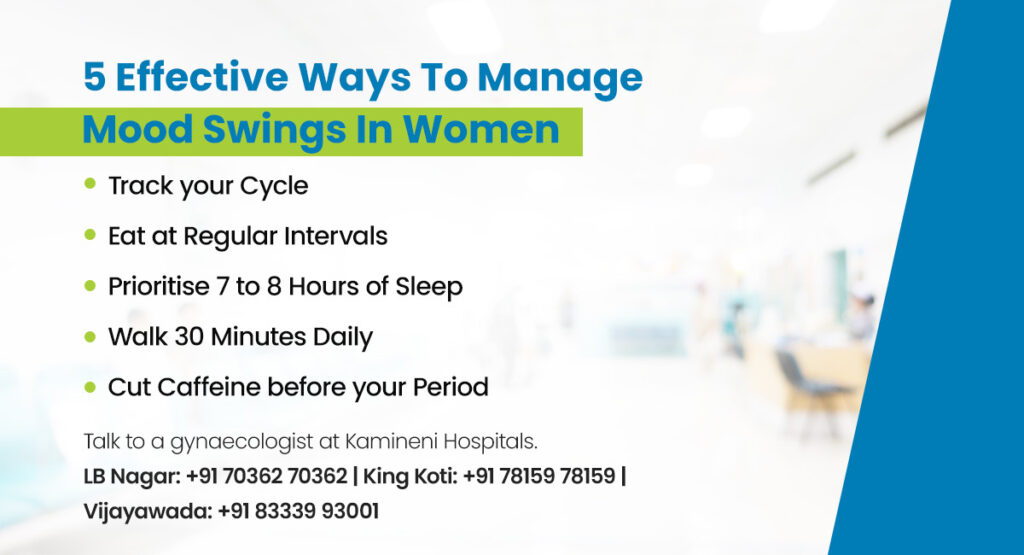
- Track your cycle. Knowing when your luteal phase begins helps you anticipate mood shifts.
- Eat at regular intervals. Skipping meals drops blood sugar and directly worsens mood.
- Prioritise sleep. Seven to eight hours is one of the most effective mood regulators available.
- Move daily. A 30-minute walk raises serotonin. You do not need an intense workout.
- Cut caffeine and alcohol before your period. Both worsen anxiety and disrupt sleep.
- Talk to someone. Putting words to what you feel reduces its intensity.
Kamineni Hospitals also offers women’s health packages covering hormonal screening and gynaecological evaluation in one visit. Widely considered the best gynecologist hospital in Hyderabad for women’s hormonal health, our specialists are ready when you are. If you have been searching for the best gynecologist near me, this is the right next step.
How Do You Know If Your Mood Swings Are Normal?
| Probably Fine | Worth Talking to a Doctor |
| Irritability a day or two before your period | Severe symptoms every month for one to two weeks |
| Mild sadness that clears once the period starts | Low mood that does not lift after the period ends |
| Emotional sensitivity in early pregnancy | Persistent hopelessness while pregnant |
| Tearfulness in the first two weeks after delivery | Low mood still present two weeks post-delivery |
| Mood dips when stressed or sleeping badly | Mood swings with no recognisable pattern |
If the right column sounds familiar, book an appointment. Searching for the best gynecologist near me is easier when you know what questions to bring.
Ready to Talk? Consult a Gynaecologist at Kamineni Hospitals
Mood swings in women are physical, real, and hormonal. Most have a clear cause and a solution.
At Kamineni Hospitals, LB Nagar, our gynaecology team treats PMS, PMDD, pregnancy mood changes, postpartum health, and PCOS-related hormonal imbalance. Whether you are looking for the best gynecologist in Hyderabad, the top gynecologist in Hyderabad, or the best gynecologist hospital in Hyderabad for period-related mood symptoms or PCOS evaluation, our specialists provide evidence-based, patient-first care.
For women in Andhra Pradesh, Kamineni Hospitals, Vijayawada is the best gynecologist hospital in Vijayawada, rated among the top choices for gynaecology and maternity care across Poranki, Tadigadapa, Kanuru, Benz Circle and surrounding areas. If you are looking for the best gynecologist hospital in Vijayawada for mood-related hormonal concerns, our team is here.
With 34+ years of women’s healthcare experience, book an appointment today.
Call us at:
- LB Nagar: +91 70362 70362
- King Koti: +91 78159 78159
- Vijayawada: +91 83339 93001
Frequently Asked Questions
How long do mood swings last in women?
Period-related mood swings last a few days and clear once menstruation begins. During pregnancy and perimenopause, they can persist for weeks until hormones stabilise. Tracking your cycle helps identify your pattern.
Can stress cause mood swings in women even without hormonal changes?
Yes. Chronic stress is one of the key causes of mood swings in females beyond hormonal changes. It raises cortisol, which suppresses serotonin and destabilises mood. Poor sleep, skipped meals, and emotional overload all amplify or trigger mood swings independently of your cycle.
Why do mood swings get worse in your 40s?
Perimenopause often begins in the early 40s, when estrogen fluctuates erratically rather than following a predictable cycle. These shifts affect serotonin and cause more intense, harder-to-predict mood changes. The top gynecologist in Hyderabad for perimenopause-related mood changes will assess hormone levels and guide you through your options.
Are mood swings a sign of depression?
Not always. Hormonal mood swings follow a pattern and resolve. Depression means persistent low mood for two or more weeks, unrelated to your cycle. If mood does not improve between periods, consult a gynaecologist or the psychiatry team at Kamineni Hospitals.