



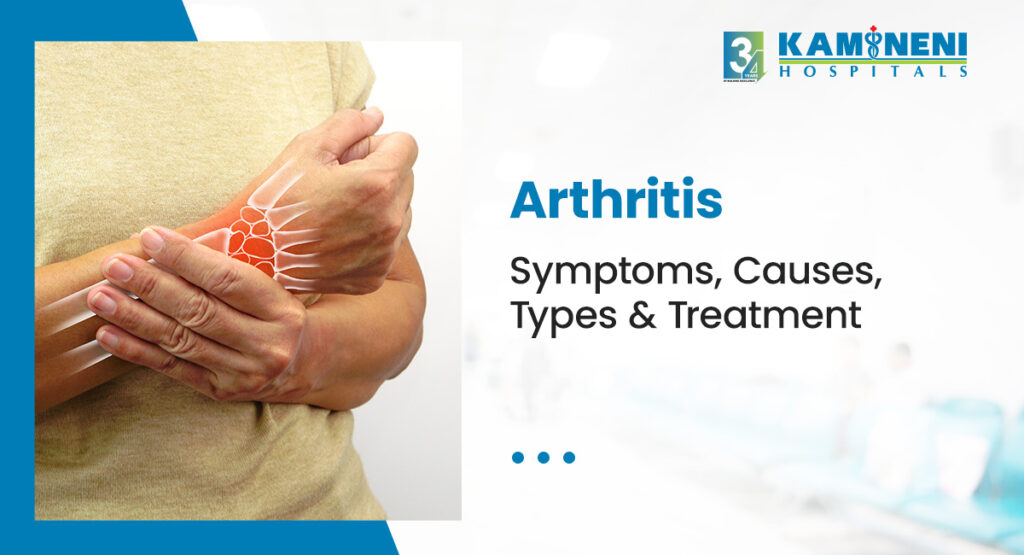
Knees ache getting up from a chair. Fingers feel stiff for the first hour every morning. Climbing stairs became something to think about before doing.
All these patterns of joint pain and stiffness slowly take over daily movement and arthritis is announced.
Arthritis isn’t one disease, but a group of about 100 conditions that cause joint pain, stiffness, and inflammation. In India the most common types are osteoarthritis and rheumatoid arthritis and both need completely different treatments. Getting the type right is what determines whether treatment works.
At Kamineni Hospitals, the Orthopedics department manages the full range of arthritis conditions from knee OA to rheumatoid arthritis to gout with total knee replacement, robotic joint replacement, arthroscopy, physiotherapy, and specialist consultation.
What follows covers the types, what causes each one, how to recognise the symptoms, and what treatment looks like surgical and non-surgical.
What Is Arthritis and What Does It Feel Like?
More people in India live with arthritis than with diabetes and cancer combined. That’s over 180 million and most of them managed the pain for months before finding out what it actually was.
Every joint has a small cushion between the bones. It’s called cartilage. It keeps movement smooth and absorbs pressure. When it breaks down or gets inflamed, that buffer disappears. Bone meets bone. That’s the pain.
What arthritis feels like:
- Joint pain : Dull or sharp, constant or coming and going with activity
- Stiffness : Worst in the morning or after sitting still; loosens with movement
- Swelling and warmth around the joint
- Reduced range of motion : Can’t straighten the knee fully, can’t grip properly
- Grinding or clicking sounds when moving the affected joint
When arthritis crosses into needing a best orthopedic doctor in Hyderabad:
- Morning stiffness lasted more than 30 minutes.
- Joint pain that wakes you at night.
- Swelling that doesn’t go down after rest.
- Any joint that’s visibly swollen and warm without a recent injury.
What Are the Types of Arthritis?
There are over 100 arthritis types but five account for most cases seen in Hyderabad and across India, each with a different cause, a different age group, and a different treatment approach.
| Type | Who Gets It | Main Cause | Key Symptom |
| Osteoarthritis (OA) | Adults 45+, overweight, post-injury | Cartilage wear and tear | Knee, hip, hand pain after activity |
| Rheumatoid arthritis (RA) | Women aged 30–60 mostly | Autoimmune : immune attacks joint lining | Symmetrical swelling; morning stiffness over 1 hour |
| Gout | Men over 40; high uric acid | Uric acid crystals in joint | Sudden severe pain, big toe or ankle |
| Ankylosing spondylitis | Young men aged 20–40 | Autoimmune : spine inflammation | Lower back pain; improves with exercise |
| Psoriatic arthritis | Psoriasis patients | Autoimmune | Joint pain + skin plaques |
OA is mechanical. It’s irreversible but it’s manageable with the right care. RA is autoimmune. The immune system attacks the joint lining itself. Pain relief alone doesn’t stop the damage. It needs disease-modifying medicines.
What Causes Arthritis?
Arthritis causes vary by type, cartilage wear drives osteoarthritis, autoimmune misfiring drives rheumatoid arthritis, and uric acid accumulation drives gout.
Arthritis By Type:
- Cartilage wear (OA): The cushion between your joints slowly breaks down with age and use. Weight gain, old injuries, and years of movement all speed that up.
- Immune system attack (RA, ankylosing spondylitis, psoriatic arthritis): The body’s defence system turns on the joints by mistake. It causes swelling and damage from inside and family history plays a big role.
- Uric acid build-up (gout): Foods like red meat, shellfish, and alcohol produce uric acid in the body. When the kidneys can’t clear it fast enough, it forms sharp crystals inside the joint that’s what causes the sudden, severe pain.
Risk Factors Across All Types:
- Age above 45 for OA; younger for autoimmune types
- Female gender : RA is three times more common in women
- Obesity : 5 kg of extra body weight adds approximately 20 kg of pressure on each knee joint
- Family history of arthritis
- Previous joint injury : A damaged joint is more likely to develop OA later
- Sedentary lifestyle : Muscles that support joints weaken without regular use
What Are the Symptoms of Arthritis That Need Specialist Attention?
Arthritis symptoms range from mild morning stiffness to severe joint swelling and the signs that separate a routine ache from a condition needing specialist care are specific.
Common symptoms across all types:
- Joint pain during or after movement
- Morning stiffness lasting 15 to 30 minutes
- Swelling and tenderness around the joint
- Reduced range of motion
- Warmth and redness over the affected joint
Go to an orthopedic specialist at a multi speciality hospital near me if:
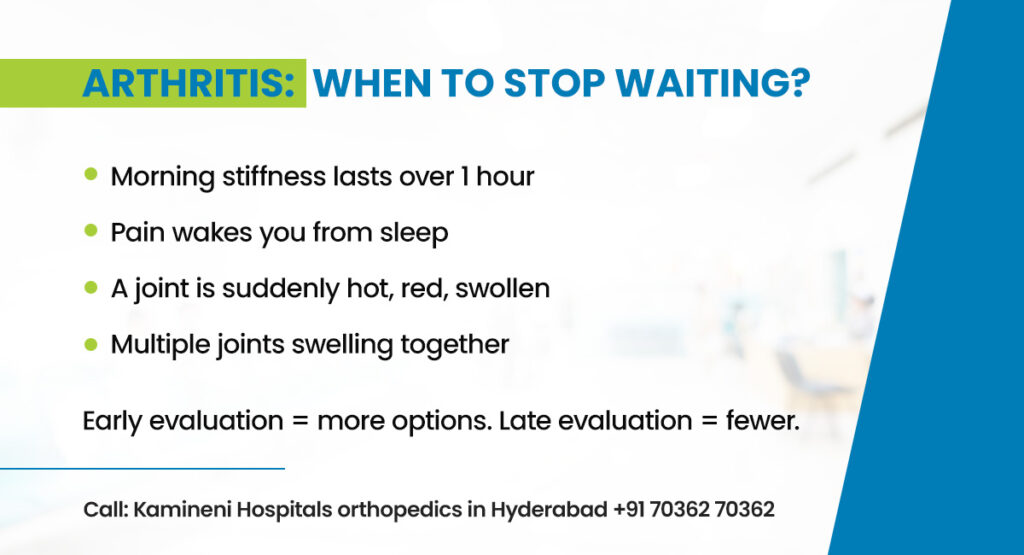
- Morning stiffness lasts more than 1 hour this suggests RA, not OA
- Pain wakes you from sleep
- Joints are visibly swollen in a symmetrical pattern
- A joint is suddenly hot, red, and severely painful
- Multiple joints are involved at the same time
- Pain has changed daily activities over the last 6 months
How Is Arthritis Treated at Kamineni Hospitals? Expert Arthritis Care
Arthritis treatment at Kamineni Hospitals begins with an accurate diagnosis of the type because osteoarthritis, rheumatoid arthritis, and gout each respond to different treatments entirely.
Non-Surgical Treatment:
- Medicines : NSAIDs reduce pain and inflammation for short-term relief; DMARDs like methotrexate slow RA progression and protect joints from further damage.
- Corticosteroid Injections : Injected directly into the affected joint; rapid short-term relief.
- Physiotherapy : Strengthening the muscles around the joint reduces the load on cartilage.
- Lifestyle Changes : Weight loss of 5 kg reduces knee load by approximately 20 kg; swimming, cycling, and walking maintain joint mobility.
Surgical Treatment:
- Arthroscopy : Keyhole procedure to remove damaged tissue, repair tears, or clean out the joint.
- Total Knee Replacement (TKR) : The damaged knee joint is replaced with a metal and plastic implant; most effective for end-stage OA when pain and mobility loss are severe.
- Total Hip Replacement (THR) : Ball-and-socket joint replaced with a prosthetic implant; removes pain from severe hip OA or fracture.
- Shoulder Replacement : For severe shoulder OA or rotator cuff arthritis; anatomic and reverse shoulder replacement options available.
Our orthopedic team led by Dr. C Kama Raj and Dr. P. S Jaya Prasad (MBBS, MS Orthopaedics, NIMS provides complete arthritis evaluation and surgical care within a NABH and NABL-accredited multispeciality hospital with 34+ years of experience. Searching for an orthopedics in Hyderabad, Call: +91 70362 70362.
Disclaimer: This content is for general patient education only. It does not replace medical consultation, diagnosis, or treatment advice from a qualified orthopedic specialist. Please consult a specialist at Kamineni Hospitals for personalised guidance based on your symptoms and medical history.
Frequently Asked Questions
What is the difference between osteoarthritis and rheumatoid arthritis?
OA is the joints wearing out, cartilage breaks down over years, usually after 45, mostly in knees, hips, and hands. RA is the immune system attacking the joint lining. Younger people get it too, and it hits both sides of the body at once.
Can arthritis be cured permanently?
No cure for OA or RA but managed well, most people live normally. Gout’s different. The right diet and one medicine can stop attacks entirely. Joint replacement removes pain from that joint permanently.
Which foods make arthritis worse?
For gout : red meat, organ meat, shellfish, alcohol. They push uric acid up quickly. For OA and RA : processed food and sugar drive inflammation up. Turmeric, ginger, and flaxseeds pull it back down.
When should I see an orthopedic doctor for arthritis?
Stiffness lasting past an hour every morning. Pain waking you at night. A joint suddenly hot and swollen. Six months of pain slowly changing what you can do. Any one of these, don’t wait.