




The ankles look puffy by 7 PM. Not painful, not alarming, just there. And you blame the commute, the weather, standing at work all day.
Leg swelling that returns daily and doesn’t have an obvious explanation isn’t something to keep waiting out. It’s one of the most common early signs of kidney dysfunction.
The Nephrology team at Kamineni Hospitals, led by Dr. A Santosh Kumar (MBBS, MD, DM : Sr. Consultant Nephrologist) and Dr. B. Sai Kanth Kumar (MBBS, MD, DM : Consultant Nephrologist) evaluates this pattern every week. Backed by 34+ years and NABH accreditation, here’s what swelling in your legs actually means.
No, But Kidney Problems Can ….
Swelling in the legs doesn’t cause kidney disease. It works the other way. The body’s fluid balance is disrupted when a kidney disease arises, and that disruption shows up as swelling in the legs and ankles.
Leg swelling has a medical name: oedema. It occurs usually when excess fluid gets trapped in the body’s tissues instead of being discharged through urine. A healthy kidney filters about 180 litres of blood daily and regulates how much fluid stays and how much goes. When that regulation breaks down, fluid accumulates and as gravity pulls it downward, the legs and ankles swell first.
The Pitting Oedema Test : Do This At Home:
Press two fingers firmly into the swollen area on your ankle or shin. Hold for 15 seconds. Release.
- Dent stays for 30 seconds or more → It’s a pitting oedema → Likely kidney, heart, or liver-related issue
- Skin bounces back immediately → Non-pitting oedema → More likely thyroid or lymphatic
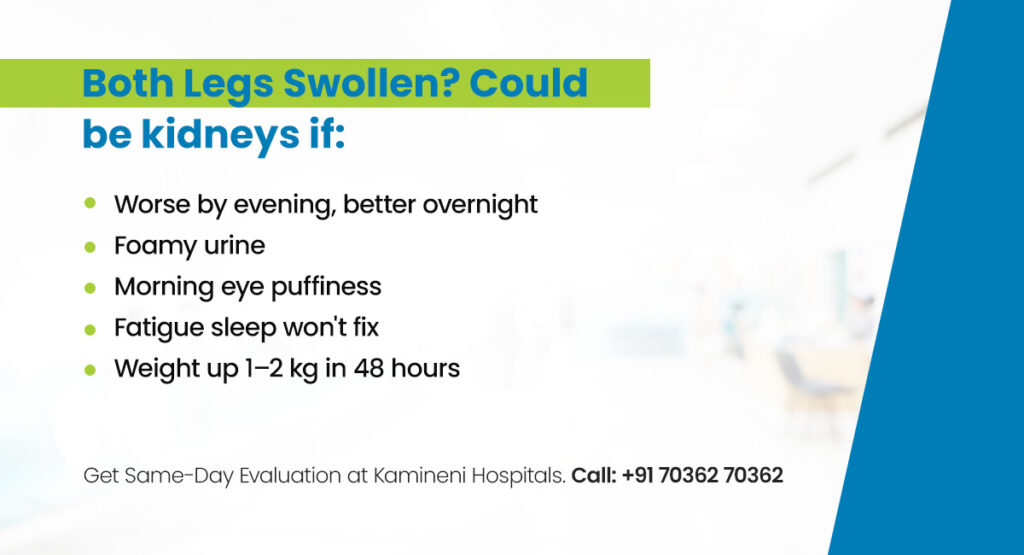
Kidney-related swelling is typically worse by evening. The fluid pools downward with gravity through the day and improves after lying down overnight because the horizontal position allows kidneys to redistribute fluid more efficiently.
Swelling that’s still significant in the morning, or that doesn’t improve with overnight rest, is a more serious signal.
What Signs Alongside Leg Swelling Point to a Kidney Problem?
Leg swelling combined with foamy urine, reduced urine output, or unexplained fatigue is the combination that most strongly points to kidney dysfunction. And the more of these that appear together, the more urgently evaluation is needed.
Watch for these alongside the swelling:
- Foamy or frothy urine : Protein leaking through damaged kidney filters
- Reduced urine output : Noticeably less urine than usual for 24 hours or more
- Puffiness around the eyes in the morning : Kidney swelling affects the face too
- Unexplained weight gain of 1 to 2 kg in 24 to 48 hours : Fluid accumulation, not dietary weight
- High blood pressure not responding to medication : Kidneys regulate blood pressure; dysfunction drives it up
- Fatigue that sleep doesn’t fix : Accumulated waste in the blood causes persistent tiredness
- Swelling not improving after overnight rest : A sign the kidneys can’t redistribute fluid even when horizontal
Two or three of these appearing together isn’t a coincidence. It’s the kidneys asking to be looked at. Visit a multi speciality hospital in Hyderabad.
When Should You Get Tested for Kidney-Related Leg Swelling?
Two first-line blood and urine tests confirm whether swelling in your legs is kidney-related or not. Both can be done same-day at a nephrology department and give clear results within hours.
- Serum creatinine : Creatinine is a waste product the kidneys filter out constantly; when it builds up in the blood, it means the kidneys aren’t clearing it properly. A raised creatinine is one of the clearest early signs of kidney dysfunction.
- Urine protein test (spot protein-creatinine ratio or 24-hour urine) : Confirms whether protein is leaking through kidney filters; this is the test that identifies nephrotic syndrome specifically.
If either test flags a problem, the next step is typically a kidney ultrasound, GFR calculation, electrolyte panel, and blood pressure review at the best kidney hospital in Hyderabad.
Stop Waiting for Your Leg Swelling to Pass: Get Evaluated at Kamineni Hospitals
Don’t self-manage swelling with reduced water intake, that approach backfires. The kidney needs hydration to function; restricting fluids without medical guidance can worsen function rather than reduce swelling.
At Kamineni Hospitals, kidney specialist hospitals in Hyderabad, Dr. A Santosh Kumar and Dr. B. Sai Kanth Kumar provide same-day nephrology evaluation, serum creatinine, urine protein, ultrasound, and specialist review.
Patients from Dilsukhnagar, Nagole, and Vanasthalipuram access the unit regularly for kidney evaluation and long-term nephrology care. Call +91 70362 70362 to book a nephrology consultation.
Disclaimer: This content is for general patient education only. It does not replace medical consultation, diagnosis, or treatment advice from a qualified nephrologist. Please consult a specialist at Kamineni Hospitals for personalised guidance based on your symptoms and medical history.
Frequently Asked Questions
Does leg swelling always mean kidney disease?
Not always. Heart, liver, and circulation problems cause it too. Both legs swelling equally, with foamy urine or fatigue alongside, is what shifts suspicion toward the kidneys.
How do I know if my leg swelling is from the kidneys or the heart?
Foamy urine and puffy eyes in the morning ? Its kidney. Lying flat and struggling to breathe, more likely the heart. A blood test settles it; symptoms alone won’t.
What does pitting oedema mean?
Push two fingers in for 15 seconds. Dent holds after you let go, that’s pitting oedema. Kidney, heart, or liver is usually the cause.
Can kidney swelling go away on its own?
Short illness swelling can clear. When it’s the kidneys themselves, CKD, nephrotic syndrome or an injury, it won’t shift without treating the cause first.