



India records about 1.8 million stroke cases every year. A stroke goes untreated every minute, and the brain loses approximately 1.9 million cells.
That number alone tells you why getting “what causes a sudden paralysis attack” matters so much.
Most paralysis attacks come from a different place. A stroke, a nerve disorder, low potassium in your blood, or a spinal injury. Each of these causes paralysis differently. And needs a completely different treatment. What triggered it determines everything: how urgent it is, what your doctor does first, and how to prevent a paralysis attack.
The Neurology and Neurosurgery teams at Kamineni Hospitals have been managing neurological emergencies for 34+ years, with 24/7 emergency care, advanced MRI and CT, Cath Lab, and a dedicated Physiotherapy and Rehabilitation Centre. Read the blog to understand what triggers a paralysis attack and how each one is treated.
What Are the Main Paralysis Attack Causes?
A paralysis attack happens when your brain’s signals can no longer reach your muscles. Think of it as a message getting cut off. Where it gets cut off, and why, is what we call the cause. And the cause decides everything that follows.
Here is a clear breakdown of every major trigger, what goes wrong in the body, and whether it can be reversed:
| What Caused It | What Went Wrong | How Fast It Hits | Can It Be Reversed? |
| Ischaemic Stroke (clot in the brain) | Blood supply to part of the brain gets blocked | Within seconds | Often yes, if treated within 4.5 hours |
| Haemorrhagic Stroke (bleed in the brain) | A blood vessel bursts and damages brain tissue | Within seconds | Partially, depending on the surgery |
| TIA (referred to as mini-stroke) | A temporary clot that clears on its own | Minutes | Yes, but it is a serious warning sign |
| Spinal Cord Injury | Trauma cuts off nerve signals in the spine | Immediately | Depends on injury severity |
| Guillain-Barré Syndrome | The immune system attacks its own nerves | Hours to days | Mostly yes, with treatment |
| Multiple Sclerosis | The protective covering of nerves gets damaged | Gradually | Partially managed over time |
| Low Potassium (Hypokalemia) | A drop in potassium disrupts nerve signals | Suddenly | Yes, often within hours of treatment |
| Brain or Spinal Tumour | A growth presses on the nerve pathways | Weeks to months | Partially, depending on treatment |
| Infections (like meningitis) | Inflammation damages the nervous system | Hours | Yes, with prompt medical care |
- Stroke is the most common paralysis attack caused by a wide margin. When blood cannot reach part of the brain, those cells start to die. The part of the body those cells were controlling stops working. That is the paralysis.
- A TIA, or mini-stroke, is a warning that most people dismiss. The symptoms come and go within minutes, so people assume it’s nothing. The risk of a full stroke is highest in the 48 hours right after a TIA.
- Two causes that often get missed: Guillain-Barré syndrome, where the immune system attacks the peripheral nerves over hours or days after an infection, and hypokalemia, where a sudden drop in blood potassium stops the muscles from receiving nerve signals. Both look alarming. But both are treatable.
How Is a Paralysis Attack Treated?
What causes a sudden paralysis attack varies so does the treatment. The trigger decides what the doctor does first, how urgently, and using which tests and tools.
There is no single treatment for what causes a sudden paralysis attack. The trigger decides what your doctor does first, how urgently, and with which tools.
#1 – Clot in the Brain (ischaemic stroke):
The goal is to restore blood flow before brain cells die permanently. The main treatment is a clot-dissolving injection called tPA. It works, but only if given within 4.5 hours of symptoms starting.
For some patients with large vessel blockages, doctors can also guide a thin tube through the blood vessels to physically remove the clot. Every hour of delay is brain tissue that cannot be saved.
#2 – Bleed in the Brain (haemorrhagic stroke):
The clot-dissolving injection would make a brain bleed far worse. Here, the priorities are:
- Stop the bleed
- Relieve the pressure on the surrounding brain tissue
- Repair the damaged vessel if needed
Surgery is the main intervention. How well a patient recovers depends on where the bleed is and how quickly the right team can act.
The first step is stabilisation. Moving a patient incorrectly before the spine is secured can turn a partial injury into a permanent one. Once stabilised, imaging will show if there is pressure on the cord and whether surgery is needed.
#4 – Guillain-Barré Syndrome & Low Potassium:
For Guillain-Barré syndrome, treatment works by calming the immune system’s attack on the nerves, using immunoglobulin therapy or a blood-filtering process called plasmapheresis. Most patients recover well with time.
What Tests Does the Doctor Run to Find the Cause?
When you arrive with symptoms, the diagnosis starts immediately, not after paperwork. The first few minutes are spent finding the cause, because the cause decides everything.
- CT scan: Done almost immediately. Tells the team whether there is a bleed in the brain. This one result determines whether the clot-dissolving injection is safe to give.
- MRI: A more detailed picture of the brain, spinal cord, and nerves.
- Blood tests: Check potassium, clotting, and infection markers. Identifies reversible causes like low potassium fast.
- EMG: Measures electrical activity in nerves and muscles. Helps identify conditions like Guillain-Barré syndrome.
- Spinal tap: Used in selected cases to check spinal fluid for infection or inflammation.
Kamineni Hospitals, the best hospital in Hyderabad, has High-end MRI and CT, neuronavigation, C-ARM, O-ARM, and a dedicated Cath Lab. So, no waiting for equipment or transfer to another facility. The team moves from arrival to diagnosis to action without interruption.
Why Does Recovery Need to Start on Day One?
The brain has a remarkable ability to reroute signals after an injury. This is called neuroplasticity. It is most active in the early days and weeks after an injury. Start rehabilitation late, and you are working against a closing window.
Kamineni Hospitals is the best multispeciality hospital in Hyderabad, with Physiotherapy and Rehabilitation Centre as part of your care from the day you are admitted. For stroke, spinal cord injury, and Guillain-Barré patients, the therapy begins while you are in the hospital.
- Physiotherapy: Rebuilds movement in affected limbs
- Speech therapy: For speech or swallowing difficulties after a stroke
- Occupational therapy: Getting back to daily life independently
- Balance therapy: For stability and coordination issues
Recovery does not start the day you go home. It starts the day you arrive.
Talk to a Specialist at Kamineni Hospitals, LB Nagar
For some paralysis attack causes, the treatment window is only a few hours. Do not wait for a second episode to get evaluated.
Why families across Hyderabad choose Kamineni Hospitals:
- 34+ years of neurological emergency care
- Neurology, Neurosurgery, and Rehabilitation under one roof
- Advanced diagnostics: MRI, CT, Cath Lab, neuronavigation, C-ARM, O-ARM
- 24/7 Emergency and Critical Care
- NABH and NABL accredited
- 16M+ lives supported across 40+ specialty departments and 3K+ beds across South India
Patients from Dilsukhnagar, Nagole, Vanasthalipuram, Hayathnagar, Mansoorabad, and Hastinapuram are closest to our LB Nagar unit.
The Cause Decides What Happens Next
Every paralysis attack has a cause. Every cause has a treatment path. Every treatment path has a time window for how to prevent paralysis attack.
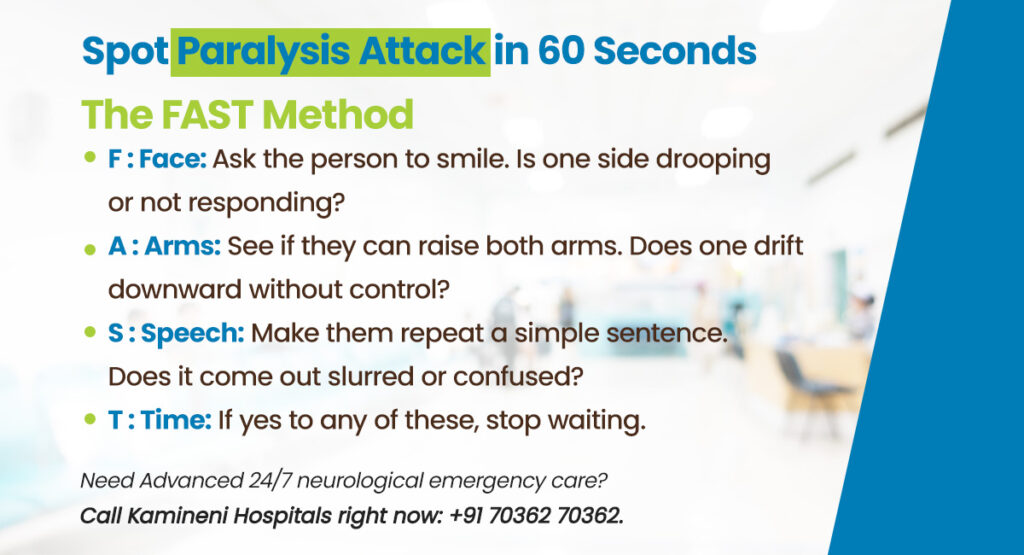
If you or someone you love has had sudden weakness, a face that drooped, an arm that stopped responding, speech that came out wrong, or an episode that seemed to pass on its own, please get evaluated. Do not wait.
The Neurology team at Kamineni Hospitals, LB Nagar, is here for exactly this.
Call: +91 70362 70362 Book a consultation online
Disclaimer: This blog is intended for educational and informational purposes only. It should not be considered medical advice, diagnosis, or treatment. Please consult a qualified healthcare professional for any medical concerns or decisions.
Frequently Asked Questions
What is the most common cause of a sudden paralysis attack?
Stroke is the most common cause. Other causes include a clot blocking blood flow to the brain, or a blood vessel bursting inside the brain, spinal cord injury, Guillain-Barré syndrome, and low blood potassium.
Can a paralysis attack be reversed?
It depends on the cause and how quickly treatment began. Clot-related strokes treated within 4.5 hours often respond well. Whereas spinal cord injury recovery depends on how severe the damage is.
Is a paralysis attack the same as a stroke?
Not always. Stroke is one cause of paralysis. Other causes like spinal cord injury, Guillain-Barré syndrome, low potassium, tumours, and infections can all cause paralysis without a stroke being involved.
What tests will the doctor run?
A CT scan is almost always first, done within minutes of arrival. It confirms whether there is a bleed. An MRI follows for more details. And sometimes a spinal tap completes the picture.