



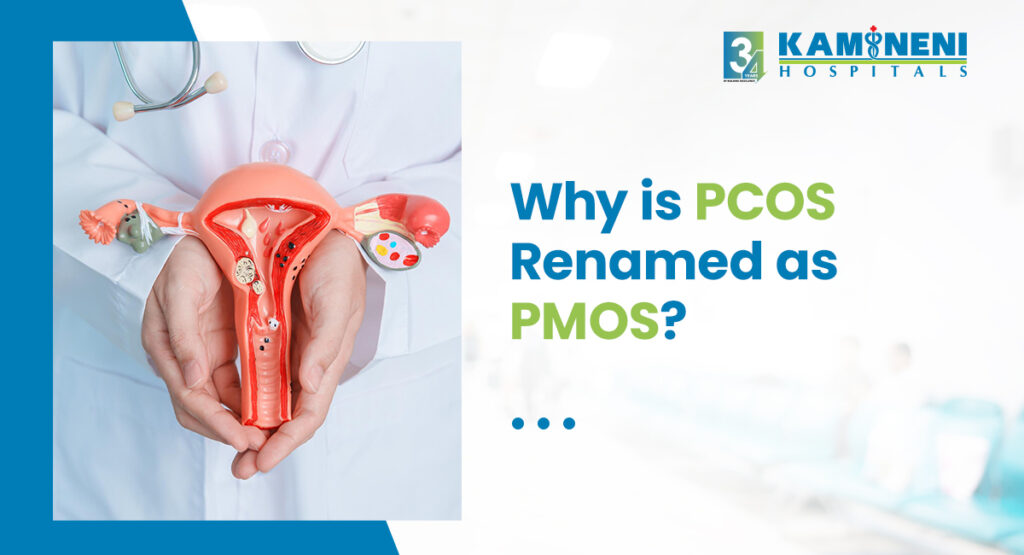
Recently, on May 12, 2026, The Lancet published the result of 14 years of research, of patients, doctors, researchers, advocates, in coordination with 56 global organisations. Polycystic ovary syndrome (PCOS) was officially renamed polyendocrine metabolic ovarian syndrome (PMOS).
1 in 5 Indian women live with this condition. And 70% of them have never been diagnosed.
That number alone tells you why PCOS is renamed to PMOS. The condition hasn’t changed. But everything doctors missed about it finally has a name.
The Gynaecology and Endocrinology teams at Kamineni Hospitals have been managing hormonal disorders in women across Hyderabad for 34+ years. And according to our specialists, here is what this landmark change means for you?
PMOS Is Not Just a New Name: Here’s What Was Actually Going Wrong?
This did not happen overnight. It started with a simple observation: the name PCOS was sending both patients and doctors to the wrong place entirely. “Polycystic” pointed to cysts. Ultrasounds looked for cysts. Diagnoses depended on cysts. But the condition was never really about cysts to begin with.
The first global survey in 2017 revealed that patients found the name deeply confusing and stigmatising, particularly around the words “cysts” and “ovary,” which made the condition sound purely reproductive.
By 2023, a second survey confirmed that doctors were missing diagnoses because a patient’s ovaries looked normal on scan even when her hormones, metabolism, and mental health were all signalling a serious disorder.
The third survey in 2025 reached nearly 15,000 stakeholders across the world.
And now PMOS : polyendocrine metabolic ovarian syndrome is the most rigorous disease-renaming process in medical history. And it exists because millions of women paid the price of getting the wrong name for too long.
So What Does PMOS Actually Mean?
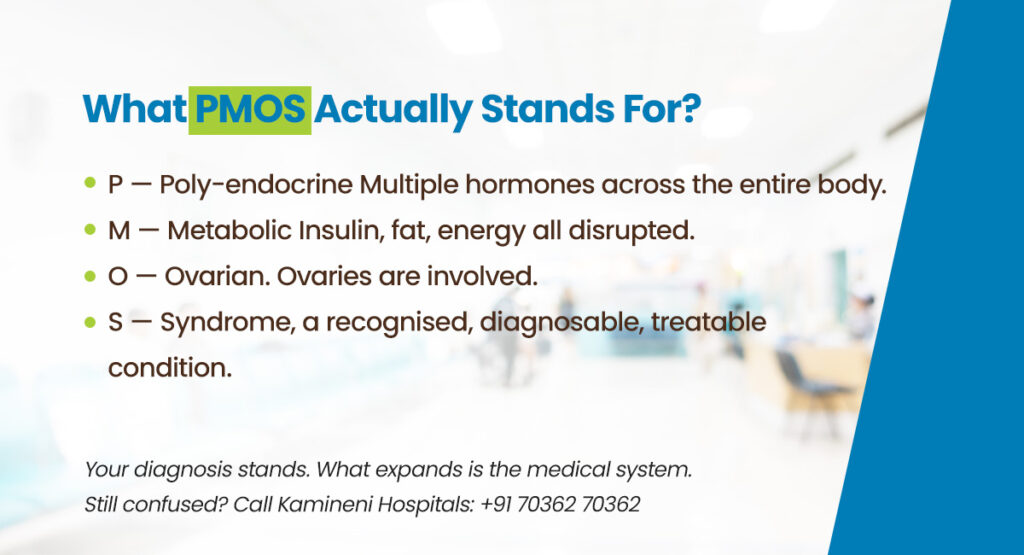
PMOS stands for polyendocrine metabolic ovarian syndrome, and each word carries weight that the old name never did.
Poly-endocrine means multiple hormones across the entire endocrine system are disrupted. Not one hormone. Metabolic means the condition directly affects how the body handles insulin, fat, and energy. This is why women with PMOS face higher risk of type 2 diabetes, high cholesterol, and fatty liver.
Ovarian means yes, the ovaries are involved. But as one part of a condition that was always much larger than one organ.
Here is the difference between PCOS and PMOS:
| Criteria | PCOS (old name) | PMOS (new name) |
| What the name implies | Cysts on ovaries | Whole-body hormone + metabolic disorder |
| Diagnosis focus | Ovarian appearance on ultrasound | Hormonal markers, metabolic indicators |
| Body systems named | Ovaries | Endocrine system, metabolism, ovaries |
| Risk of being missed | High — if no cysts on scan | Lower, broader diagnostic criteria |
| Specialist involvement | Primarily gynaecology | Gynaecology + endocrinology + metabolic care |
A simple way to understand it: the old name described what one test sometimes showed. The new name describes what the condition actually is.
Your PCOS Diagnosis Is Not Wrong, It Just Needs to Expand!
Most women with PCOS are wondering: does any of this change what is happening to me? No, your diagnosis stands. The condition has not changed. What has changed is the clinical obligation around it.
Under the old name, a gynaecologist could check the ovaries, not find cysts, and close the file. PMOS makes that harder to do.
A whole-body hormonal and metabolic disorder demands a wider care team. Endocrinologists need to be in the room. Metabolic markers need to be tracked, not occasionally, but as part of the standard pathway.
Hence, the rename did not change your condition. It changed what the system is now obligated to do about it.
The full transition to PMOS in records and global disease classifications comes with the 2028 International Guideline update. Your current medication continues without interruption. But the shift in clinical thinking that comes with this name does not wait for 2028. It starts now.
What Effect Will PMOS Have on Women in Hyderabad?
India carries a disproportionate share of this condition. It recorded the steepest rise in burden across all of South Asia between 1990 and 2021. And through all of it, most women were never diagnosed, because a name that pointed to cysts on a scan left everyone else without a pathway in.
PMOS changes what clinicians are required to see. It changes what questions women are allowed to ask. So, If you have been managing symptoms without a clear diagnosis, this is the moment to ask better questions.
Kamineni Hospitals, among the best hospitals in Hyderabad, brings Gynaecology and Endocrinology together under one roof. Advanced hormone profiling. Metabolic assessment. A care pathway that starts at the hormones and does not stop at the ovaries. With 16M+ lives supported across 40+ specialties and teams across LB Nagar, King Koti, and Vijayawada, the multidisciplinary approach PMOS now demands has been here for years.
Talk to a specialist at Kamineni Hospitals, the best multispeciality hospital in Hyderabad. Our Gynaecology and Endocrinology team is available for consultations, second opinions, and comprehensive hormonal assessment. Call: +91 70362 70362
Disclaimer: This blog is intended for educational and informational purposes only. It should not be considered medical advice, diagnosis, or treatment. Please consult a qualified healthcare professional for any medical concerns or decisions.
Frequently Asked Questions
Q: Is PMOS the same condition as PCOS?
Yes. The condition itself has not changed, only the name and the clinical understanding of it. Your existing diagnosis is fully valid.
Q: Why does the rename matter if my symptoms stay the same?
Because the name shapes what your doctor looks for. PMOS formally requires metabolic and endocrine assessment alongside gynaecological care. That means insulin resistance, cardiovascular risk, and mental health are now part of the clinical checklist.
Q: Should women in Hyderabad seek a second opinion?
If your current care has focused only on the ovaries, or if your symptoms have never been fully explained, yes. PMOS provides the framework for a broader evaluation.