



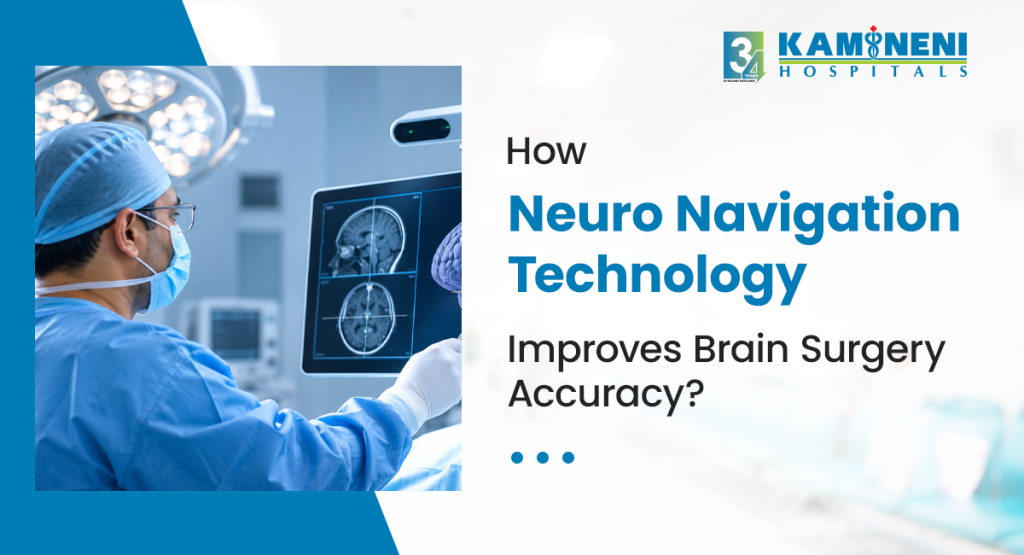
Your doctor says the problem sits near the part of the brain that controls speech or movement. Feeling scared is natural. Most families ask us the same thing first. How will the surgeon reach the problem without harming the healthy brain nearby?
Neuro navigation technology is a big part of the answer. Neuro navigation works like GPS for the brain. In surgery, the system matches your own MRI or CT scan to your head. Your surgeon can then see where each tool is. The live map helps us plan a smaller, safer path and stay on target.
We’re the neurosurgery team at the Advanced Neuro Centre, Kamineni Hospitals, LB Nagar. Our group has 34+ years of care behind us. Below, we explain how the neuro navigation technology works, where the system helps most and where the system falls short.
What Is Neuro Navigation Technology?
Neuro navigation technology is a computer system. The system guides brain surgery using your own scans. The system shows your surgeon a 3D map of your brain on a screen. The tip of each tool appears on the map as the tool moves. Think of navigation as GPS. You still drive the car, but you always know where you are. You may also hear doctors call neuro navigation image-guided surgery. Both names mean the same thing.
The setup is easy to picture. A screen sits next to the surgeon. A camera watches small markers on the tools. A frame holds your head still, so the map and your head stay lined up.
Let’s be clear about one point. The navigation system doesn’t operate on you. Your neurosurgeon does every step by hand. The map only shows the surgeon where things are. With the map on screen, the surgeon plans and checks each move instead of guessing.
How Does Neuro Navigation Improve Accuracy in Brain Surgery?
Neuro navigation makes surgery more exact at every stage, from the first cut to the last check. Before surgery, the system helps pick the safest route. During surgery, the map shows the surgeon’s exact spot, again and again. Here’s how, step by step.
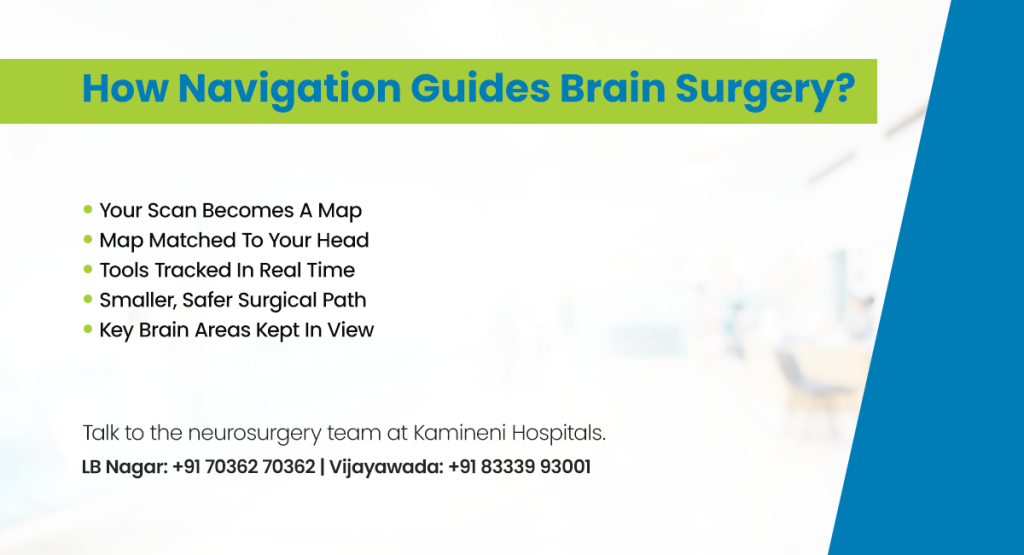
- Planning On Your Own Scan. Before the operation, your surgeon studies a detailed scan of your brain. Our diagnostic services at Kamineni Hospitals, LB Nagar include a 3T MRI and a 128-slice CT. On the screen, the surgeon marks the problem area. Then the surgeon picks the shortest, safest path. A good plan often means a smaller opening in the skull.
- Matching The Scan To Your Head. In surgery, the system lines up your scan with your real head. Doctors call this matching step registration. The surgeon touches a few points on your face and scalp with a special pointer. The computer then finds the same points on your scan. Registration takes only a few minutes. Still, few steps matter more.
- Tracking Tools Live. A camera follows markers on the tools. As the surgeon moves a tool, the tool tip moves on the screen too. So the surgeon always knows the tool’s depth and its distance from the target.
- Working Near Key Areas With Care. Some problems sit right next to areas controlling speech, sight or movement. The map helps the surgeon keep a safe gap from those areas and still reach the problem.
- Reaching Small Or Deep Spots. Some problems are tiny or sit deep inside the brain. Navigation can guide a thin needle through a small hole to take a sample. Doctors call the sampling a biopsy. The biopsy result tells us what the problem is before we plan treatment.
Some surgeons also add MRI maps of the nerve paths for speech and movement. Laid on top of the main map, the nerve maps show the surgeon what to protect.
Precise surgery like this helps most with brain tumours, deep cysts, some bleeds and some fit (epilepsy) surgeries. Brain tumours aren’t rare, either. India saw about 34,107 new brain and nervous system cancer cases in 2022. The figure comes from the Indian Council of Medical Research’s National Cancer Registry Programme.
What Are the Benefits of Neuro-Navigation in Brain Surgery?
The benefits of neuro-navigation in brain surgery all come from a clear map. Your surgeon can plan better and open less. The surgeon also touches less healthy brain on the way to the problem. Here’s what each benefit means for you.
| What Navigation Does | What It Means for You |
| Plans the shortest, safest route | A smaller opening in the skull in many cases |
| Shows the exact tool position | Less handling of healthy brain around the problem |
| Keeps key areas in view | More care around speech, vision and movement areas |
| Finds small or deep spots | A sample taken through a small hole |
| Pairs with scans during surgery | A better chance of removing more of a tumour |
The last row needs a little more detail. A 2024 review in Frontiers in Surgery found that navigation works best with scans done during surgery. Used together, the map and live scans helped surgeons remove more of a tumour than the map alone. The same review said the effect on long-term survival differs from patient to patient.
There’s also a quieter benefit. Knowing your surgeon has a clear map can help you feel calm going in. You can ask your surgeon to show you the plan on your scan. A smaller opening often means a smaller scar, too.
How Accurate Is Neuro Navigation, and Where Does It Fall Short?
Neuro navigation is very precise. But the system isn’t perfect, and no tool makes surgery risk-free. The biggest limit is brain shift. We’d rather you hear about brain shift from us before surgery than wonder about the problem later.
Brain shift means the brain moves slightly once the skull is open. Fluid drains, the tumour shrinks as the surgeon takes the tumour out, and the brain settles a bit. But your scan came from before any of those changes. So, as surgery goes on, the map on the screen can drift a little from the real brain.
Small errors can also creep in if your head moves or the match is off. For that reason, the frame keeps your head still, and surgeons check the match more than once.
Good surgeons never rely on the screen alone. Here’s what careful surgeons do instead:
- Check the map against landmarks visible under the microscope
- Repeat the matching step if something looks off
- Add an ultrasound or a scan during surgery when needed
- Trust their own training and judgement at every step
None of these checks is a reason to worry. Checking and rechecking is simply how careful brain surgery works. The checks are also worth asking about.
So pick a team that checks its work, not one that only trusts the screen. The map cuts guesswork, but the map doesn’t remove every risk. Before you say yes to surgery, your surgeon should explain your own risks in plain words.
What Should You Ask About Navigation Before Your Surgery?
Ask whether your surgeon will use navigation in your operation, and why. A good team will explain the plan openly. For most people, the road to this conversation starts with a neurologist. Maybe you searched for the best neurologist near me after headaches or a fit. Then a scan showed a problem. Once you see a neurosurgeon, four questions help you judge how careful your surgery will be.
- Will you use neuro navigation for my operation? Not every brain surgery needs the system. Ask why your surgeon will or won’t use the map.
- Which scans will you use to plan the surgery? New, clear scans make the map more exact.
- How do you handle brain shift? Listen for checks during surgery, not just the screen.
- Who will do the operation? Ask how often the surgeon treats your kind of problem.
Write your questions down before the visit, and take a family member with you. Forgetting things is easy when you’re worried. A good team won’t rush you.
If you’re comparing neurosurgery hospitals in Hyderabad, the four questions help you judge more than the machine. The answers show you how the team thinks. You can read more about our neurology and neurosurgery care at LB Nagar, including how we use navigation. Our brain and spine care in Hyderabad also covers the scans and follow-up you may need.
Told You Need Brain Surgery? Let’s Talk It Through First
A calm, clear talk before surgery makes a real difference. We’ll show you your scan, explain the plan and answer your questions. At Kamineni Hospitals, our neurosurgery department at LB Nagar uses navigation, a surgical microscope and stereotaxy. Dr. M A Jaleel, Senior Consultant Neurosurgeon, sees patients at LB Nagar.
If you’re compairing neurosurgery hospitals in Hyderabad, bring your scans and your questions. For consultations nearer home, visit our neurology hospital in Vijayawada. Call +91 70362 70362 (LB Nagar) or +91 83339 93001 (Vijayawada), or book a consultation.
This content is for general patient education only. It does not replace medical consultation, diagnosis, or treatment advice from a qualified neurosurgeon or doctor. Please consult a specialist at Kamineni Hospitals for personalised guidance based on your symptoms and medical history.
Frequently Asked Questions
Is Neuro Navigation the Same as Robotic Surgery?
No. In navigation-guided surgery, your surgeon does every step by hand. The system only shows where the tools are, like GPS shows your car.
Is Neuro Navigation Used in Every Brain Surgery?
No. Navigation helps most with tumours, deep spots and work near key areas. Your neurosurgeon decides whether your operation needs navigation.
Does Neuro Navigation Make the Surgery Take Longer?
Setting up the system and matching your scan add some time at the start. Total time depends more on your condition than on navigation.
Can Navigation Guide a Brain Biopsy?
Yes. Navigation can guide a thin needle through a small hole to take a sample from a deep or small spot in the brain.
Where Can I Find the Best Neurologist Near Me in Hyderabad or Vijayawada?
Most brain problems start with a neurologist. Our neurology doctors at LB Nagar and our neurology hospital in Vijayawada can see you.