

Maybe your headaches feel different lately, or your father’s hand has started to shake while he watches TV. Most families wait, hoping it settles on its own. We understand that, but in our OPD we see how much an early visit can change.
Five neurological disorders often start with small signs that are easy to miss: stroke, migraine, epilepsy, Parkinson’s disease and dementia. Each of them usually gives a warning before it gets worse. If you know the signs of neurological problems, you can act early, and early care gives you more choices.
We’re the neurology team at Kamineni Hospitals, a group with 34+ years of care across Hyderabad and Vijayawada. Below, we’ll explain each one the way we would in our clinic. We’ll also tell you which signs mean you should come in today.
What Are the Early Signs of a Stroke?
A stroke happens when blood stops reaching part of the brain. A clot or a bleed causes it. Its signs come on suddenly. The face droops, an arm goes weak, speech slurs or balance goes, all within minutes. Please don’t wait to see if it passes. Call for help.
We teach families the words BE FAST. It’s easy to recall when you’re scared:
- Balance: sudden dizziness or trouble walking
- Eyes: blurred or lost vision in one or both eyes
- Face: one side droops when the person smiles
- Arm: one arm drifts down when both are raised
- Speech: words come out slurred or strange
- Time: call for emergency help right away
Also, note the clock. The time the signs began helps doctors pick the right treatment. Medicine that breaks up a clot works only in the first few hours.
Some people get these signs for just a few minutes, and then they feel fine. That’s called a TIA, or mini-stroke. It’s easy to brush off. Please treat it as a warning, and see a doctor the same day.
A few strokes come from a bleed, and some of those need surgery. If you’re comparing neurosurgery hospitals in Hyderabad, our neurosurgery team at Kamineni Hospitals, LB Nagar takes care of these cases. For more on sudden weakness, read our guide on paralysis attack causes and treatment.
Is It a Migraine or Something More Serious?
Most headaches aren’t harmful, and many are migraines. A migraine is a strong, throbbing headache, usually on one side. Light and noise feel harsh, and you may feel sick or throw up. Some people see zigzag lines or flashing spots before the pain starts. Doctors call this an aura.
Here in Hyderabad, we see the same triggers again and again. Skipped meals, late nights, the afternoon sun and stress top the list. Many patients have taken a painkiller with every attack for years. The trouble is, too many painkillers can cause more headaches. A brain and nerve doctor can find your triggers and help you have fewer bad days.
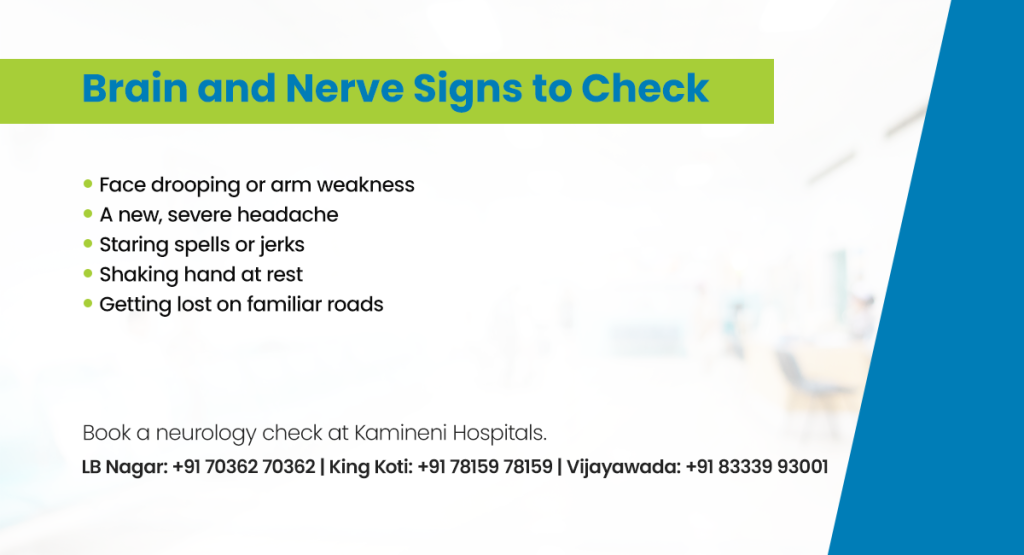
A few headaches need help the same day, though. Come to the hospital at once if you have:
- The worst headache of your life, coming on in seconds
- A headache with fever and a stiff neck
- A headache with weakness, confusion or loss of vision
Are you over 50, with a new kind of headache you’ve never had? Then book a check soon.
What Does Epilepsy Look Like in the Early Stages?
In epilepsy, the brain sends out sudden bursts of electrical signals. These cause fits, which doctors call seizures. Most people picture someone shaking on the floor. In real life, early seizures are often quiet, and families can miss them for months.
A child may stare blankly for a few seconds and not answer. An adult may get sudden jerks of an arm in the morning. Some notice a strange smell or a déjà vu feeling, and then a short spell of confusion. Some people only learn about it when they wake with a bitten tongue or a fall they can’t explain.
If someone near you has a seizure, here’s what to do:
- Stay calm, and note the time it started.
- Roll them gently onto their side.
- Move hard things away, and put something soft under their head.
- Stay with them until they’re fully awake.
Please don’t put anything in their mouth or hold them down. Many families still give keys or a shoe to smell. It doesn’t stop a seizure, so you can skip it.
Call for emergency help if a seizure lasts over five minutes, a second one follows, or it’s the person’s first ever. Our emergency and critical care team at Kamineni Hospitals, LB Nagar is open day and night.
In India, one cause we often find is tapeworm cysts in the brain. People can pick them up from unwashed vegetables or undercooked pork. Doctors call this neurocysticercosis. A brain scan can find it, and we can treat it.
There’s good news, too. The World Health Organization says up to 70% of people with epilepsy could live without fits. They just need the right tests and care.
How Does Parkinson’s Disease Start?
Parkinson’s disease is a slow brain condition. It changes the way you move. The sign most people know is a shake in one hand while it’s resting. But when we ask families, they often remember smaller changes from years before.
Perhaps your father’s handwriting got smaller and more cramped. His voice got softer, and his face looked flat in photos. He started to walk slower, with short steps, and one arm stopped swinging. Some people lose their sense of smell, or stay constipated for years, before any shaking starts. Others act out their dreams, kicking or shouting in their sleep.
One of these alone doesn’t mean Parkinson’s. But when two or three show up together, it’s worth a visit. Our neurology doctors at Kamineni Hospitals, LB Nagar check movement problems and plan care with you.
How Can You Tell Dementia From Normal Forgetfulness?
We all forget a name or misplace our glasses now and then. Dementia is different. It’s a slow loss of memory and thinking. Over time, it gets in the way of daily life. Alzheimer’s disease is its most common type.
Families often first spot it in small moments. Your mother asks about the wedding date three times in one evening. She gets lost on the road to the temple she’s gone to for 20 years. Paying the power bill suddenly feels hard for her. She can’t find simple words, or turns moody and suspicious in a way that isn’t like her.
It’s more common than many people think. A 2023 study from the Longitudinal Aging Study in India looked at this closely. Published in the journal Alzheimer’s & Dementia, it found that 7.4% of Indians aged 60 and above have dementia. That’s about 8.8 million people.
Here’s why an early check matters. Some memory problems have causes we can treat. Low vitamin B12, thyroid trouble and some medicines can all look just like dementia.
| Disorder | Early Signs to Watch |
| Stroke | Face drooping, arm weakness, slurred speech, sudden imbalance |
| Migraine and headache | One-sided throbbing pain, aura, nausea, light sensitivity |
| Epilepsy | Staring spells, sudden jerks, brief confusion |
| Parkinson’s disease | Shake at rest, slowness, stiffness, smaller handwriting |
| Dementia | Repeated questions, getting lost, trouble with daily tasks |
Are These Signs Just Stress or Ageing?
Sometimes they are, and that’s exactly why people ignore them. Stress can bring on a headache, and age can slow you down a bit. Signs of neurological problems act in a different way, though. They stay, come back or slowly get worse over weeks.
| Usually Everyday | Worth a Neurologist Visit |
| A headache after a long, tiring day | A headache that’s new, severe or wakes you up |
| Forgetting where you kept the keys | Forgetting what the keys are for |
| Hands shaking after too much tea | A hand that shakes while it’s resting |
| Feeling dizzy after standing up fast | Sudden dizziness with weakness or blurred vision |
You’re also far from alone. A 2024 study in The Lancet Neurology found that about 3.4 billion people had a brain or nerve condition in 2021. That’s 43% of the world. So neurological disorders deserve the same care you’d give to heart or sugar problems.
Noticed One of These Signs? Let’s Talk It Through
Early signs are easier to manage when a specialist sees them soon. Kamineni Hospitals brings 34+ years of care, NABH-accredited units and a 3T MRI at LB Nagar. For a neurology hospital in Hyderabad, or the best hospital for neurology in Hyderabad, meet Dr. M. Lakshmi Lavanya, Sr. Consultant Neurologist. Comparing neurosurgery hospitals in Hyderabad? Dr. Sivasai Arumulla, Consultant Neurosurgeon, sees patients at LB Nagar. We also run a neurology hospital in Vijayawada. Call +91 70362 70362 (LB Nagar), +91 78159 78159 (King Koti) or +91 83339 93001 (Vijayawada), or book a consultation.
This content is for general patient education only. It does not replace medical consultation, diagnosis, or treatment advice from a qualified neurologist or doctor. Please consult a specialist at Kamineni Hospitals for personalised guidance based on your symptoms and medical history.
Frequently Asked Questions
Which Neurological Disorder Is the Most Common?
Headaches like migraine are among the most common neurological disorders. Stroke, though, causes the most serious harm to health worldwide.
What’s Usually the First Sign of Parkinson’s Disease?
A shake in one hand at rest is the best-known sign. Loss of smell, constipation and smaller handwriting can appear years earlier.
Is Forgetfulness Always a Sign of Dementia?
No. Forgetting names or keys sometimes is normal. Forgetting how to do familiar tasks, or getting lost on known roads, needs a check.
When Should I Worry About a Headache?
Get same-day care for a sudden, severe headache, or one with fever, a stiff neck, weakness, confusion or loss of vision.
Which Is the Best Hospital for Neurology in Hyderabad?
Look for neurologists, MRI, EEG and emergency care in one place. Kamineni Hospitals runs a neurology hospital in Hyderabad and a neurology hospital in Vijayawada.